


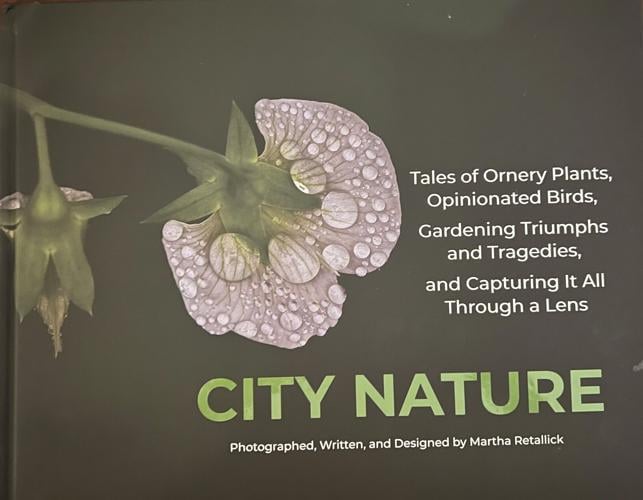
“City Nature: Tales of Ornery Plants, Opinionated Birds, Gardening Triumphs and Tragedies, and Capturing It All Through a Lens” Photographed, Written and Designed by Martha Retallick; Western Sky Communications; 101 pgs. $199.95 Collector’s Signed, Limited Edition; $99.95 Premium Edition. Available via CityNatureBook.com.
Martha Retallick is a nature enthusiast, with the emphasis on “enthusiasm.” The fact that she lives in hot, arid Tucson does not prevent her from making the most of scarce rainwater to nurture her city lot’s flora and fauna and raise a thriving garden, as this beautiful book demonstrates.
Ms. Retallick has many passions, each complementing the next as the book unfolds. By trade, she is a photographer and journalist, and photography is the place where this adventure in book publishing began. Having acquired a sophisticated new camera, she wanted to practice with it. But Tucson’s scorching summer heat kept her close to home, so her backyard became her studio.
Good choice. A dedicated water harvester with an understanding of dry climate landscaping, her urban yard boasts an abundance of desert-friendly trees and plants, which her photographs display in breath-taking detail. The photos alone would be reason enough to wander through this beautiful, coffee table-sized book, but that would be missing the point. Retallick shares her knowledge and experience, offers ideas for cooking with garden produce (mesquite flour and salsa, anyone?) shares what she’s learned about the birds who visit her in-town oasis, and sings the praises of upcycling (the creative reuse of discarded objects). It sounds like a lot to take in, but in Retallick’s breezy, conversational style, one subject flows easily into the next for an enjoyable, informative read.
Retallick opted to produce her book — from writing and editing through publishing — entirely in Tucson. It will not surprise the reader to learn that she is also passionate about her community.
— Helene Woodhams
“Cracking Chests: How Thoracic Surgery Got from Rocks to Sticks” by Alex G. Little, M.D. Sdp Publishing. 242 pgs. $24.68; $9.99 Kindle.
Dr Alex Little, an eminent academic thoracic surgeon, offers a richly-detailed autobiography that expertly braids memoir, medical history, and current practices in the specialty of chest surgery.
Dr. Little’s professional journey began with medical school at Johns Hopkins and the University of Chicago, and his account offers insights into the education of a young surgeon, highlighting valued mentors and experiences with patients—sometimes harrowing, always memorable. His subsequent pursuit of his chosen specialty informs a discussion of modern-day thoracic surgery and the types of ailments treated by its practitioners.
As a counterpoint to the rapidly developing state of chest surgery, Dr. Little offers some perspective with a discussion of its development, beginning with ancient times—hence his subtitle’s reference to rocks (ancient surgical tools) and sticks (meaning the instruments currently employed in non-invasive surgery). The author’s talent for story-telling is evident here, with anecdotes that are intriguing, occasionally wince-inducing, and sometimes outright funny. For instance, before anyone realized that ether had a practical medical application (and it’s probably best not to dwell on hapless patients who went under the knife without anesthesia) polite, mid-19th century Victorians had already discovered its entertainment value and hosted “Ether Frolics,” an excuse to get silly and behave, says the author, “like the human equivalent of bumper cars.”
With this informative book, written with evident humor and compassion, Dr. Little makes a challenging subject accessible to a general audience. The author, who now lives in Tucson, chaired the Departments of Surgery for the Universities of Nevada and Wright State (Ohio), and also served as President of the American College of Chest Physicians.
— Helene Woodhams
“Son of Light, Son of Darkness: Drow Heritage Unleashed” by Bob Perrill. Writers Branding LLC, 396 pp. $12.99 pbk; $22.99 hdcvr; $3.99 Kindle.
Well-versed in the ways of healing and opposed to weapons, compassionate Connate is his mother’s son. Liana, also a healer, has never revealed the identity of Connate’s father to anyone in their elven village, relying instead on Calyx, an elderly druidic healer with deep reserves of magic, to mentor her son.
It was a good arrangement until the night it blew up. Ambushed by a group of murderous elves, Connate is rescued by a mysterious stranger who is, Liana informs him, his father, Dradamus. It’s a horrifying admission: Dradamus is a drow, one of the dark elves who live in the bowels of the earth and are the sworn enemies of Connate’s people, the sylvan elves.
His belief system upended, Connate must re-evaluate everything he thought he understood about himself as he moves from deep fury and betrayal to a questioning acceptance and a desire to find harmony in the duality of his nature. Taking a deep dive into the dark and unknown side of his heritage, Connate travels with Dradamus to his home in the Underdark, where they experience adventures simultaneously magical, deadly, and life-changing as Connate searches for answers to the questions he formerly never knew to ask.
In this enchanted version of a classic morality tale, Perrill creates a fantastical world in which he considers choices between good and evil, darkness and light, and hatred and love — and the precarious balancing point where they meet. A former field biologist who surveyed rare and endangered species across the Southwest, Tucsonan Bob Perrill is retired from the University of Arizona.
— Helene Woodhams
“The Broke Hearts” by Matt Mendez (Simon & Schuster). 229 pp. $19.99.
At first blush, this young adult novel concerns two 19-year-old Mexican American boys trying to right their lives after the cop-murder of their best friend up-ended them. But Tucson creative writing instructor Matt Mendez deepens this affecting tale. Yes, it’s about Danny Villanueva and JD Sanchez, but it’s also about parent-child relations, about thwarted best intentions, family; about cultural pressures and gender expectations.
A companion book to Mendez’s acclaimed “Barely Missing Everything” (Kirkus and “Seventeen”’s Best YA Book of 2019), “The Broke Hearts” follows Danny, listing through his first semester at UTEP, flunking even his best class, Art; and JD, training to load bombs into military planes at Davis Monthan. He longs to make movies, but he’s going to war. It’s the year after their best friend Juan was killed trying to connect with his father.
There’s a theme here.
Connections with parents are threaded throughout: through Danny’s efforts to salvage his grade in art (which he nearly torpedoes by lashing out at classmates and instructor), and JD’s struggles to master live-bomb manipulation for deployment. Danny’s father, the “Sarge,” tough, unsmiling, always working when not deployed, pushed Danny into college. JD’s mother is angry and resentful of JD and his philandering father, and he, in turn, desperately seeks JD’s approval. Deeper, you have the Sarge’s own attempts to rupture a relentless cycle of macho and military expectations of fathers.
Sarge’s sudden heart emergency (note the title) brings them all together. Resolution will involve family, art, and community.
Mendez, who grew up in El Paso, makes fine use of the city and a particular, gritty culture to suggest universals.
— Christine Wald-Hopkins
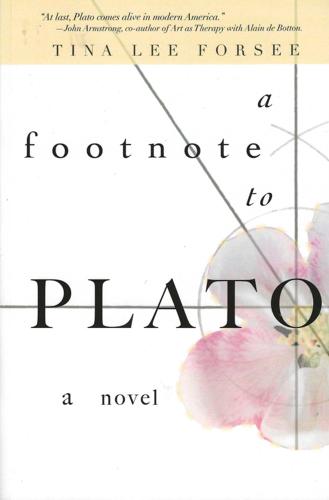
“A Footnote to Plato” by Tina Lee Forsee. (Resource Publications). 247 pp. $26.
So, what would be a suitable project for a philosophy graduate of a small, experimental Vermont liberal arts college that didn’t survive in this century? To Immortalize it in a novel wrapped in philosophy, of course. The setting of Tucsonan Tina Lee Forsee’s new novel — down to the campus stemming from three converted farmhouses on a Vermont hill — is remarkably reminiscent of her alma mater, Marlboro College, which closed in 2020. Forsee, an associate acquisitions editor of “After Dinner Conversations,” a magazine of philosophical short stories, recreates it with clear-eyed affection.
Central to “A Footnote to Plato” are issues of the role of the classics, of slippery aspects of Title IX, and gender and power dynamics in academe.
When the book opens, Dr. Isaac Fischelson, 40 years a philosophy professor at Winston College, has been called by the testy, feminist Dean of Faculty, to an emergency meeting. It’s just before the winter break, 2012, and Fischelson has been awaiting the response to a sabbatical request. But this meeting is not to address the sabbatical. Rather, it’s to present an anonymous allegation against him of impropriety toward a female student. There will be an investigation that could terminate his career. And, by the way, the sabbatical is denied.
Fischelson is flummoxed. He’s a sensitive guy, and ethical. A professor renowned enough for philosophy students to come to Winston to study with him. And the allegation includes “standing too close?” Does Title IX not give him an opportunity to respond?
Not gregarious, Fleschelson’s respected but has no natural allies on the faculty. So Forsee gives him students to help play out the action (and characterize the college): Alexandra, the sexpot, Joshua and Uri her willing partners; Sarah, the fundamentalist Christian; Zeb, the gifted math son of an abusive mother. He pays his own tuition by peddling cocaine. Plus, the deceased former college president, who haunts Fischelson’s dreams. Some join him as he gets one final chance to repair his reputation on a Plato/Socrates video trip to Greece.
These are smart kids. They relish philosophical debate and exploring ideas — on which Forsee elaborates — but you don’t have to grasp all their ideas to enjoy her story. Certainly, you don’t have to be in academe to recognize abuses of power.
— Christine Wald-Hopkins
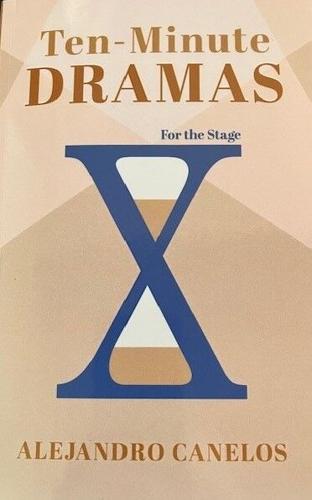
“Ten Minute Dramas for the Stage” by Alejandro Canelos. (Neotenic Press). 229 pp. $16.95.
Ants escape from their formicarium (that’d be an ant farm). “Weirdos” transform normal citizens into other “weirdos.” (Cue Boris Karloff.) A checkout dispute morphs into a “moon”-off. And plenty more ... Tucson writer Alejandro Canelos has directed his fertile (and, at times, absurd-ish) imagination to 24 short plays. After his creative 2022 collection of anthropological desert animal stories — “The Neotenic Queen”— Canelos turns to human animals. Often domestic situations, they focus on single situations that can reflect outside conflicts. Short, with precise stage directions, they’re readily visualized. Whether these original dramas are ever staged, images — some, admittedly, bizarre — will linger in your mind’s eye. Like those pants dropped at the checkout.
— Christine Wald-Hopkins

