


There’s nothing like an intricate model train display to transport you to another time in a magical place.
Take the front yard of the foothills home of John Carmichael and Philip Pappas. The Tucsonans have created a western Victorian-era scene.
Work on the masterpiece began in 2010. Since then, they’ve laid 375 feet of track, capable of running five trains at once. It would take about 10 years to complete the garden railway, though to this day, it continues to evolve.

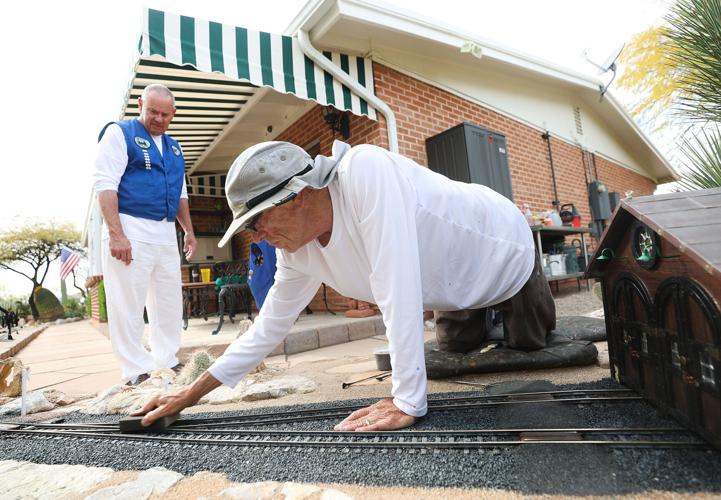
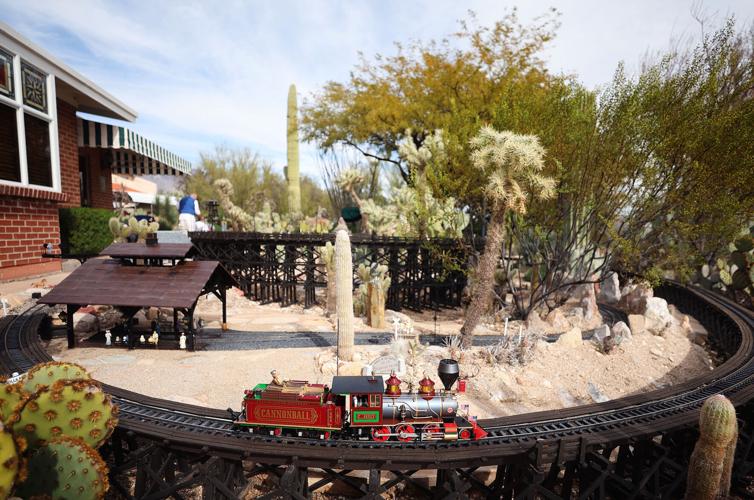
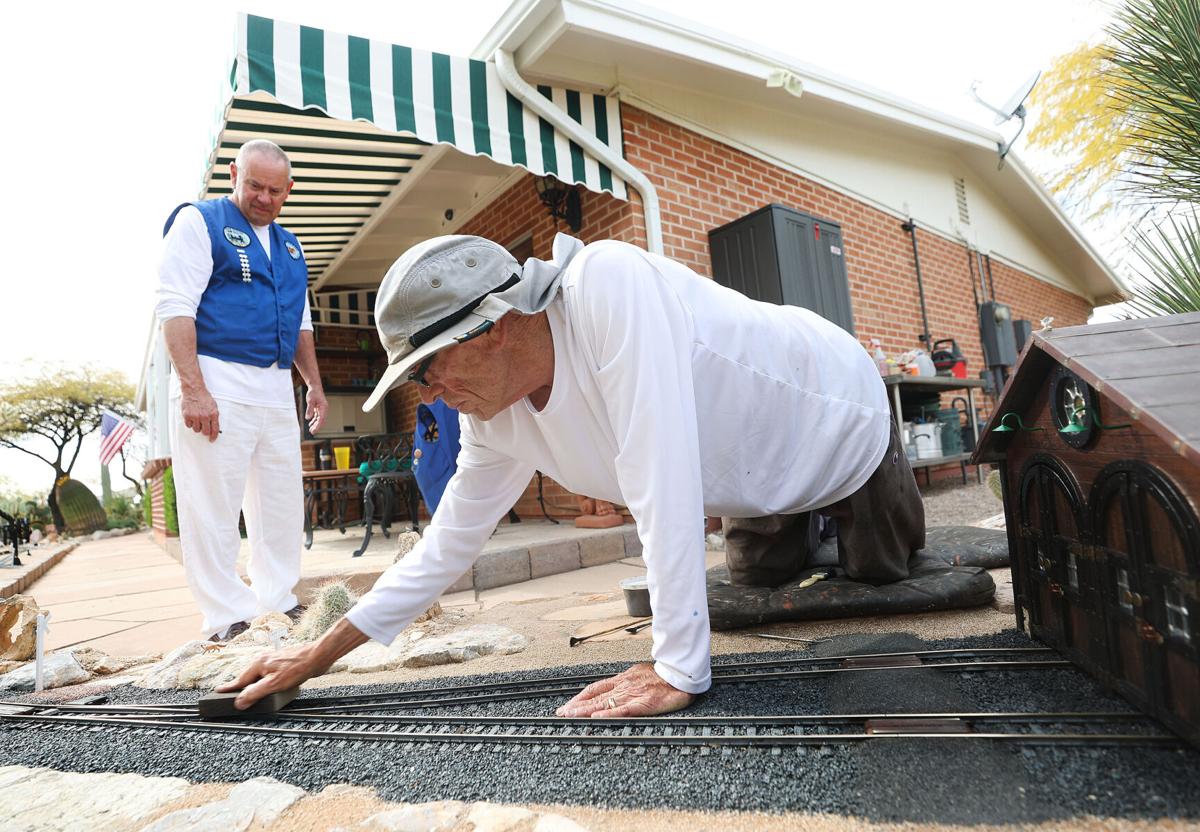
John Carmichael and Philip Pappas’ Cholla Patch Railroad is one of the stops on the annual Rails in the Garden tour. Carmichael used his horticulture experience to incorporate desert landscape.
The idea for the fantasy land where trains, bridges, a tunnel, buildings and figurines live amongst giant desert plants was Carmichael’s. Growing up with a love for railroads, the 59-year-old utilized his horticulture experience, along with learnings from internet tutorials and magazine articles to construct the display.
Pappas, 67, is credited with hauling 17 tons of rock and dirt and was instrumental in much of the interior work found in the vignettes along the track.
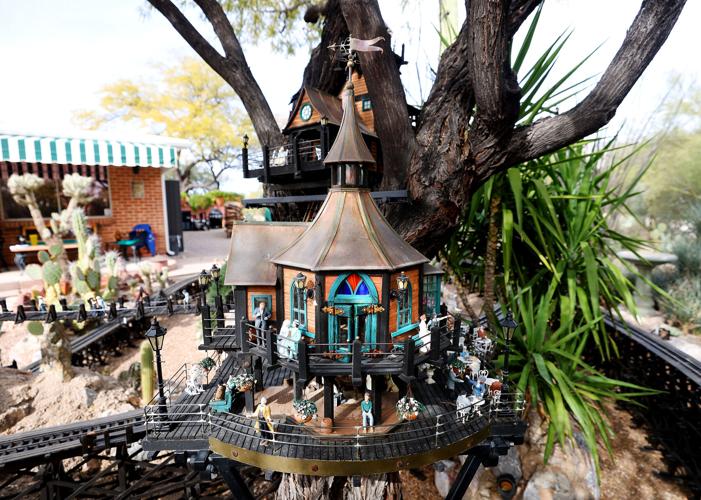
The fruits of their labor are visible in one of the railway’s showstoppers — the Victorian treehouse, which features a lodge and a kitchen, a flickering fireplace, an outdoor restaurant and a Victorian elevator that takes people between treehouse levels. There’s also a dinosaur dig, with fossils acquired from Tucson’s Gem and Mineral Show, and mountains constructed from stones from the showcase, as well.

The treehouse is one of the features incorporated into John Carmichael and Philip Pappas’ Cholla Patch Railroad. Many figurines stand and sit on the patio as a wedding reception takes place inside and out.
You can see the full set up, dubbed the “Cholla Patch Railroad,” along with that of six others during the 20th anniversary Rails in the Garden event.
The free self-guided tour, on March 2 and 3, also brings museums in Tucson into the fold. At the north-side Gadsden-Pacific Division Toy Train Operating Museum, you’ll find trains winding around landmarks including San Xavier del Bac Mission and Old Tucson. Downtown at the Southern Arizona Transportation Museum there are two layouts. On the south side, the Tucson Rodeo Parade Museum has a railroad based in the early frontier days of Tucson.
“There’s something in it for everyone, I think,” Carmichael said. “Electrical, horticulture, design, architecture, history. Pick your favorite subject and you can see it at the railroad.”

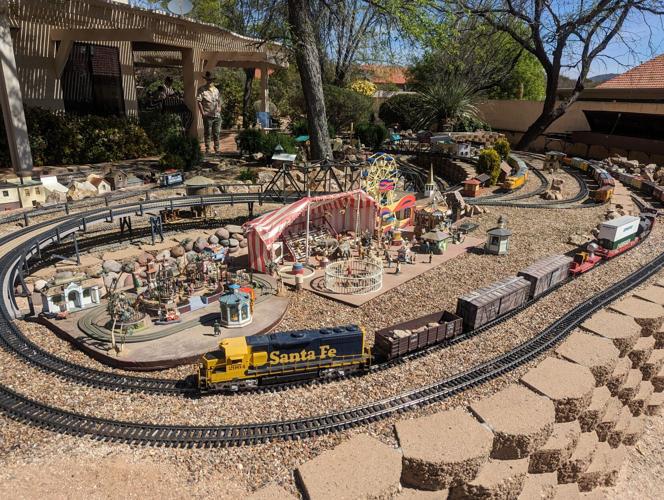
The Viewpoint Railroad is one of the stops on the tour. A circus and rodeo can be seen along the tracks. There are also two bridges going over a canyon with a river flowing below.
Keeping history alive
Carmichael hopes visitors to his home and other garden railways on the tour gain an appreciation for the history of the locomotive and how it built the country.
“This country wouldn’t be the way it is without the locomotives,” he said. “It’s just amazing what was done over 100 years ago with so little knowledge that we have now. I want to keep that history alive.”
Established in 1994, the Tucson Garden Railway Society promotes model railroading, preservation of railroad history and railroad safety throughout the Tucson area, according to its website.
The nonprofit has designed, donated, built and maintained community displays at locations including Diamond Children’s Medical Center, Children’s Museum Tucson, the Rodeo Parade Museum, Tucson Botanical Gardens and the Southern Arizona Transportation Museum.
The Rails in the Garden event got its start in 2004, inspired by a similar event put on by an East Coast club.

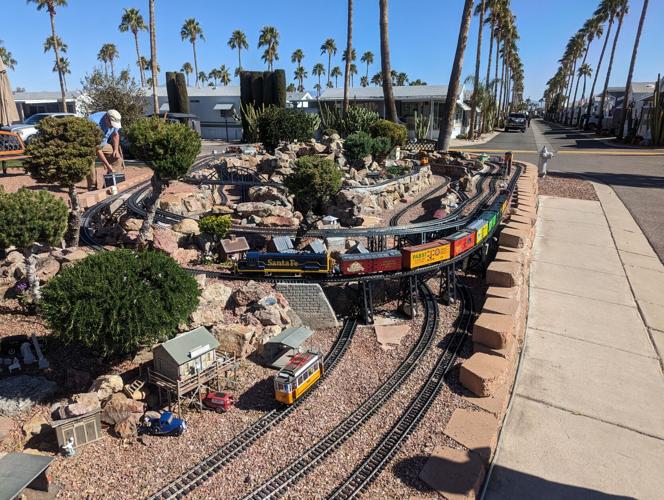
Rincon Country West RV Resort layout, which is part of the tour, has approximately 1,000 feet of track. Four tourist trolleys and an abundance of flowers, trees and bushes showcase whimsical vignettes.
As the treasurer at the time, Willis Fagg was looking for a way to raise funds to purchase a trailer to house materials that were used for a railway at the Pima County Fair.
Fagg had read about the East Coast event and presented it to the organization, which went forward with its first tour in January 2004.
“It was more popular than we expected,” he said. “We sold tickets for $5 for adults and $10 for a family. We earned enough money that year to come very close to buying a trailer outright. It kind of shook us up so we said, OK let’s keeping going with this because it’s so popular.”
In the years that followed, the tour would be held each March, with the exception of 2021 due to the COVID-19 pandemic.
Funds raised from ticket sales were used for community projects and equipment for the Southern Arizona Transportation Museum. By 2009, admission for children became free, followed by no charge for military families in 2010. Averaging 10,000 to 12,000 attendees a year, the educational nonprofit decided in 2015 to stop charging admission entirely in an effort to reach even more of the community, Fagg said.
Since COVID, the Rails in the Garden event has seen a decline in attendance, but families with children, along with the older generation who have a connection to the railroads continue to flock to the railway displays.
It was a display outside of the Tucson Convention Center at a home show in 2000 that convinced Fagg, the son of a railroad worker, to join the Tucson Garden Railway Society. His own garden railway will be featured on the tour in the Foothills.
Fagg, 79, moved to Tucson in 1993 from Southern California for work. Ten years later, he decided to construct his own garden railway. Many create their layouts on a blank canvas and landscape around their railroads. Fagg did the opposite, adapting his around established landscaping with help from his wife, Dottie, who worked on most of the figurines and structures.
Fagg says he enjoyed the challenge of building, and maintaining, his layout more so than running it, though one of his grandsons would run trains from dawn to dusk if he could when he comes to visit from Oklahoma.

The South Park and Western Railroad is based on the mountain railroads of Colorado in their heyday.
New railroad on the block
Across town on Tucson’s far east side, Charlie Weesner is just getting started on his garden railway journey.
Attendees will get to see his layout under construction and learn about model operations.
Though Weesner has only been working on his layout for about a year, much of his life has involved trains in one way or another.
As a child, he saved up his weekly 10-cent allowance to purchase an indoor train set that he’d upgrade over the years as he grew older. By the time he went to college, Weesner, a retired Raytheon engineer, got his electrical engineering degree “because I wanted to know how the trains worked,” plus a history minor in the history of technology development related to trains.
It’s no surprise that his retirement project was a garden railway, which takes up residence in the west portion of his yard. He guesses that he’s laid out about 450 feet of raised track, but never took the time to measure it.
The centerpiece of his train-centric design, which also features a sawmill, complete with spinning blades, shops, a cafe and a freight station, is a 4-foot tall hill that Weesner’s trains wind their way up and down and houses a mine.
His wife, Jennifer, pitches in on the artistic side — painting buildings and figurines passed on from other members of the Garden Railway Society.
Weesner’s inspiration is the Silver City, Deming and Pacific, a narrow gauge line that reached Silver City from Deming in 1883. His layout is set in 1924 and covers Silver City, Santa Rita and Pinos Altos.
Weesner is in the process of growing trees and shrubs to add to the scenery, but also to attract pollinators. He anticipates completing his track in a year, but the greenery will take much longer to fully develop.
Throughout the process, Weesner has learned to contend with the elements including strong winds and severe swings in temperatures that impact the track.
He works to incorporate modern technology, running his trains through an app on old iPhones. Though many of the society’s members are in their retirement years, Weesner is finding that people in the 20 to 40 age range are gaining interested in train operations.
“My impression is the 20- and 30-somethings that are getting into it are seeing it as something that’s a physical game instead of a video game because you’re playing this complicated mental task of how do I get these things done but I’m doing it with something that I’m physically building and physically moving, not just playing with a joystick,” he says.
It’s estimated there are more than two dozen garden railway layouts throughout Tucson.
Learn more about the tour, which runs from 10 a.m. to 4 p.m. each day, find maps and descriptions of the layouts at tucsongrs.org.
While the event is free, donations are accepted for charity outreach and to cover a small portion of the society’s cost. Last year’s Rails in the Garden, which attracted more than 3,400 people, raised $1,500 for the Community Food Bank of Southern Arizona.
Nearly 2,600 500-pound U.S. Navy bombs on a train detonated in three massive explosions near Dragoon, Ariz., on May 24-25, 1973.

