


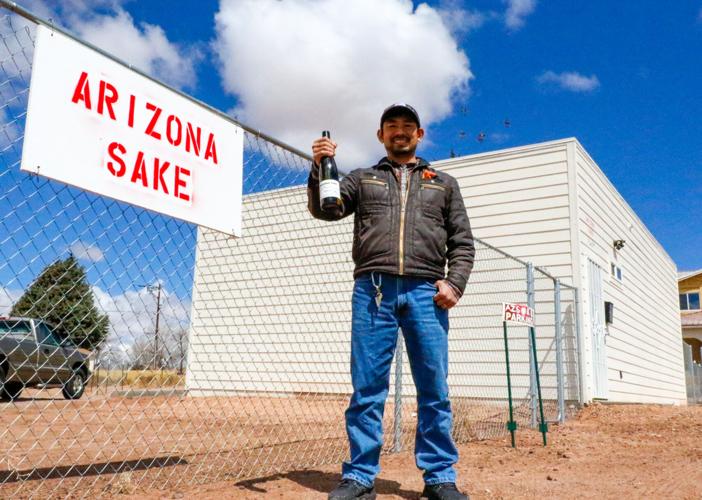
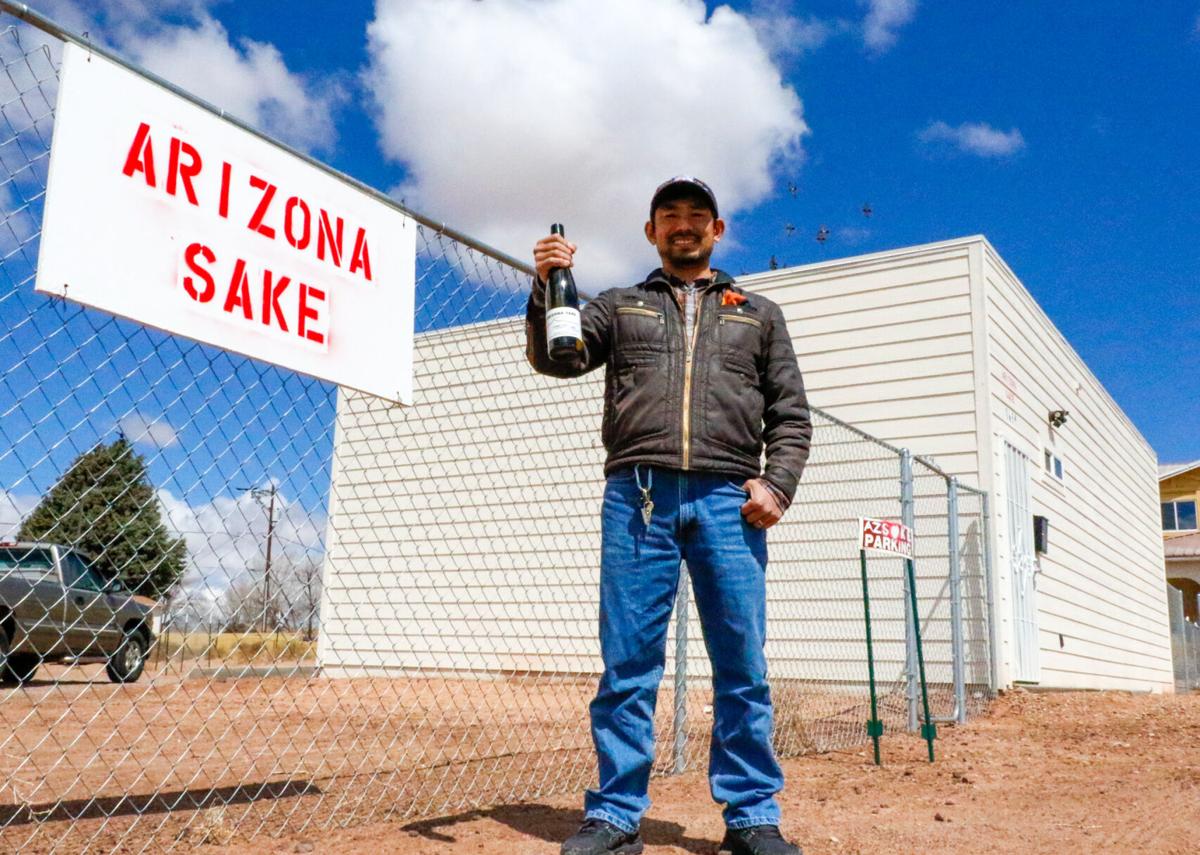
HOLBROOK — Just off historic Route 66, a sign with red capital letters outside a white wood building reads “Arizona Sake.”
Here, in the small town of Holbrook, Atsuo Sakurai brews a high quality and hand crafted sake driven by his passion for the national drink of Japan and the pursuit of owning his own business.
Alongside his traditional sake, Sakurai uses a plant known as Navajo tea that he sources from a nearby artisan to brew a specialty infused sake. His sake is available in shops around the state including Tucson’s Plaza Liquors, Westbound at the MSA Annex, and restaurants across Arizona including Sushi Zona in Tucson. Sushi Zona displays a framed exhibit of Arizona Sake on the walls in between the traditional paintings.
How Sakurai came to make the favorite liquor of his native Japan in the small rural town of just over 5,000 is part love story, part necessity.
Sakurai began his sake journey while studying agriculture at Tohoku University. He took a course on sake taught by an expert from an esteemed sake company in Sendai, which sparked his interest, making sake fit in with his agriculture studies because of the connection of growing the ingredients.
Sakurai honed his craft in the sake breweries and mountains of Japan, shaping his palate far from fermentation tanks.
Sakurai’s appreciation of nature and how he approaches crafting his sake was formed during the 10 years he spent working in Japan’s sake industry, learning the trade in breweries across the country. At one of those breweries in the midsize city of Akita, he met his wife, Heather, who was on a sake tour he was leading. They fell in love and later married in Niigata.
After years of working for others, Sakurai saved enough money to launch his own sake brewery. But opening a sake brewery in Japan involves a complicated licensing process. In Arizona, where Heather had gone to high school in Holbrook, the process was not nearly as challenging.
In 2014, the couple and their three children left Japan and moved to Holbrook, about 140 miles from Heather’s family, to give the rural Arizona town a chance.
In turn, the community of Holbrook provided a chance for Sakurai, his family and Arizona Sake.
Heather Sakurai remembers how nervous her husband was when he was preparing to present his proposal to the Holbrook City Council just before Christmas 2015. He wanted to launch the brewery out of his garage, which required a conditional use permit from the town.
Being new to the community, Sakurai was far from certain that the town would OK the permit. It took a couple of years, but in 2017, he began making sake out of his garage. The following year, he broke ground on a 1,000-square-foot brewery just minutes from his home up the hill and near the freeway.
Taking on this new endeavor was no simple task Sakurai said, “I felt nervous and uncertain about the situation.” But those nerves have now been remedied by success.
One of Sakurai’s earliest supporters was the acclaimed Japanese chef Nobuo Fukuda, former owner of now closed Nobuo at Teeter House restaurant in downtown Phoenix. Fukuda took a bottle of Arizona Sake with him on a trip to Japan and let his expert sake friends give it try.
Fukuda said their reaction was similar to his: “What do you mean this sake is made in Arizona?’”
Fukuda said he still doesn’t fully understand how Sakurai is making such high-quality sake with such simple ingredients. Most sakes use high-quality specific types of rice and only the purest water. Sakurai uses groundwater from Holbrook and cooking rice from California, importing only the koji and sake yeast from Japan.
Sakurai is an environmentalist who believes in the value of protecting natural resources.

In 2017, Atsuo Sakurai began making sake out of his garage in Holbrook. The following year, he broke ground on a 1,000-square-foot brewery, dubbed Arizona Sake.
“For us, our water is our life. We use that water for everything in this town,” Sakurai said. “Water is our most important thing.”
Sakurai recently released a Navajo tea-infused sake made from a wild-growing plant found in Arizona, New Mexico, and as far away as Montana. The tea, which Sakurai uses to incorporate the local Native American culture into his sake, is harvested and processed by artisan grower Frankie Spencer, known as “Highhorse.” It has a mild earthy taste similar to chamomile and adds a spice component to the sake.
Sakurai made his first sale on March 31, 2017, after driving his dust-covered Chevy Silverado from Holbrook to Fujiya Market in Tempe. The store’s owner bought just six bottles because neither he nor Sakurai could predict how it would sell.
“Two minutes later, a customer came in and looked for something and found my sake. They said, ‘What is this? It looks interesting. I guess I’ll buy it,’” Sakurai recalled. Both Sakurai and the owner had the same amazed reaction, “Oh my god.”
That year, Sakurai was producing 200 gallons of sake; in 2020, he was producing four times that.
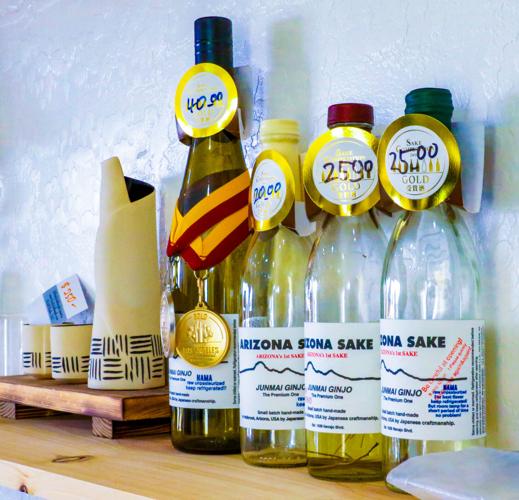
“It doesn’t have a crazy bottle label like you sometimes find in Japan,” said Mark Tarbell, a longtime sake fan who sells Arizona Sake in his upscale Phoenix restaurant Tarbell’s. “It’s a very basic presentation and bottling, but it’s all about what’s in the bottle.”
Arizona Sake sits alongside cold beer and beef jerky at Hatch’s Market in Holbrook. At Tucson’s Plaza Liquors, it’s shelved among the thousands of beers and spirits.

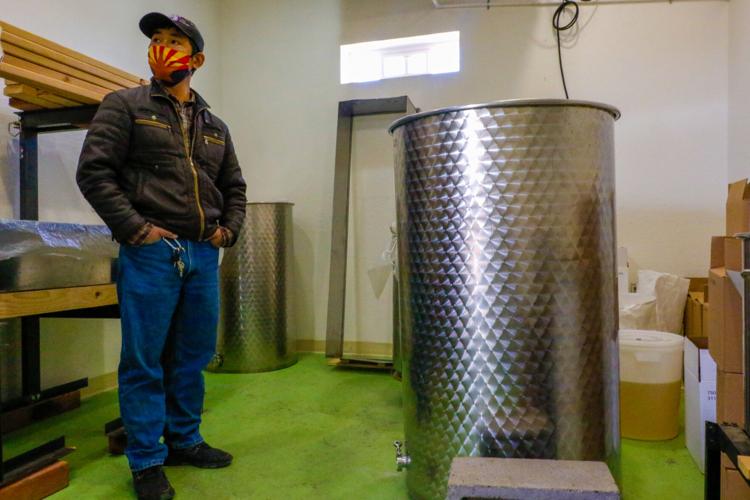
Atsuo Sakurai uses groundwater from Holbrook and cooking rice from California, importing only the koji and sake yeast from Japan, for his Arizona Sake.
Plaza Liquors started carrying Sakurai’s sake after customers kept asking if it was available. The first cases delivered to the store at 2642 N. Campbell Ave. were sold even before the cases were unpacked.
Sakurai’s success is similar to the success Arizona craft brewers and distillers have been experiencing the past decade. But rather than look to expand production on his acre lot in Holbrook, Sakurai said his focus is on quality, not quantity.
“I don’t aim to be bigger and bigger,” Sakurai said. “I want to keep producing the same quality, something I have to do no matter how much I make.”
Zio Peppe on East Tanque Verde Road isn't the first nor the only pizzeria with female pizza makers, but it is one of only a few with an all-woman staff tossing pies.

