




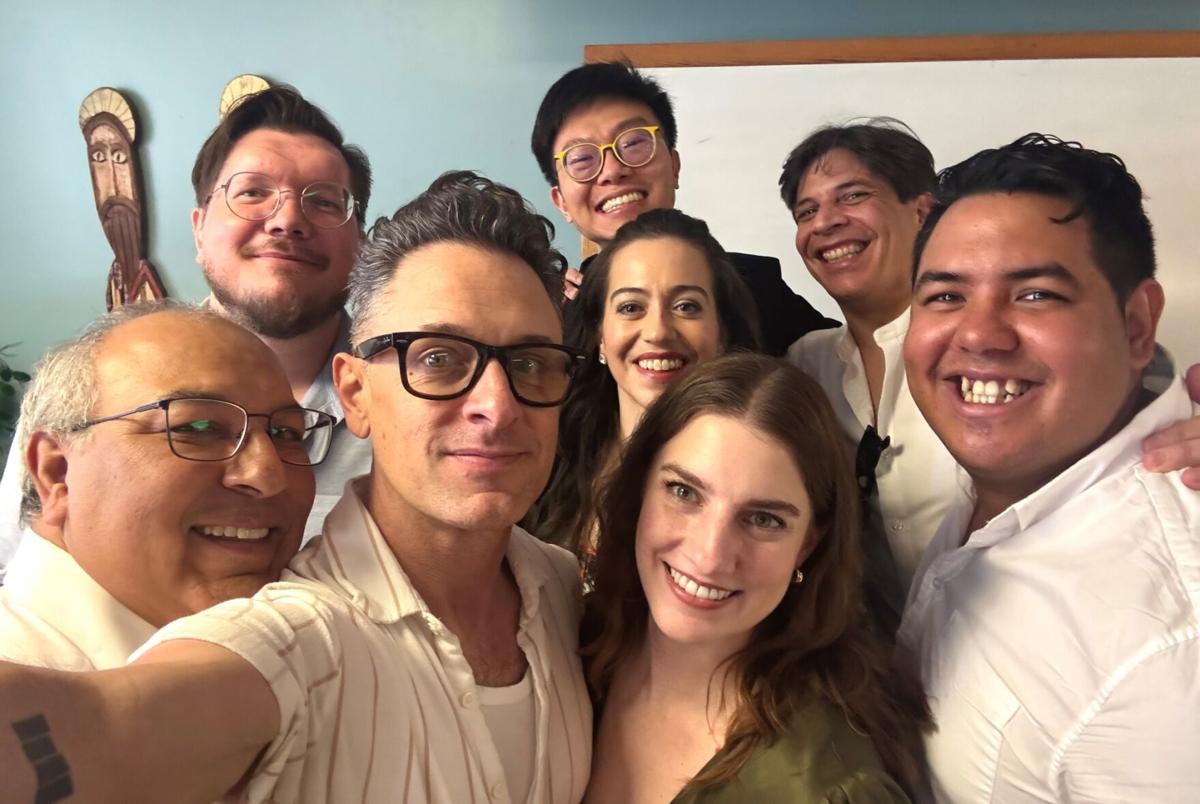
When he’s with his Tucson Symphony Orchestra colleagues on the Linda Ronstadt Music Hall stage, all we in the audience see is Nelson Yovera’s head peeking out from behind the cellos and violas.
But we hear him.
He blows into his horn and summons beautiful music and whether it’s a short burst or a prolonged passage, we have come to know and love his singular voice.
Our best shot at seeing more than his head is when he has an outsized role in a TSO concert. That’s when Music Director José Luis Gomez will point to him and gesture for Yovera to rise and the applause is often deafening.
On Saturday afternoon, Yovera was front and center on the stage at Grace St Paul’s Episcopal Church when he headlined the opening event of the St. Andrew’s Bach Society‘s 37th annual summer concert series.
Yovera had a starring role in “Yovera, Roth and Brahms” at Grace St. Paul’s Episcopal Church in the first of four Bach Society concerts through August.
He curated the program of works that put the horn in the spotlight from the lushly romantic Adagio and Allegro for Piano and Horn by Schumann and Brahms’ Trio for Horn, Violin and Piano that bookended the two-hour concert to the Beethoven Sextet that featured a pretty impressive cast of Yovera’s TSO colleagues — cellist Marguerite Salajko, pianist Dean Zhang, veteran horn player Victor Valenzuela, violist Michael Davis and Gomez on violin as a last-minute fill-in for St. Andrew’s Bach Society Director Ben Nisbet.
Early in the concert, Yovera got to show off his mad horn skills on Esa-Pekka Salonen’s Concert Etude for Solo Horn. He brought out the work’s brilliant colors and temperaments, from moody and ominously dramatic to jazzy and brash, with sublime flashes of dissonance that sounded like a second horn was playing in the background.
He and TSO principal keyboardist Zhang shared the spotlight for Schumann’s romantic Adagio and Allegro, conjuring the nuances as the piece gorgeously swung from mellow and contemplative to urgent and bouncy expressed through Yovera’s thrilling horn runs.
The pair each had a starring role in 21st century French composer Eugène Bozza’s En Forêt for Horn and Piano; Yovera made the virtuosic solo runs look easy while Zhang brought out the subtle dynamics of Bozza’s piano writing that changed moods and tempos, going from reflective and somber to fits of jazzy energy.
When the strings and horns were on stage for Beethoven’s fanciful Sextet in E-flat, it felt like old home week. Roth, who left the orchestra in February to become assistant concertmaster with the Atlanta Symphony Orchestra, was back in her first chair with her former boss playing second fiddle as she slipped back into concertmaster mode. With a subtle nod to Yovera and a smile verging on a laugh to Gomez, she was the time keeper, making sure everyone was in step.
Yovera and Valenzuela had the bulk of the workload — Beethoven intended for the lighthearted work to be a showpiece for duo horns. But the exciting interplay between the horns and strings, with lively passages giving way to breathtaking lyricism from Salajko’s cello, converged on flashes of depth that we didn’t see coming. Yovera’s lead horn moved the work from charming and delightful to mournful and serene.
Yovera, Zhang and Roth played the concert’s finale, Brahms’ Trio for Horn, Violin and Piano. The trio brought out all the richness and emotional baggage Brahms had packed into the four movements to express the stages of mourning, from grief to anguish to glimpses of hope.
It’s been months since Yovera, Roth and Zhang have shared a TSO stage, but their performance, so perfectly in sync and effortless, made it feel like it was just yesterday.

