

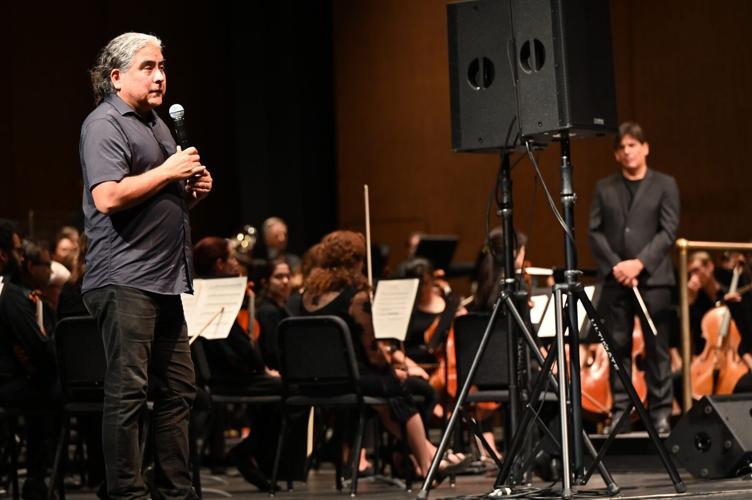

Tucson Symphony Orchestra on Sunday afternoon had asked composer Raven Chacon to come onstage and shed some light on the music they were about to perform.
Truth be told, there is no real story behind “Inscription,” Chacon told Sunday’s full house at Linda Ronstadt Music Hall. It’s just music for the sake of music.
But some people in places like Europe or the East Coast have told him they can hear the desert of his native Arizona in his music.
Maybe it was the seed he planted, but we, too, could hear the eerie silence of the desert in “Inscription,” a work that TSO co-commissioned last year with American Composers Orchestra and Dallas Symphony Orchestra.
In two performances last weekend, the TSO played the second of three world premieres of the 15-minute work.
The intriguing dissonance of “Inscription” that paired quiet and painstakingly slow-moving strings against a sonic landscape of percussion instruments that chirped, blew like a calm breeze and howled, reminded us of the expanse of nothingness that surrounds us.
Cellos played with circular bowing that created a pleasantly eerie backdrop to the quiet clank of a cymbal and woodwinds and brass buzzing like a swarm of bees.
Under the baton of TSO Music Director José Luis Gomez, we pictured a rattlesnake emerging from the haunting discordance of a solitary note on the harp interrupted by a flurry of percussion and a high-pitched ringing not too different from that constant ringing some people experience in their ears.
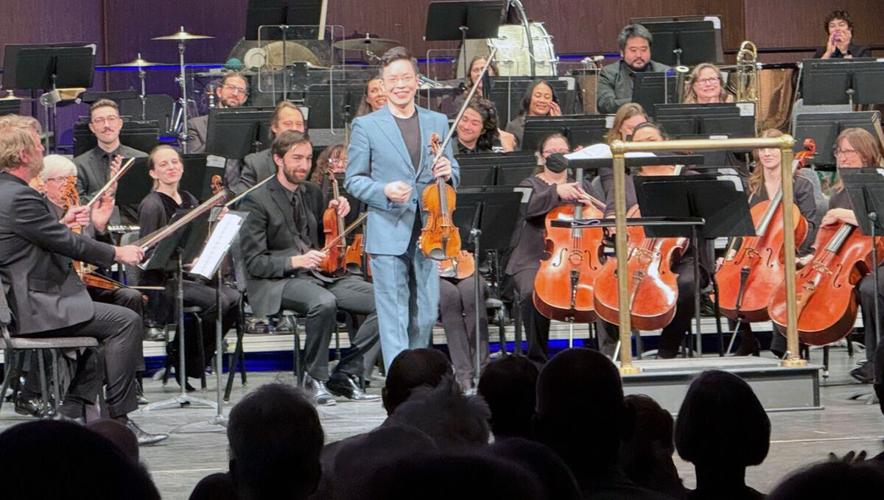
“Inscription” opened the second half of the TSO’s “Dvorák and the American Experience” concert, which featured the return of the impressive violinist Paul Huang performing Dvorák’s Violin Concerto in A minor.
Huang is one of those once-in-a-generation violinists whose sheer virtuosity is equally matched by his intensity and sensitivity especially when tackling a piece as demanding as the Dvorák.
The soloist has very little downtime in the 32-minute piece, punctuated by a series of syncopated Czech folk dance rhythms that go from slow to fast where you would anticipate it would progress fast to slow.
Huang interrupted spasms of frenetic energy with sublimely lush drama and simply gorgeous passages that he summoned with dramatic flourishes that always seemed in service to the music.
Gomez was in lockstep with every move Huang made, leading the orchestra in a perfectly timed and exciting performance.
Gomez’s shining moment in the concert, though, came in the TSO’s first-ever performance of William Grant Still’s Symphony No. 1 “Afro-American.”
It’s hard to believe TSO had never performed this wonderful work by America’s dean of African-American composers, a piece that Southern Arizona Symphony Orchestra performed last year. The half-hour symphony is filled with beautiful jazz and blues rhythms woven into the tapestry of early 20th century classical writing. It was so much fun to hear, and seeing Gomez on the podium almost dancing as he led the orchestra made it even more memorable.
When Gomez got to the toe-tapping counter melodies in the popular third movement, you could see people in the audience bop along to the “I Got Rhythm” tune from Ira and George Gershwin’s jazz standard.
During a pre-concert talk, TSO Artistic Administrator Ben Nisbet explained how the Gershwins had originally heard the four-note riff from Still and adapted it into their 1930 song. Still reclaimed the riff the following year in his “Afro-American” Symphony.

