



Lyric Opera of Chicago is reimagining Puccini's "Madama Butterfly" this spring as a reality video game, where the player assumes the role of Pinkerton, recasting the character as someone lost in fantasy and disconnected from reality.
Some companies are tamping down the stereotypes by removing the white makeup on the geisha girls, losing the samurai-style costumes and ditching historically inaccurate wigs.

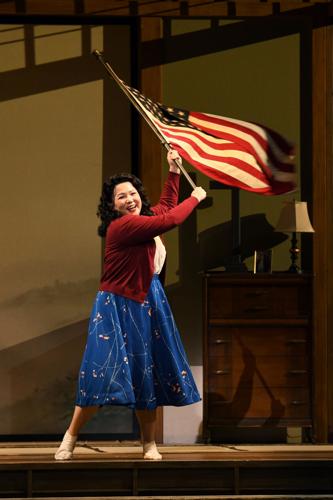
Cio-Cio San (soprano Karen Chia-ling Ho) waves an American flag mounted to her home in Japan, as she waits for her husband Pinkerton to return for her. Mo Zhou's new version of Puccini's "Madama Butterfly" is set against the backdrop of the American-led Allied occupation of post-WWII Nagasaki, Japan.
Chinese expatriate director Mo Zhou's version, on stage with Arizona Opera at Tucson's Linda Ronstadt Music Hall on Saturday, Feb. 7, is a historical reckoning. She shifts the setting from Puccini's 1906 Japan, when the country opened trade to the West, to post-World War II Nagasaki and the American-led Allied occupation.
Zhou reframes the story around the marriage brokers and war brides, some of them underage like Puccini's Cio-Cio San (Butterfly), who are sold the dream of a future in America only to find themselves left behind and humiliated.

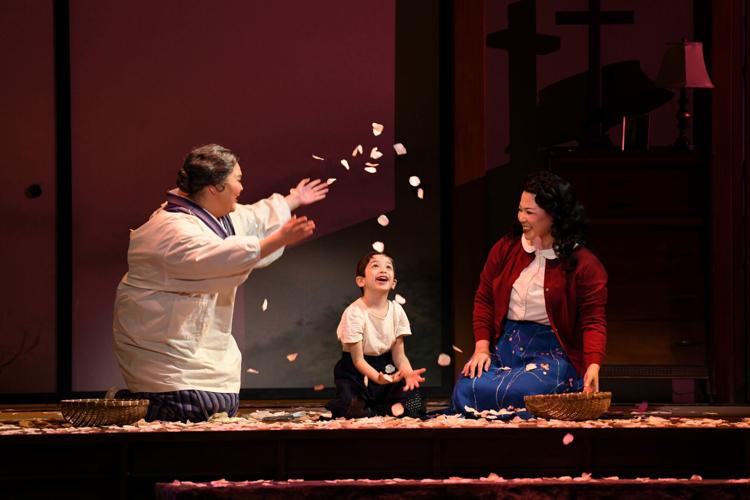
Suzuki (Alice Chung), left, and Cio-Cio San (Karen Chia-ling Ho), right, toss petals in the air for Sorrow (Travis Chavez), Butterfly's son with Pinkerton.
Arizona Opera, in a co-production with Calgary Opera and Opera Grand Rapids, is only the sixth company to perform it since it premiered with Virginia Opera in March 2024. The performance is part of the 2026 Tucson Desert Song Festival.
"There are many U.S. soldiers in Japan, in Nagasaki, and so, of course, they would have built some relationship with Japanese women," said soprano Karen Chia-ling Ho, who sings the role of Butterfly. "So after the war finished, the soldiers went back to the States and left so many women and children, the 'mixed blood' children, in Japan. And it just fit this story very perfectly."
In an interview before Arizona Opera's premiere in Phoenix last Saturday, Ho said "Madama Butterfly," one of her signature roles that has earned her wide acclaim, is "really problematic" in its portrayal of Japanese stereotypes and racist concepts.
"It has stereotypes in Western males' eyes, how they think about Asian women," she explained. "In this opera, it's ... the little female from Japan, and they think, 'Oh, you know, I can buy this wife. I can buy her the house because it's so cheap and then I can just go back to America and then I will get my real American wife'."
Ho said Zhou redefines Cio-Cio San as a woman not afraid to stand up for herself, even in death.

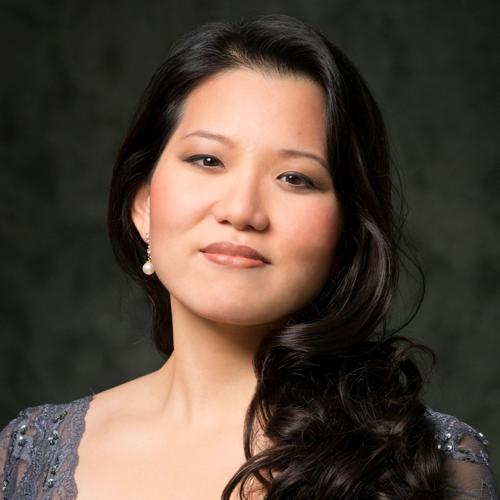
Soprano Karen Chia-ling Ho makes her song festival debut singing the role of Cio-Cio San in Arizona Opera’s production of “Madama Butterfly” on Saturday.
"The story ends with Butterfly killing herself ... but I think the backstory of her killing herself, it's not because she has no hope," Ho explained. "She's a victim. I feel like she kills herself ... because she doesn't want people to feel pity on her."
Arizona Opera's production features a creative team led by first generation Asian women. The company also has a professional kimono dresser to help the cast "wear the kimono in the correct way," Ho said, adding that the kimonos they are using are Japanese antiques.
"Also our dresser and our culture consultant, their families are survivors of the (Hiroshima and Nagasaki) bombing," she said, which lends to the authenticity of the production. "I think it's very culturally accurate."
"The cast also had a session with a culture consultant, who taught us how to walk, how to bow, how to kneel when you're wearing the kimono. I think that helps a lot, because it's completely different from our modern lives."
Saturday's performance at Linda Ronstadt Music Hall, 260 S. Church Ave., begins at 2 p.m. It runs three hours with one 30-minute intermission. Tickets are $37-$190 through azopera.org.

