



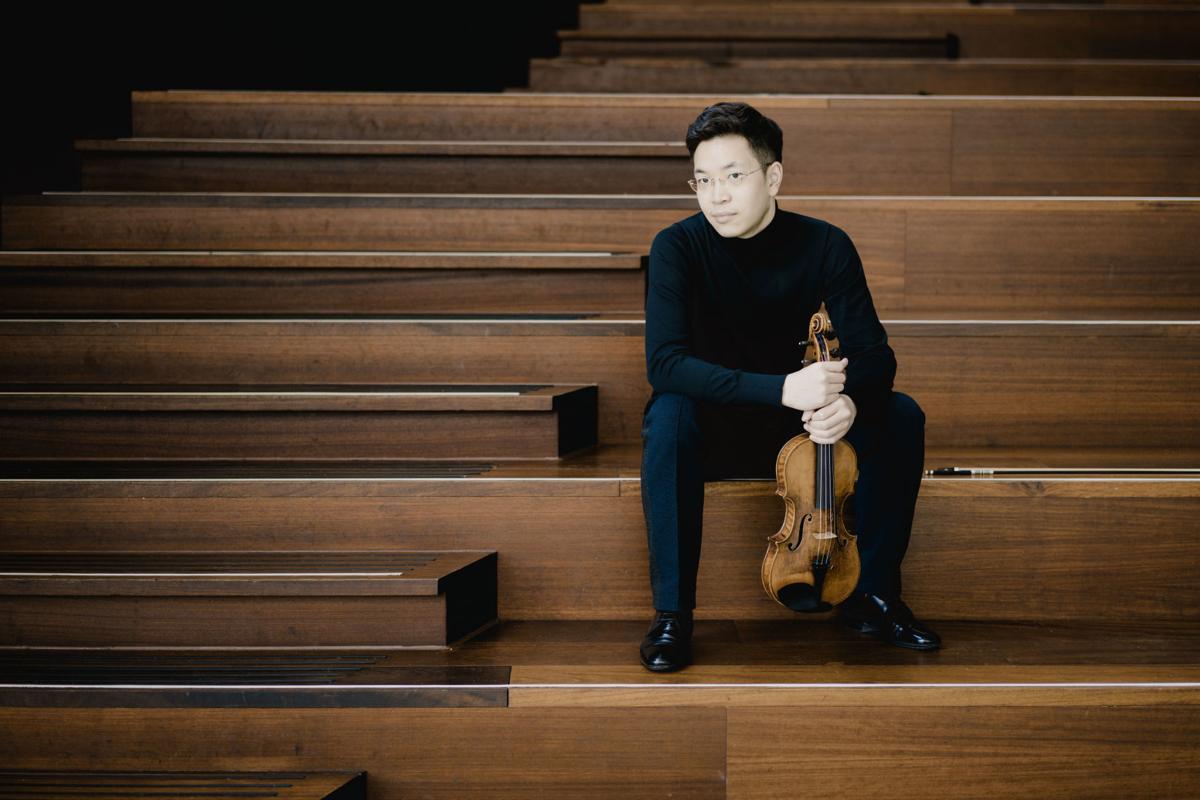
Violinist Paul Huang was about to make his Tucson Symphony Orchestra debut on March 13, 2020, when the emerging COVID-19 pandemic turned everything topsy-turvy.
On the morning of the first of two planned concerts, the orchestra announced it was suspending its season in light of the pandemic, joining other arts organizations and venues in Tucson that hit pause that day.
Huang, who is making up that missed date this weekend, said he had a feeling things were going to get wonky so on the night before the concert, he booked a seat on the last flight out of Tucson to New York, where the Taiwanese-born violinist has called home for several years.
Huang was supposed to play the Barber Violin Concerto in 2020. He’s set this weekend to perform Shostakovich’s Concerto No. 1, a work that he said fits the times we are in.
“I think this piece probably resonates even more today with all of us and what’s going on around the world,” said the 31-year-old, who has been a regular Tucson visitor for the last five or six years, visiting his godmother, Yunah Lee, who teaches at the University of Arizona Fred Fox School of Music, and watching his girlfriend perform with the Arizona Friends of Chamber Music’s Tucson Winter Chamber Music Festival.
Shostakovich wrote the Violin Concerto No. 1 in 1947-48 but it languished unperformed after it was denounced by the Russian government and local critics. The government at the time was trying to root out all Western influence in classical music, and Shostakovich was in their crosshairs.
The four-movement piece was finally premiered in 1955 after Stalin’s death.
Huang’s performance this weekend also reunites him with TSO Music Director José Luis Gomez. The pair have been friends for years after both appeared with the National Taiwan Symphony Orchestra.
Also on the program for this weekend’s concerts at 7:30 p.m. Friday, March 18, and 2 p.m. Sunday, March 20, is Tucson composer Daniel Asia‘s five-minute fanfare “Gateways.”
“It’s a fun piece,” Asia said of the work that he composed in 1993 on commission from the Cincinnati Symphony Orchestra. “I did something that I had never done before, which was write a piece through sketching.”
Asia, who teaches at the UA and who has composed hundreds of works from symphonies to string quartets, sketched ideas that popped in his head with no particular regard to the beginning, middle and end. After three months of sketching, he put those ideas, all laid out on paper, on the floor and walked around them for three hours, looking at what he had created.
After staring at something three hours, all those pieces of papers became puzzle pieces and Asia believed he had solved it.
What he arrived at was “not a straight fanfare,” he explained, because intermingled throughout is flashes of intimate tunes carried out through trios of instruments playing the same music. At points, it sounds as if the trio is talking among itself.
This is the first time “Gateways” will be performed in Tucson, adding to the growing list of Asia’s works performed by the TSO including his 1979 piece “Why (?) Jacob.” The TSO performed the world premiere of the orchestrated version of “Why (?) Jacob” in 2008.
Friday and Sunday’s performances, which also include Brahms’ Symphony No. 4, will be at Tucson Music Hall, 260 S. Church Ave. Tickets are $17 to $83 through ticketmaster.com.

