



Arizona Opera is celebrating its 50th anniversary season by revisiting an opera that started it all.
This weekend, Arizona Opera opens its Main Stage series at Linda Ronstadt Music Hall with Rossini’s “The Barber of Seville,” which was the first production from the then Tucson Opera Company in 1973.
“With this season in particular, as we are bringing audiences back to the theater, we thought it was really important to have an opera that was great for families, adults and young people alike,” said Arizona Opera President and General Director Joseph Specter. “'Barber of Seville’ is one of those pieces. It’s so perfect. … This is a show that if you never heard of opera and you want to try it for the first time, this is something you can enjoy with young ones.”
The performance is part of the opera’s Arlyn M. Brewster Operatunity Program that brings fully-staged, 40-minute adaptations of classic operas to schools throughout Arizona. Specter said the program last fall presented 52 performances at Tucson schools.
“The kids just go crazy for opera; they love opera,” he said. “When they see an opera performance up close, it’s so over the top, the characters are so big, the storylines are so engaging, they really love it. Kids love opera; it’s one of the things we have going for us as an art form.”
“Barber,” one of the 19th century Italian composer’s most enduring and popular operas, has landed on the Arizona Opera stage every decade or so since that first performance. This is the first production since Arizona Opera presented it in the 2017-18 season.
Here are five things to know before you go:
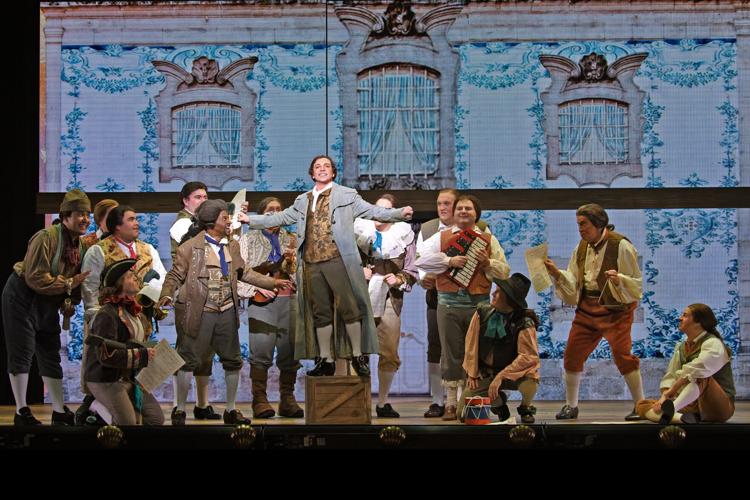
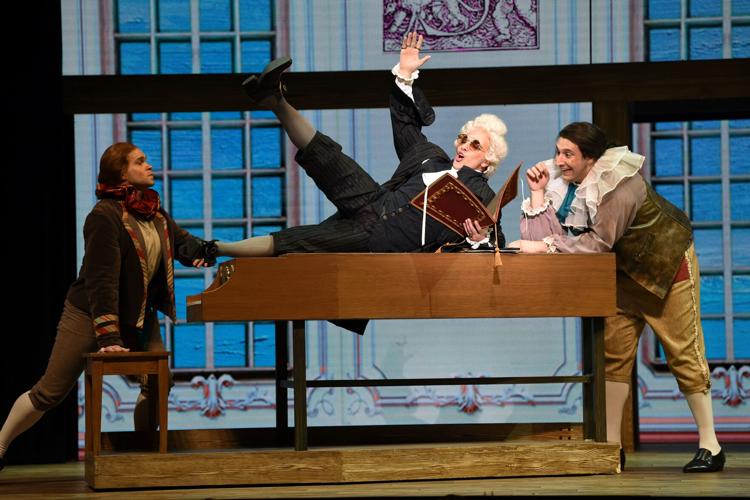
1. This is an opera buffa; you’re allowed to laugh: That literally means comic opera, which defines Rossini’s “The Barber of Seville,” a story of love longed for and love rejected, mistaken identities, greed, lust, comical hijinks and some pretty hilarious bait-and-switch scenarios. It’s the story of Count Almaviva who falls desperately in love with the beautiful Rosina, the young ward of the elderly and spiteful Dr. Bartolo, who plans to wait it out until Rosina is old enough to marry then marry her himself to steal her sizeable dowry. Enter Figaro, who choreographs several subplots and plot twists in an effort to get Rosina into the arms of the Count.
2. Return of the video wall: Arizona Opera is using its state-of-the-art video wall to project sets that recreate 17th century Spain. It’s the same technology the company used in October for the world premiere of Gregg Kallor’s “Frankenstein,” which Arizona Opera commissioned.
Arizona Opera has been using the video wall since the 2017 production of “Riders of the Purple Sage” and it has made star turns in several productions since, including “Candide” and “The Falling and the Rising.” The company purchased the 27-by-52-foot screen with a grant from the Virginia G. Piper Charitable Trust.
“It’s such a powerful tool. It can achieve anything that traditional hard scenery can achieve but on another level,” Specter said, explaining that with hard scenery, you get a single look throughout the production. With a video wall, “that same surface can have not just varying static images, but transitions. … The goal is never to have the video wall be the star but to enhance the action on the stage. We’re really blessed to have this resource available to us.”
3. About Figaro: Yes, he is the same Figaro as the title character in Mozart’s “The Marriage of Figaro,” composed 30 years before “Barber.” The character was central in French playwright Pierre Beaumarchais’s trilogy on which both “Barber” and “Marriage of Figaro” are based. Both operas are among the top 10 most performed in the world.
4. Some say Italian is the language of love: It’s also the language of love’s silly side. “Barber” is sung in Italian with English and Spanish supertitles.
5. Fun facts: Rossini wrote “The Barber of Seville” in less than three weeks although the composer himself put that timeframe at 12 days. While it is arguably one of the greatest opera buffas ever composed, it received lukewarm reviews and was booed from the audience when it premiered in Rome in February 1816. Apparently some fans of Giovanni Paisiello’s “Barber of Seville” opera composed in 1775 and still wildly popular at the time of Rossini’s premiere felt Rossini was treading on Paisiello’s legacy.
Arizona Opera will perform Rossini’s “The Barber of Seville” at 7:30 p.m. Saturday, Feb. 3, and 2 p.m. Sunday, Feb. 4, at Linda Ronstadt Music Hall, 260 S. Church Ave., with Detroit Opera Music Director Roberto Kalb at the podium. The opera in two acts runs 2 hours, 47 minutes with a 30-minute intermission.
Tickets ($30-$145) are available through tickets.azopera.org.
The performance is part of the 2024 Tucson Desert Song Festival, which includes Ballet Tucson‘s world premiere Feb. 9-11 of “Eternal Love,” choreographed by the company’s artistic director and resident choreographer Chieko Imada and featuring soprano Katherine Byrnes. Performances are at Leo Rich Theatre, 260 S. Church Ave. For tickets and details, visit ballettucson.org.
Grammy-winning soprano Angel Blue performed a recital with Arizona Opera as part of the 2023 Tucson Desert Song Festival

