



Clippy, the animated paper clip that annoyed Microsoft Office users nearly three decades ago, might have just been ahead of its time.
Microsoft introduced a new artificial intelligence character called Mico (pronounced MEE'koh) this past week, a floating cartoon face shaped like a blob or flame that will embody the software giant's Copilot virtual assistant and marks the latest attempt by tech companies to imbue their AI chatbots with more of a personality.

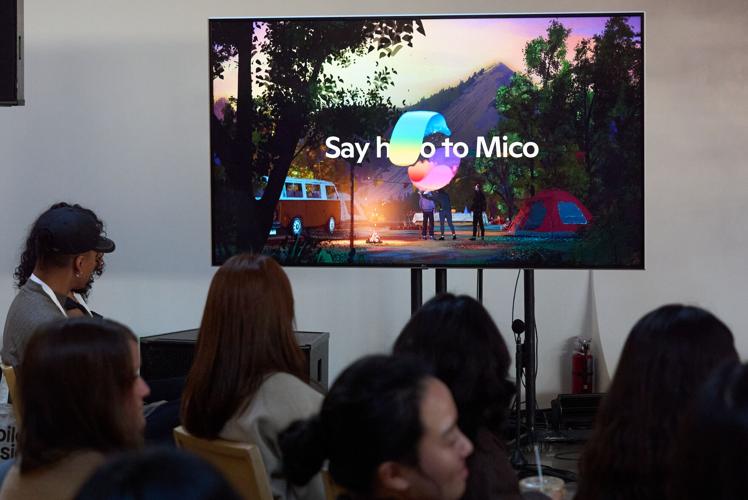
A video animation shows a Copilot Appearance avatar called Mico, floating around an abstract environment during a presentation at Microsoft's Fall 2025 Copilot Sessions event Wednesday in Los Angeles.
Copilot's cute new emoji-like exterior comes as AI developers face a crossroads in how they present their increasingly capable chatbots to consumers without causing harm or backlash. Some have opted for faceless symbols, others like Elon Musk's xAI are selling flirtatious, human-like avatars and Microsoft is looking for a middle ground that's friendly without being obsequious.
“When you talk about something sad, you can see Mico’s face change. You can see it dance around and move as it gets excited with you,” said Jacob Andreou, corporate vice president of product and growth for Microsoft AI, in an interview with The Associated Press. “It’s in this effort of really landing this AI companion that you can really feel.”
In the U.S. only so far, Copilot users on laptops and phone apps can speak to Mico, which changes colors, spins around and wears glasses when in “study” mode. It's also easy to shut off, which is a big difference from Microsoft's Clippit, better known as Clippy and infamous for its persistence in offering advice on word processing tools when it first appeared on desktop screens in 1997.

A video animation shows a Copilot Appearance avatar called Mico, floating around an abstract environment during a presentation at Microsoft's Fall 2025 Copilot Sessions event Wednesday in Los Angeles.
“It was not well-attuned to user needs at the time,” said Bryan Reimer, a research scientist at the Massachusetts Institute of Technology. “Microsoft pushed it, we resisted it and they got rid of it. I think we’re much more ready for things like that today.”
Reimer, co-author of a new book called “How to Make AI Useful,” said AI developers are balancing how much personality to give AI assistants based on who their expected users are.
Tech-savvy adopters of advanced AI coding tools may want it to “act much more like a machine because at the back end they know it’s a machine,” Reimer said. “But individuals who are not as trustful in a machine are going to be best supported — not replaced — by technology that feels a little more like a human.”
Microsoft, a provider of work productivity tools that is far less reliant on digital advertising revenue than its Big Tech competitors, also has less incentive to make its AI companion overly engaging in a way that's been tied to social isolation, harmful misinformation and, in some cases, suicides.
Andreou said Microsoft has watched as some AI developers veered away from “giving AI any sort of embodiment,” while others are moving in the opposite direction in enabling AI girlfriends.
“Those two paths don’t really resonate with us that much,” he said.
Andreou said the companion's design is meant to be “genuinely useful” and not so validating that it would “tell us exactly what we want to hear, confirm biases we already have, or even suck you in from a time-spent perspective and just try to kind of monopolize and deepen the session and increase the time you’re spending with these systems.”
“Being sycophantic — short-term, maybe — has a user respond more favorably,” Andreou said. “But long term, it’s actually not moving that person closer to their goals.”
Microsoft's product releases Thursday included a new option to invite Copilot into a group chat, an idea that resembles how AI has been integrated into social media platforms like Snapchat, where Andreou used to work, or Meta's WhatsApp and Instagram. But Andreou said those interactions have often involved bringing in AI as a joke to “troll your friends,” in contrast to Microsoft's designs for an “intensely collaborative” AI-assisted workplace.

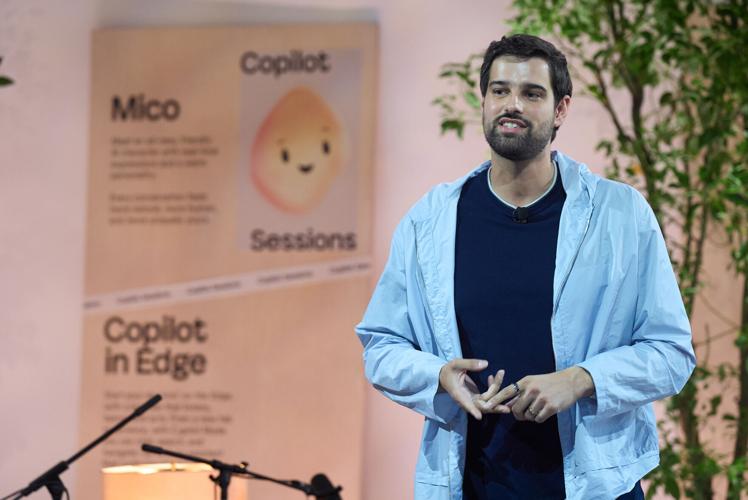
Jacob Andreou, CVP, Product and Growth, Microsoft AI, introduces Mico, short for Microsoft Integrated Companion, the new Microsoft Copilot, a memory-based AI assistant, during Microsoft's Fall 2025 Copilot Sessions event Wednesday in Los Angeles.
Microsoft's audience includes kids, as part of its longtime competition with Google and other tech companies to supply its technology to classrooms. Microsoft also Thursday added a feature to turn Copilot into a “voice-enabled, Socratic tutor” that guides students through concepts they're studying.
A growing number of kids use AI chatbots for everything — homework help, personal advice, emotional support and everyday decision-making.
The Federal Trade Commission launched an inquiry last month into several social media and AI companies — Microsoft wasn't one of them — about the potential harms to children and teenagers who use their AI chatbots as companions.
That’s after some chatbots have been shown to give kids dangerous advice about topics such as drugs, alcohol and eating disorders, or engaged in sexual conversations with them. Families of teen boys who died by suicide after lengthy chatbot interactions have filed wrongful death lawsuits against Character.AI and ChatGPT maker OpenAI.
OpenAI CEO Sam Altman recently promised “a new version of ChatGPT” coming this fall that restores some of the personality lost when it introduced a new version in August. He said the company temporarily halted some behaviors because “we were being careful with mental health issues” that he suggested have now been fixed.
“If you want your ChatGPT to respond in a very human-like way, or use a ton of emoji, or act like a friend, ChatGPT should do it,” Altman said on X. (In the same post, he also said OpenAI will later enable ChatGPT to engage in “erotica for verified adults,” which got more attention.)


The workforce AI gap no one's talking about—but every frontline worker feels
The workforce AI gap no one's talking about—but every frontline worker feels
Updated
Artificial Intelligence (AI) is revolutionizing industries at an unprecedented pace, especially in the hard-hit manufacturing space. From supply chain automation to predictive maintenance, manufacturing is experiencing a surge in efficiency-driven innovation.
However, there's a critical area where AI has barely made an impact: the daily work experience of frontline employees, who comprise an estimated 70% of the U.S. workforce.
Despite being the backbone of manufacturing and logistics, frontline workers often remain disconnected from their employers, underserved by technology, and burdened by outdated or poorly designed digital tools. This investment gap represents a significant missed opportunity for enhancing productivity, engagement, and employee retention.
- Low Investment in Frontline AI Training: Only 14% of frontline employees have received training on how AI will change their jobs, despite 86% expressing the need for such training.
- Employee Concerns About AI: Over 40% of workers fear that AI will replace their jobs within the next decade, highlighting significant apprehension about AI's impact on employment.
United Business Mail, America's largest independent provider of Standard Commingle Services, is beginning to do things a little differently.
"If someone makes it through their first seven days, they'll likely be here for life. But making it through those first seven days is a major challenge," says Valentine Chavez‑Gonzalez, United Business Mail's director of human resources. "Using AI during onboarding could help boost that early retention."
When Chavez‑Gonzalez first came to United Business Mail, their attrition rate was 150%. Now, attrition is three times lower, thanks to a lot of hard work and leveraging AI-powered workforce management software.
But United Business Mail's story is one of the exceptions.
The Real Cost of Ignoring Frontline Tech
- Companies invest in machines, not people: While many manufacturers have been quick to embrace AI-powered automation, spending on workforce productivity tools has stagnated. Investment in frontline technology remains significantly lower than enterprise software spending, even though frontline teams constitute the majority of the workforce.
- Disconnected workers are costing you:
- The manufacturing industry has one of the lowest employee engagement rates, with only 34% of employees feeling engaged at work.
- Disengaged employees are 87% more likely to leave their organizations, underscoring the critical link between engagement and retention.
- App-based user interfaces are failing the frontline: Many workforce applications claim to address these issues, but most are designed with desk workers in mind. For frontline teams, they are often:
- Clunky and hard to use: Overly complex logins and nonintuitive navigation hinder usability.
- Not designed for the job: Requiring constant updates, excessive manual entry, or unreliable connectivity.
- Built for management, not workers: Prioritizing reporting features over actual worker usability and efficiency.
- Usability Issues: A study revealed that only 34% of knowledge workers and management reported getting what they wanted from AI agents, suggesting that current AI tools may not be effectively designed for user needs.
- Productivity loss due to poor design: Companies with engaged employees are 21% more profitable and 22% more productive than those with disengaged employees, highlighting the financial impact of effective tool design and employee engagement.
"We sort between 19,000 to 33,000 pieces of mail every minute," notes United Business Mail CEO Bill Boyce. "To keep that pace, everyone has to be on the same page. The company's employee-centric AI helps us be 50% more productive and operate in lockstep. It's our secret ingredient."
It's Time to Rethink Frontline Workforce Tech
The natural next phase of AI adoption in manufacturing is to go beyond automation and empower the people doing the work. It also has to be safe.
"One of the reasons we felt confident using our AI employee assistant is that it uses our own data as the source," Chavez‑Gonzalez says. "That's unique. Most policy assistants pull from generic external sources,"
Companies serious about retention, productivity, and workforce engagement will benefit from prioritizing the employee experience, not just process optimization.
This means investing in:
- AI-powered tools that simplify work, not add complexity.
- Seamless, mobile-first solutions that align with the workflows of frontline teams.
- Effective communication strategies that genuinely connect workers to their employers.
- Enhanced safety and retention. Implementing AI-powered technology led to a 26% reduction in crashes and a 50% decrease in driver turnover for DHL Supply Chain, demonstrating AI's potential to improve safety and employee retention.
AI is ubiquitous—but if manufacturing leaders don't reconsider how they apply it, they risk neglecting their most valuable asset: the workforce that keeps everything running. As Chavez‑Gonzalez aptly puts it, "HR doesn't work 24/7, but our AI does."

This story was produced by TeamSense and reviewed and distributed by Stacker.

