



Alexis Ratcliff, an 18-year-old self-proclaimed “social butterfly” and a ventilator-dependent quadriplegic, has a simple hope.
“Long term, I want to find a loving, patient, caring Christian home that I can make into my place,” Ratcliff said.

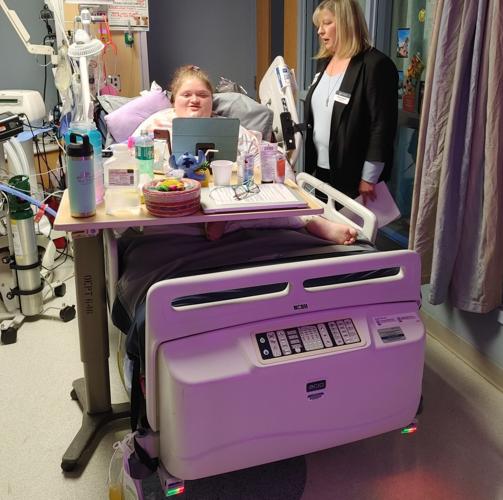
Alexis in her room in the ICU unit at Atrium Health Wake Forest Baptist hospital.
Ratcliff comes across wise well beyond her years, yet fully embracing her playfulness. Her ventilator leaves her voice a mixture of youthfulness and rasp.
Ratcliff, from Mount Airy, North Carolina, was severely injured in a car accident at 18 months old caused by her mother. She requires around-the-clock care.
Both of her parents, who struggled with drug use, have died, including her mother in January.
Ratcliff achingly wants to leave the ICU unit at Atrium Health Wake Forest Baptist, where she has lived since being admitted in January 2019 as part of a court-ordered housing solution after family options could no longer meet her needs.
Baptist administrators want Ratcliff to leave, too, but into out-of-state skilled-nursing housing arrangements that she intensely opposes.
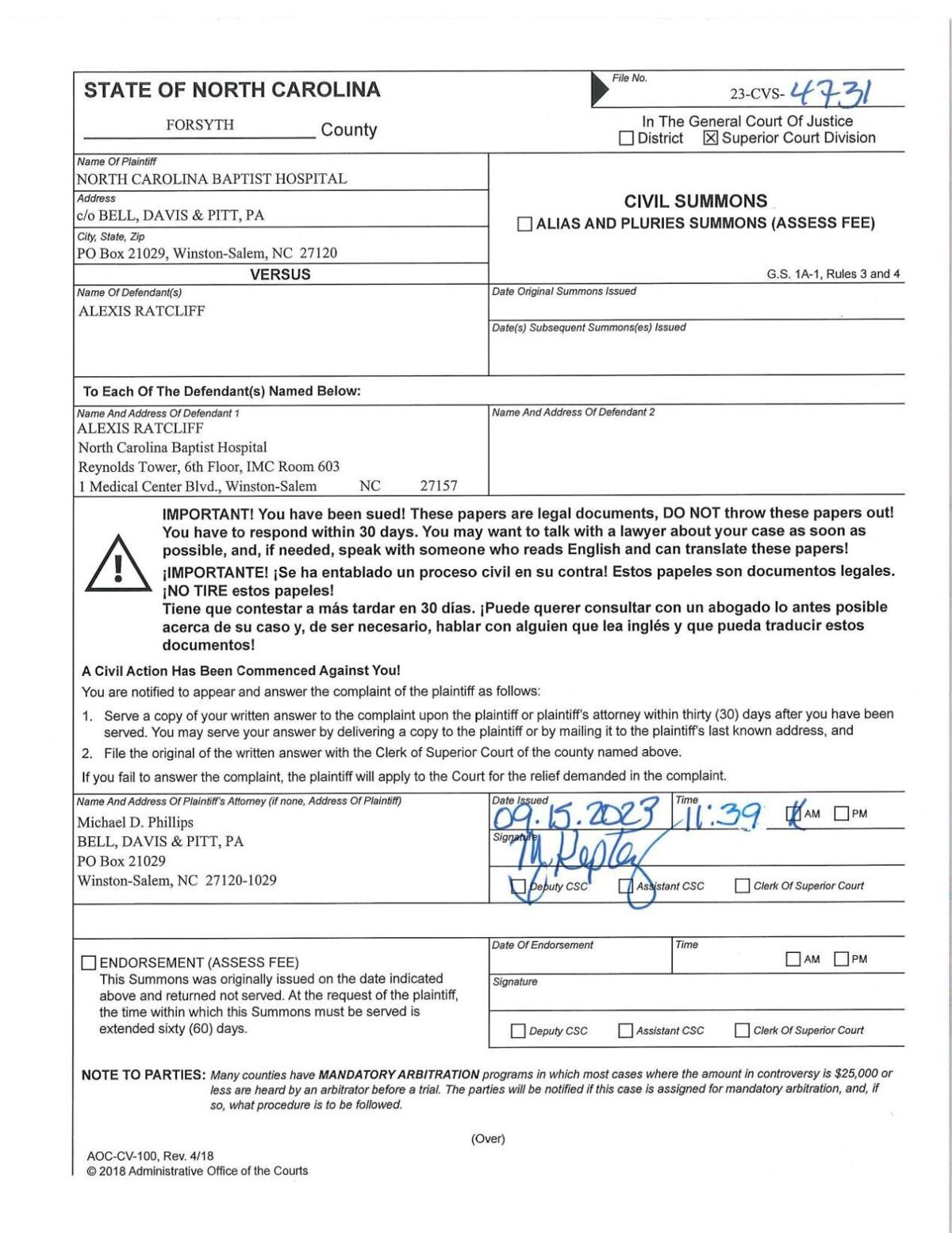
In September, Baptist filed a lawsuit in Forsyth Superior Court that requested a permanent mandatory injunction to compel Ratcliff’s departure and a determination that she is trespassing according to state law. The lawsuit was filed about six weeks after Ratcliff turned 18 in August.
A Surry Superior Court order has blocked Baptist from involuntarily discharging Ratcliff.
On Thursday, Baptist announced unexpectedly it will file to dismiss the lawsuit.
Baptist said in a statement Thursday that “we continue to work with all parties, including her attorneys and North Carolina Medicaid, and are seeking resolution through mediation, to ensure a safe and appropriate long-term care plan for Ms. Ratcliff.”
That has included the potential for a foster care or adoptive resolution with a Surry County family.
Joonu-Noel Andrews Coste, a Disability Rights NC attorney representing Ratcliff, said Thursday following the Baptist statement that "Alexis is happy the hospital dropped the case against her, and DRNC is still working through the legal details.”

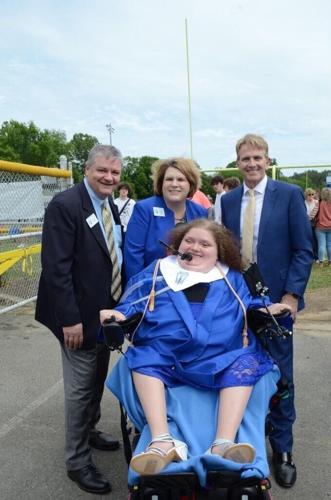
Alexis Ratcliff at her high school graduation with honors.
Since the filing of the lawsuit, Ratcliff has lived each day knowing she could be forced to leave and move to a housing setting signed off by Baptist, but not of her approval.
Ratcliff said in a Zoom interview with the Journal that “it was a very big shock” when she learned about the lawsuit. Baptist declined to give her attorneys with Disability Rights NC permission to conduct an-person interview.
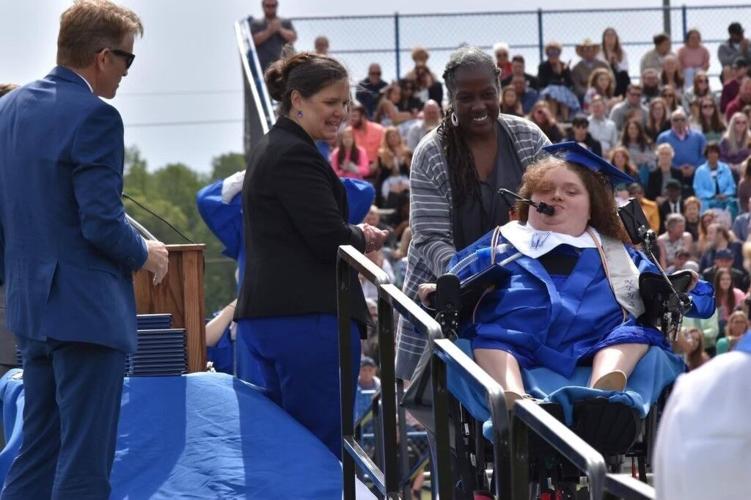
The lawsuit left her confused and questioning how a hospital whose medical staff have been so warm — including celebrating her graduation from North Surry High School in June and her 18th birthday on Aug. 2 — can have an administrative side so cool to her future that it would sue to compel her eviction.
“So, you’re suing me? Believe me, I want to get out of Baptist, too, but it’s not my fault, and not my decision, to be here at age 18,” Ratcliff said. “It’s really stressed me out a lot.”
Coste said Baptist administrators have told her that since she turned 18, she will not be re-admitted if she leaves the hospital — “there was no ‘maybe’ about it.”
Coste said her group views Baptist’s stance on Ratcliff leaving hospital grounds “as giving the appearance of being highly retaliatory.”
As a result, Ratcliff has not been outside the hospital since late last fall.
Ratcliff said that “some people may think, ‘well, she’s been there (in Baptist) five years,’ but it’s not like I’m a typical patient, and this has become a second home to me.”
“I want to get out of the hospital and not come back to the hospital unless I am sick and knocking on death’s door,” she said. “That’s just where I am at now.”
Why Baptist ICU is necessary
All parties acknowledge there is no current medical necessity for Ratcliff’s ICU-level care outside it is the only properly equipped area within the hospital for a ventilator-dependent patient.
Baptist claims in the lawsuit that by Ratcliff refusing to leave and accept the placement that the hospital arranged at a Bestian, Virginia, skilled-nursing facility, she is trespassing and denying a potential patient an ICU room.
Ratcliff said she refuses the Baptist placement because she prefers an independent residential setting in Winston-Salem, the Triad or close to her Mount Airy roots, but “definitely not” out of state.
When asked if Baptist was ending its efforts to compel Ratcliff to leave, the hospital said Thursday that “everything else in our previous statement (submitted Wednesday to the Journal) stands.”
Baptist administrators want court permission to require Ratcliff to “accept transfer to the next available skilled-nursing facility placement that the hospital determines is safe and appropriate for (her) care needs.”
Baptist said in the first statement sent to the Journal that “none of the three appropriate skilled nursing facilities in North Carolina have been willing to accept Ms. Ratcliff.”
“Unfortunately, we had no choice except to take legal action consistent with the processes outlined by the laws of North Carolina.
“That difficult decision was necessary because Ms. Ratcliff was discharged by her physicians, refused all skilled nursing facility placement options, provided no residential placement options and refused to leave the hospital.”
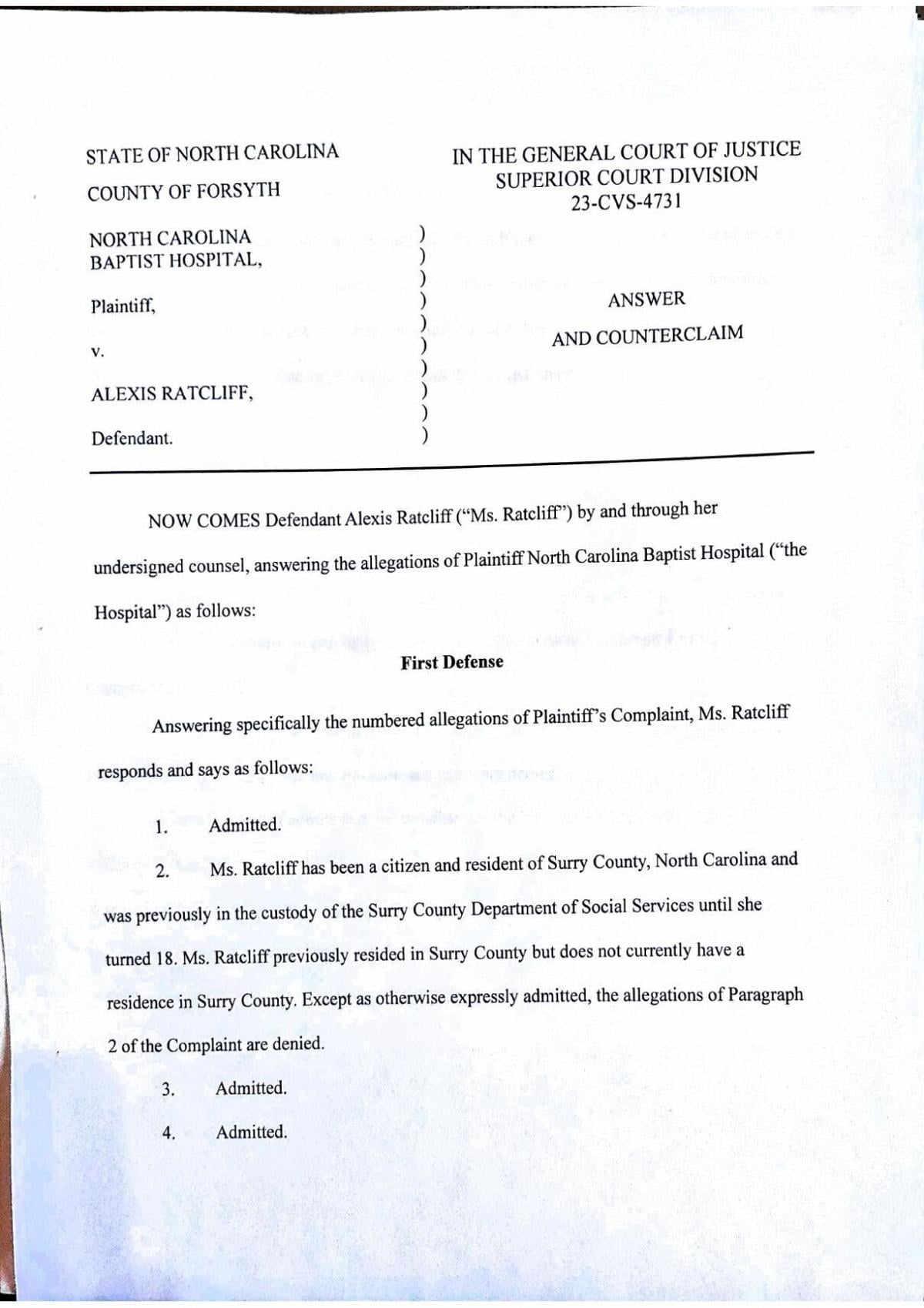
Ratcliff counterclaim
The main dilemma in Ratcliff’s housing limbo is that no agreement has been reached on a safe and 100% electricity-reliant residential setting between Ratcliff, her attorneys, Surry DSS and Baptist.
Such a setting in particular in North Carolina has proven frustratingly hard to secure.
Ratcliff said her preferred short-term housing solution is accommodations that would allow her to be a full-time, on-campus student at Salem College, where she has a full academic scholarship as a freshman.
In the Disability Rights NC counterclaim, filed in November, her attorneys said that after Ratcliff turned 18, Baptist has “consistently pressured her to leave the state and has purported to discharge her knowing that discharge endangers her access to NC Medicaid and her ability to pursue community-based services.”
If another state doesn’t accept NC Medicaid, Ratcliff would be dropped from NC Medicaid and placed in that state’s program.
“She has made (Baptist) aware of her need to remain at the hospital until such time as an appropriate option is identified in North Carolina” or a viable out-of-state option that would not deprive her of NC Medicaid eligibility,” according to the counterclaim.
The counterclaim accuses Baptist’s social worker unit of “intimidation” and making “threats” in an attempt “to coerce her to relinquish her property rights to NC Medicaid.”
Coste considers the Baptist lawsuit “as a system default.”
“It’s really psychologically impacted her because none of us anticipated a lawsuit was the direction the hospital was going.
“She was not ready or willing to consent to the hospitals’ plans to send her to Virginia until her questions were answered, and very quickly thereafter they filed their lawsuit.”

Alexis Ratcliff at her high school graduation.
Making lemonade
Ratcliff said she has been making lemonade our of lemons most of her life.
It’s just part of being a social butterfly, as well as a coping mechanism for the darker element of her childhood.
Alexis’ room at Baptist, both while within Brenner Children’s Hospital and now in the adult ICU, have been filled with personal items meant to provide rays of cheer and sunshine.
They include an array of stuffed animals, photos, makeup, hair and beauty supply accessories, dream catchers and a Nutcracker Mickey Mouse.
“Normal is not really a word I would use to describe me or anything about my life,” Ratcliff said.
“My surroundings are normal in that what I have done in this room is what I would have in an apartment or dorm. I look at this as my hospital dorm room.
“I just want to live the best life I can,” Ratcliff said.
Ratcliff accepts her physical limitations, but doesn’t allow herself to be bitter or defined by them. She uses her voice to communicate with her iPad for her online studies at Salem College.
“Everything happens for a reason,” Ratcliff said. “I’m thankful for the opportunities that I have had and I am getting.
“Has this situation been ideal? No. Would I have chosen this for myself? Probably not.
“But, it has made me into the person I am today, so I guess I wouldn’t choose it any other way.”
Her background
Ratcliff spoke limitedly about her childhood, in particular the car accident that left her a quadriplegic. Ratcliff’s attorneys said her parents struggled with drug use.
Her mother, Anna Marie Crim, was driving when the car accident occurred in February 2008. Crim was 22 at that time.
In a June 9, 2011, report in the Journal, hours before Crim crashed her car with Ratcliff inside, she had taken methadone to treat her drug addiction, smoked marijuana and taken Xanax and Klonopin pills, according to Forsyth Superior Court records.
Crim’s boyfriend’s sister told authorities that on Feb. 26, 2008, Crim, who was seven months pregnant, slurred her words, stumbled when she walked and nodded off while standing.
The behavior concerned the sister so much that she begged Crim to leave Ratcliff with her. Crim refused.
Ratcliff was moving from her unsecured car seat as Crim was driving north on Main Street in Kernersville when she veered off the road and hit a parked car. The toddler was crushed between the dashboard and her father, Dustin Ratfcliff, according to Crim’s attorney. The crash did not affect Crim’s pregnancy with her daughter, Apple.
Besides becoming a quadriplegic, Ratcliff began suffering from lung infections, pneumonia, seizures and suffers from scoliosis, which is curvature of the spine. As of the time of her mother’s trial, doctors said it was not clear what was Ratcliff’s life expectations.
Crim pleaded guilty to assault with a deadly weapon inflicting serious injury, assault inflicting serious bodily injury and misdemeanor driving while license revoked. Judge Todd Burke sentenced her to 24 to 38 months in prison after consolidating the misdemeanor into the assault with a deadly weapon charge
“My daughter was so full of life, and I’m so sorry this car accident has taken this away from her,” Crim said during the trial.
“It kills me for Alexis to be in the condition she is in. I love Alexis with all my heart.”
She told Burke she wished that she — not Alexis — had been injured in the accident.
Dustin Ratcliff was not charged in the incident. Forsyth District Attorney Jim O’Neill said prosecutors charged Crim because she was the driver and bore the ultimate responsibility in making sure her child was safe.
After Crim was released from prison, mother and daughter found a way to reconcile at Alexis Ratcliff’s urging before Crim died in January at age 37. Ratcliff said her mother had returned to some old friends and relapsed.
Meanwhile, Dustin Ratfcliff died a few years after the car accident.
Alexis Ratcliff lived with family, in particular her paternal grandfather, until 2019, going to school in-person in elementary and middle schools.
However, her grandfather became unable to care for her as he developed severe health issues that required going into an assisted-living setting.
With no other family able to provide suitable accommodations, she was placed into Baptist in 2019 through a court order secured by Surry DSS.
From December 2021 to June 2022, she was placed into a foster care setting, but went back to Baptist after developing health conditions that required rehospitalization.

Alexis Ratcliff at her high school graduation
Baptist perspective
Baptist said in the lawsuit “there is no step-down from the ICU to a less-intensive care setting within the hospital.”
“Such patients must be discharged to a skilled nursing facility capable of providing care and maintenance.”
By refusing to vacate the ICU room, Baptist claims she “is taking up a bed ... and preventing admission of other patients with critical medical needs who actually require the ICU level of care.”
“Multiple benefits would be provided to Ms. Ratcliff if she moves to a skilled nursing facility,” Baptist said. “These benefits include increased independence and opportunities for social interactions that cannot be provided in a hospital.”
Baptist claims Ratcliff’s attorneys “have instructed her to not speak with us about discharge planning and who have not provided us with specific discharge plans.”
“We have gone so far as to offer to contribute financially toward a private home option where Ms. Ratcliff could live with a caregiver, but her attorneys declined to respond to this offer.
“Unfortunately, we had no choice except to take legal action consistent with the processes outlined by the laws of North Carolina. “
Baptist said it appreciates how Ratcliff has “faced unbelievable challenges.”
“We truly want her to live a fulfilling and rewarding life in an environment that can provide safe and appropriate ventilator care, offer her greater independence and social activities and help her reach her goals.
“That environment is not in a hospital ICU.”
Ratcliff attorneys’ response
Coste and Ratcliff acknowledge that a hospital “is not a place you want to live for non-medical reasons.”
“She does not want to continue to live in the hospital any longer than she has to.”
“She was placed there as a 13-year-old and had no choice since the court in Surry County ordered her to stay in the hospital. Until she turned 18, the hospital didn’t have a choice.”
Coste said one of her main irritations with the status of Ratcliff’s case is that “it just strikes us that with everyone knowing she was turning 18 and could have the option to leave for suitable housing that the hospital didn’t try to get ahead of it, but rather chose to try to force her to go somewhere she didn’t want to go.
“We have been hopeful that at anytime they would shift their stance, but it hasn’t happened yet.”
Coste said that even though Ratcliff’s plight has gotten media attention, Baptist’s position on trying to force her to leave “has not changed, and we are continuing to litigate this case.”
“We are, and have been open, with the hospital about how we can work together to move her into the community.”
Coste said that skilled nursing facilities in North Carolina that have beds “won’t take her because of her specific trachea tube and valve that she uses.”
Citing her previous foster-care situation that left Ratcliff becoming “quite ill” and requiring hospitalization out of medical necessity, Coste said “unfortunately, we know that people with significant disabilities (that) decisions can be made that do not value their lives as much as we would hope.”
“Her big fear, which we can all understand, is living in another state, having a medical emergency and not have anybody she knows around her.,” Coste said.
Salem College role
Salem College “has been lovely to work with” with Ratcliff’s freshman online studies, Coste said.
“They have said that when she determines which classes she wants to attend in person, they will place them in classroom accessible to her.
“Unfortunately, because their dorms are so old, they won’t be possible. They have directed us to some apartment dwellings that their students use.”
Jennifer Borrero, the college’s interim Dean of Students, said that at this point, after conversations with Ratcliff’s legal advocate Kirby Morrow, “we explored our on-campus housing (and) determined that Salem’s on-campus housing was not suitable for Alexis.”
Diane Lipsett, Ratcliff’s academic adviser at Salem College, said her course materials and assignments are accessible online.
“She is warmly supported by Salem’s disability services coordinator and her professors,” Lipsett said. “As her academic adviser, I meet with her in person weekly.
“As we would for other students with disabilities, Salem can schedule Alexis’ classes in accessible classrooms and would provide related accommodations.”
The college said it cannot comment on whether it can accept funding from Baptist or other sources toward providing housing accommodations.
“We have not been approached about funding or support from any source,” the college said.
DHHS’ role
DHHS, citing privacy healthcare policies, said it “cannot comment on specifics of any case, regardless of a patient’s permission.”
DHHS did provide a synopsis of how the N.C. Medicaid program under its supervision “ensures people are receiving the best care possible in the least restrictive setting possible.”
“Medicaid, in situations as described, partner with the beneficiary, their families and providers taking a person-centered approach to balance what is important for the individual with the best available care.
“Once the appropriate setting of care and services are determined, NC Medicaid will leverage available programs: state plan programs such as private duty nursing and personal care services, and (federal) waiver programs” for disabled children and adults.
DHHS said those programs “provide wraparound services, like home and vehicle modification, limited care transition and home delivered meals.”
“If needed, initiatives like the Money Follows the Person program provide funding for security deposits for housing and groceries for someone transitioning from institutional care to community living.
“Most importantly, a care transition coordinator to offer support pre- and post-transition.”
DHHS stressed that “each care transition is unique, and identifying the most appropriate option can be complicated because the age of an individual, the complexity of their care needs and the personal goals and aspirations of the individual and their family.”
Room to grow
When Ratcliff’s attorneys filed their response in November to Baptist’s lawsuit, they indicated another foster care home setting in Surry may be possible if the potential adoptive family can modify their home to meet her needs.
Coste said Baptist is aware of that potential residential solution.
Coste said Ratcliff needs living space that is modified to allow for a wheelchair, to provide access for her to a bathroom, a lift to get in and out of bed, and most importantly, a back-up power source.”
The other key factor to independent life for Ratcliff is dependable and accessible modified transportation to get her to and from Salem College, Coste said.
Coste said that getting Ratcliff qualified for CAP/C takes time, but “it will provide all the resources for the care that she needs and the staff wherever she is.”
CAP/C is part of the state Medicaid Home and Community-based Services program — authorized by the federal Social Service Act — that’s overseen by NCDHHS.
It assists children determined to be medically fragile and medically complex from birth until age 21, at which point she would transfer to the adult waiver version of CAP/C that Coste described as “a well-oiled machine.”
Beneficiaries are determined to require a level of institutional care under the N.C. Medicaid State Plan, including needing at least one or more CAP/C home-and community-based services “based on a reasonable indication of need assessment that must be coordinated by a CAP/C case manager.”
Those services can include attendant nurse care, in-home aide services, care coordination, community integration and transition services, coordinated caregiving, financial management services, home accessibility and adaptation, goods and nutrition service, non-medical transportation, respite care, specialized medical equipment and supplies, training, education and consultative services, and vehicle modification.
“We continue to have more stakeholders coming to the table, but we can’t do anything until we know where she’s going to live,” Coste said.
“It would not be an obligation of that housing provider to pay for those things,” Coste said. “We have the ability through Medicaid to get those things done.”
What’s next?
Before Ratcliff turned 18, Coste said she couldn’t move into anywhere that wasn’t a foster-care setting without Surry DSS approval
“Now that she’s 18, more options are possible,” Coste said.
That includes working with the Children’s Home Society for being adopted “since we know there are families out there willing to take a young person like Alexis into their home.”
“Her entire world is in Winston-Salem and Mount Airy, although she would be good in Greensboro or somewhere geographically close by where her aunt or her sister could be called in if something happens to her,” Coste said.
When people come forward asking how they can help Ratcliff, Coste said “that while she has many needs, the foremost is securing proper housing because everything else feeds out of that.”
Ratcliff said she has aspirations of becoming a lawyer providing legal services for those with disabilities as herself.
“Even though it seems I have changed my mind a million times. I would love to go to law school, though,” she said. “I have been helping with N.C. Adapt for a number of years.
“While this state is one of the best for people with disabilities, I want to make this state the best it can be for people like myself to thrive.
“I do know I want to be the face of that change, the voice of that change, because there are so many disabled people who are in their right mind, but they just have physical limitations.”
Ratcliff stressed that “having a disability doesn’t mean you shouldn’t be able to live your life to the fullest of your abilities.”
“Something better is coming. I don’t know what that is yet, but I’m hopeful.”

