


NEW YORK — Dr. Ruth Westheimer, the diminutive sex therapist who became a pop icon, media star and best-selling author through her frank talk about once-taboo bedroom topics, died. She was 96.
Westheimer died Friday at her New York City home, surrounded by her family, according to publicist and friend Pierre Lehu.
Westheimer never advocated risky sexual behavior. Instead, she encouraged an open dialogue on previously closeted issues that affected her audience of millions.
Her recurring theme: there’s nothing to be ashamed of.

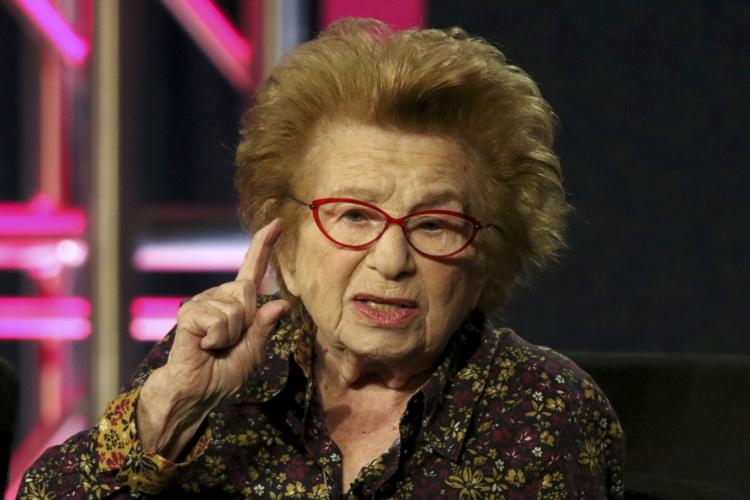
Dr. Ruth Westheimer participates in the “Ask Dr. Ruth” panel Feb. 11, 2019, during the Hulu presentation at the Television Critics Association Winter Press Tour at The Langham Huntington in Pasadena, Calif.
“I still hold old-fashioned values and I’m a bit of a square,” she told students at Michigan City High School in 2002. “Sex is a private art and a private matter. But still, it is a subject we must talk about.”
Westheimer’s giggly, German-accented voice, coupled with her 4-foot-7 frame, made her an unlikely looking — and sounding — outlet for “sexual literacy.” The contradiction was one of the keys to her success.
Her extensive knowledge and training, coupled with her humorous, nonjudgmental manner, catapulted her radio program, “Sexually Speaking,” into the national spotlight in the early 1980s.
She had a nonjudgmental approach to what two consenting adults did in the privacy of their home.
“Tell him you’re not going to initiate,” she told a concerned caller in June 1982. “Tell him that Dr. Westheimer said that you’re not going to die if he doesn’t have sex for one week.”

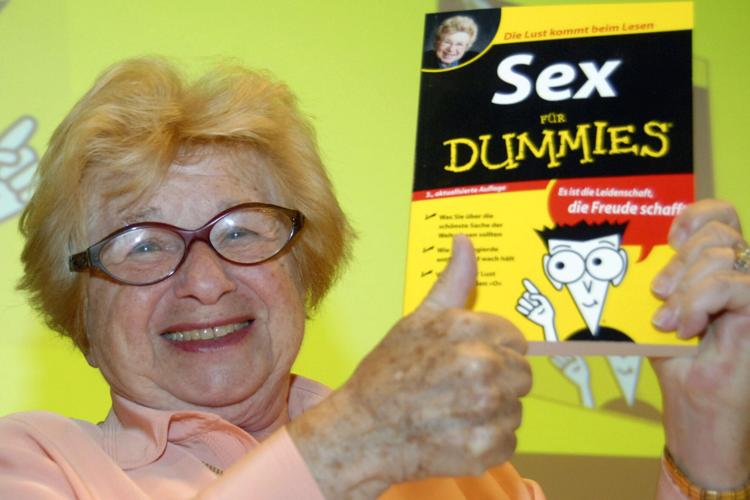
Dr. Ruth Westheimer holds a copy of her book "Sex for Dummies" on Oct. 11, 2007, at the International Frankfurt Book Fair "Frankfurter Buchmesse: in Frankfurt, Germany.
Her radio success opened new doors, and in 1983 she wrote the first of more than 40 books: “Dr. Ruth’s Guide to Good Sex,” demystifying sex with both rationality and humor. There was even a board game, Dr. Ruth’s Game of Good Sex.
She soon became a regular on the late-night television talk-show circuit, bringing her personality to the national stage. Her rise coincided with the early days of the AIDS epidemic, when frank sexual talk became a necessity.
“If we could bring about talking about sexual activity the way we talk about diet — the way we talk about food — without it having this kind of connotation that there’s something not right about it, then we would be a step further. But we have to do it with good taste,” she told Johnny Carson in 1982.
She normalized the use of words like “penis” and “vagina” on radio and TV, aided by her Jewish grandmotherly accent, which The Wall Street Journal once said was “a cross between Henry Kissinger and Minnie Mouse.”
People magazine included her in their list of “The Most Intriguing People of the Century.” She even made it into a Shania Twain song: “No, I don’t need proof to show me the truth/Not even Dr. Ruth is gonna tell me how I feel.”
Westheimer defended abortion rights, suggested older people have sex after a good night’s sleep and was an outspoken advocate of condom use. She believed in monogamy.
In the 1980s, she stood up for gay men at the height of the AIDS epidemic and spoke out loudly for the LGBTQ community. She said she defended people deemed by some far-right Christians to be “subhuman” because of her own past.
Born Karola Ruth Siegel in Frankfurt, Germany, in 1928, she was an only child. At 10, she was sent by her parents to Switzerland to escape Kristallnacht — the Nazis’ 1938 pogrom that served as a precursor to the Holocaust. She never saw her parents again; Westheimer believed they were killed in the gas chambers at Auschwitz.
At age 16, she moved to Palestine and joined the Haganah, the underground movement for Israeli independence. She was trained as a sniper, though she said she never shot at anyone.
Her legs were severely wounded when a bomb exploded in her dormitory, killing many of her friends. She said it was only through the work of a “superb” surgeon that she could walk and ski again.
She married her first husband, an Israeli soldier, in 1950, and they moved to Paris as she pursued an education. Though not a high school graduate, Westheimer was accepted into the Sorbonne to study psychology after passing an entrance exam.
The marriage ended in 1955; the next year, Westheimer went to New York with her new boyfriend, a Frenchman who became her second husband and father to her daughter, Miriam.
In 1961, after a second divorce, she met Manfred Westheimer, a fellow refugee from Nazi Germany. The couple married and had a son, Joel. They remained wed for 36 years until “Fred” — as she called him — died of heart failure in 1997.
After receiving her doctorate in education from Columbia University, she taught at Lehman College in the Bronx. There, she developed a specialty: instructing professors how to teach sex education.
Westheimer then decided take classes with the renowned sex therapist Dr. Helen Singer Kaplan. She discovered her calling; soon, she said, she was dispensing sexual advice “like good chicken soup.”

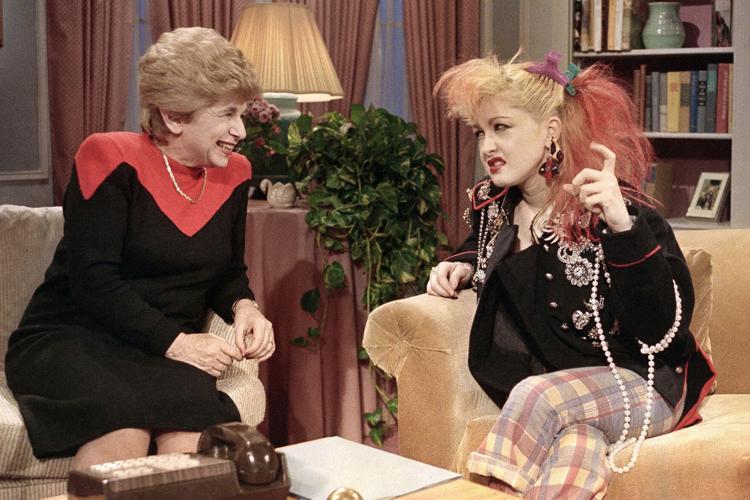
Sex therapist Dr. Ruth Westheimer, left, talks with rock singer Cyndi Lauper on Jan. 17, 1985, in New York.
In 1984, her radio program was nationally syndicated. A year later, she debuted in her own television program, “The Dr. Ruth Show,” which went on to win an Ace Award for excellence in cable television.
She also wrote a nationally syndicated advice column and appeared in videos produced by Playboy. She even had a series of calendars.
Westheimer appeared on shows including “The Tonight Show,” “The Ellen DeGeneres Show,” “The Dr. Oz Show” and “Late Night with David Letterman.” She played herself in episodes of “Quantum Leap” and “Love Boat: The Next Wave.”
Her books include “Sex for Dummies,” her autobiographical works “All in a Lifetime” (1987) and “Musically Speaking: A Life through Song” (2003). The documentary “Ask Dr. Ruth” aired in 2019.
She remained committed to teaching, with posts at several universities and a busy college lecture schedule. She also maintained a private practice.
She is survived by two children, Joel and Miriam, and four grandchildren.
Photos: Notable deaths in 2024
Glynis Johns
Updated
Glynis Johns, a Tony Award-winning stage and screen star who played the mother opposite Julie Andrews in the classic movie “Mary Poppins” and introduced the world to the bittersweet standard-to-be “Send in the Clowns” by Stephen Sondheim, died, Thursday, Jan. 4, 2023. She was 100.
Adan Canto
Updated
Adan Canto, the Mexican singer and actor best known for his roles in “X-Men: Days of Future Past” and “Agent Game” as well as the TV series “The Cleaning Lady,” “Narcos,” and “Designated Survivor,” died Monday, Jan. 8, 2024, after a private battle with appendiceal cancer. He was 42.
Bud Harrelson
Updated
Bud Harrelson, the scrappy and sure-handed shortstop who fought Pete Rose on the field during a playoff game and helped the New York Mets win an astonishing championship, died Thursday, Jan. 11, 2024. He was 79. The Mets said that Harrelson died at a hospice house in East Northport, New York after a long battle with Alzheimer's.
Dejan Milojevic

Golden State Warriors assistant coach Dejan Milojević, a mentor to two-time NBA MVP Nikola Jokic and a former star player in his native Serbia, died Wednesday, Jan. 17, 2024, after suffering a heart attack, the team announced. He was 46.
Jack Burke
Updated
Jack Burke Jr., the oldest living Masters champion who staged the greatest comeback ever at Augusta National for one of his two majors, died Friday, Jan. 19, 2024, in Houston. He was 100.
Mary Weiss
Updated
Mary Weiss, the lead singer of the 1960s pop group the Shangri-Las, whose hits included “The Leader of the Pack,” died Friday, Jan. 19, 2024, in Palm Springs, Calif. She was 75.
Norman Jewison
Updated
Norman Jewison, a three-time Oscar nominee who in 1999 received an Academy Award for lifetime achievement, died “peacefully” Saturday, Jan. 20, 2024, according to publicist Jeff Sanderson. He was 97.
Charles Osgood
Updated
Charles Osgood, who anchored “CBS Sunday Morning” for more than two decades, hosted the long-running radio program “The Osgood File” and was referred to as CBS News’ poet-in-residence, died Tuesday, Jan. 23, 2024. He was 91.
Melanie Safka
Updated
Melanie, a singer-songwriter behind 1970s hits including “Brand New Key,” died Tuesday, Jan. 23, 2024. She was 76. Born Melanie Safka, the singer rose through the New York folk scene and was one of only three solo women to perform at Woodstock. Her hits included “Lay Down” and “Look What They've Done to My Song Ma.”
Chita Rivera
Updated
Chita Rivera, the dynamic dancer, singer and actress who garnered 10 Tony nominations, winning twice, in a long Broadway career that forged a path for Latina artists, died Tuesday, Jan. 30, 2024. She was 91.
Carl Weathers
Updated
Carl Weathers, a former NFL linebacker who became a Hollywood action movie and comedy star, playing nemesis-turned-ally Apollo Creed in the “Rocky” movies, facing-off against Arnold Schwarzenegger in “Predator” and teaching golf in “Happy Gilmore,” died Thursday, Feb. 1, 2024. He was 76.
Wayne Kramer
Updated
Wayne Kramer, the co-founder of the protopunk Detroit band the MC5 that thrashed out such hardcore anthems as “Kick Out the Jams” and influenced everyone from the Clash to Rage Against the Machine, died Friday, Feb. 2, 2024. at Cedars-Sinai hospital in Los Angeles, according to Jason Heath, a close friend and executive director of Kramer's charity, Jail Guitar Doors. Heath said the cause of death was pancreatic cancer. He was 75.
Ian Lavender
Updated
Actor Ian Lavender, who played a hapless Home Guard soldier in the classic British sitcom “Dad’s Army,” died Monday, Feb. 5, 2024. He was 77.
Toby Keith
Updated
Country music singer-songwriter Toby Keith, whose pro-American anthems were both beloved and criticized, died Monday, Feb. 5, 2024. He was 62.
Henry Fambrough
Updated
Henry Fambrough, the last surviving original member of the iconic R&B group The Spinners, whose hits included “It’s a Shame,” “Could It Be I’m Falling In Love,” and “The Rubberband Man,” died Wednesday, Feb. 7, 2024, of natural causes, according to a statement from his spokeswoman. He was 85.
Bob Edwards
Updated
Bob Edwards, right, the news anchor many Americans woke up to as founding host of National Public Radio's “Morning Edition” for nearly a quarter-century, died Saturday, Feb. 10, 20243. He was 76.
He's shown here with sports announcer Red Barber.
Don Gullett
Updated
Don Gullett, a former major league pitcher and coach who played for four consecutive World Series champions in the 1970s, died Feb. 14. He was 73. He finished his playing career with a 109-50 record playing for the Cincinnati Reds and New York Yankees.
Lefty Driesell
Updated
Lefty Driesell, the coach whose folksy drawl belied a fiery on-court demeanor that put Maryland on the college basketball map and enabled him to rebuild several struggling programs, died Feb. 17, 2024, at age 92.
Andreas Brehme
Updated
Germany players celebrate after Andreas Brehme, left on ground, scores the winning goal in the World Cup soccer final match against Argentina, in the Olympic Stadium, in Rome, July 8, 1990. Andreas Brehme, who scored the only goal as West Germany beat Argentina to win the 1990 World Cup final, died Feb. 20, 2024. He was 63.
Golden Richards
Updated
Despite the effort of Denver Broncos defensive back Steve Foley (43), Dallas Cowboys wide receiver Golden Richards hauls in a touchdown pass during NFL football's Super Bowl 12 in New Orleans on Jan 15, 1978. Richards died Friday, Feb. 23, 2024, of congestive heart failure at his home in Murray, Utah. He was 73. Richards' nephew Lance Richards confirmed his death in a post on his Facebook page.
Richard Lewis
Updated
Comedian Richard Lewis attends an NBA basketball game in Los Angeles on Dec. 25, 2012. Lewis, an acclaimed comedian known for exploring his neuroses in frantic, stream-of-consciousness diatribes while dressed in all-black, leading to his nickname “The Prince of Pain,” died Feb. 27, 2024. He was 76. He died at his home in Los Angeles on Tuesday night after suffering a heart attack, according to his publicist Jeff Abraham.
Nikolai Ryzhkov
Updated
Former Soviet Prime Minister Nikolai Ryzhkov attends a session of the Federation Council, Russian parliament's upper house, in Moscow, Russia, Wednesday, June 25, 2014. Ryzhkov, former Soviet prime minister who presided over failed efforts to shore up the crumbling economy in the final years before the collapse of the USSR, died Feb. 28, 2024, at age 94.
Brian Mulroney
Updated
Brian Mulroney, the former prime minister of Canada, listens during a Senate Foreign Relations Committee hearing on the Canada-U.S.-Mexico relationship, Tuesday, Jan. 30, 2018, on Capitol Hill in Washington. Mulroney died at the age of 84 on Feb. 29, 2024.
Akira Toriyama

Akira Toriyama is pictured in 1982. Toriyama, the creator of one of Japan's best-selling “Dragon Ball” and other popular anime who influenced Japanese comics, died March 1, 2024. He was 68.
Iris Apfel
Updated
Iris Apfel, a textile expert, interior designer and fashion celebrity known for her eccentric style, died March 1, 2024, at 102.
Andy Russell
Updated
Andy Russell, the standout linebacker who was an integral part of the Pittsburgh Steelers’ evolution from perennial losers to champions, died Feb. 29, 2024. He was 82. Russell won two Super Bowls during a 12-year NFL career between 1963-76 that was briefly interrupted by a stint in the military. Russell played in 168 consecutive games and spent 10 years as a team captain. He was named to the Pro Bowl seven times. Russell remained active in the Pittsburgh community after retiring, writing several books and launching the Andy Russell Charitable Foundation.
Ed Ott

Pittsburgh Pirates' Ed Ott slides across home late out of reach of Orioles catcher Rick Dempsey to score the winning run in the ninth inning of Game 2 of the World Series at Baltimore, Oct. 11, 1979. Ott, a former major league catcher and coach who helped the Pittsburgh Pirates win the 1979 World Series, died March 3, 2024. He was 72. He batted .259 with 33 homers and 195 RBIs in 567 major league games. Ott and Steve Nicosia were the main catchers when the Pirates won it all in 1979.
Chris Mortensen

In a photo supplied by ESPN, Chris Mortensen appears on the set of Sunday NFL Countdown at ESPN's studios in Bristol, Conn., on Sept. 22, 2019. Mortensen, the award-winning journalist who covered the NFL for close to four decades, including 32 as a senior analyst at ESPN, died March 3, 2024. He was 72. Mortensen announced in 2016 that he he had been diagnosed with throat cancer. Even while undergoing treatment, he was the first to confirm the retirement of Hall of Fame quarterback Peyton Manning. Mortensen announced his retirement after the NFL draft last year so that he could “focus on my health, family and faith.”
Steve Lawrence

Singer Steve Lawrence, left, and his wife Eydie Gorme arrive at a black-tie gala called honoring Frank Sinatra in Las Vegas on May 30, 1998. Lawrence, a singer and top stage act who as a solo performer and in tandem with his wife Gorme kept Tin Pan Alley alive during the rock era, died Wednesday, March 6, 2024 at age 88. Gorme died on Aug. 10, 2013.
Naomi Barber King

Martin Luther King III, right, the son of Rev. Martin Luther King Jr., walks with his daughter Yolanda, and Naomi Barber King, left, the wife of Rev. King's brother, A.D., through an exhibition devoted to the awarding of the Nobel Peace Prize to King at the Martin Luther King Jr. Historical Site, Wednesday, Dec. 10, 2014, in Atlanta. Civil rights activist Naomi Barber King died Thursday, March 7, 2024, in Atlanta, according to family members. She was 92.
Paul Alexander
Updated
A Texas man who spent decades using an iron lung after contracting polio as a child died March 11, 2024, at the age of 78. Paul Alexander's longtime friend Daniel Spinks says Alexander died Monday at a Dallas hospital. Spinks called his friend one of the "bright stars of the world.” Friends of Alexander, who graduated from law school and had a career as an attorney, say he was a man who had a great joy for life. Alexander was a child when he began using an iron lung, a cylinder that encased his body as the air pressure in the chamber forced air in and out of his lungs.
Thomas P. Stafford
Updated
Astronaut Thomas P. Stafford stands near the NASA Motor Vessel Retriever during training Aug. 23, 1965, in the Gulf of Mexico. Stafford, who commanded a dress rehearsal flight for the 1969 moon landing and the first U.S.-Soviet space linkup, died March 18, 2024, at 93.
Chris Simon

New York Rangers' Chris Simon celebrates his second-period goal against the New York Islanders, Thursday, Feb. 26, 2004, at Nassau Coliseum in Uniondale, N.Y. Former NHL enforcer Chris Simon has died. He was 52. Simon died March 18, 2024, according to a spokesperson for the NHL Players' Association.
M. Emmet Walsh

M. Emmet Walsh arrives at the 2014 Film Independent Spirit Awards, March 1, 2014, in Santa Monica, Calif. Walsh, the character actor who brought his unmistakable face and unsettling presence to films including “Blood Simple” and “Blade Runner,” died March 19, 2024, at age 88, his manager said Wednesday.
Laurent de Brunhoff
Updated
Obit Angelos Baseball
Updated
Joe Lieberman
Updated
Democratic presidential candidate Al Gore, left, and his running mate, vice presidential candidate Sen. Joe Lieberman of Connecticut, wave to supporters Oct. 25, 2000, at a campaign rally in Jackson, Tenn. Lieberman died March 27, 2024. He was 82 and died Wednesday of complications from a fall. Lieberman nearly won the vice presidency on Democrat Al Gore's ticket in the disputed 2000 White House race. Eight years later, he came close to joining the GOP ticket as John McCain’s running mate. The Democrat-turned-independent stepped down from the Senate in January 2013 after 24 years. His independent streak often irked Senate Democrats he aligned with. Yet his support for gay rights, civil rights, abortion rights and environmental causes at times won him the praise of many liberals over the years.
Louis Gossett Jr.
Updated
Joe Flaherty
Updated
Former cast members of SCTV, from left, Dave Thomas, Joe Flaherty, Catherine O'Hara, Andrea Martin, foreground, Harold Ramis, Eugene Levy and Martin Short, pose at the U.S. Comedy Arts Festival on March 6, 1999, in Aspen, Colo. Flaherty, a founding member of the Canadian sketch series “SCTV,” died Monday, April 1, 2024 at age 82.
John Sinclair
Updated
John Sinclair talks at the John Sinclair Foundation Café and Coffeeshop, Dec. 26, 2018, in Detroit. Sinclair, a poet, music producer and counterculture figure whose lengthy prison sentence after a series of small-time pot busts inspired a John Lennon song and a star-studded 1971 concert to free him, has died at age 82. Sinclair died Tuesday, April 2, 2024 at Detroit Receiving Hospital of congestive heart failure following an illness, his publicist Matt Lee said.
Larry Lucchino

Boston Red Sox president Larry Lucchino, right, tips his cap to fans as majority owner John Henry holds the 2013 World Series championship trophy during a parade in celebration of the baseball team's win, Saturday, Nov. 2, 2013, in Boston. Larry Lucchino, the force behind baseball’s retro ballpark revolution and the transformation of the Boston Red Sox from cursed losers to World Series champions, has died. He was 78. Lucchino had suffered from cancer. The Triple-A Worcester Red Sox, his last project in a career that also included three major league baseball franchises and one in the NFL, confirmed his death on Tuesday, April 2, 2024.
Christopher Durang

Playwright Christopher Durang appears on stage with producers to accept the award for best play for "Vanya and Sonia and Masha and Spike" at the 67th Annual Tony Awards, on June 9, 2013 in New York. Also on stage are actors, background from left, Shalita Grant, Kristine Nielsen and Billy Magnussen. Durang died Tuesday, April 2, 2024, at his home in Pipersville, Pennsylvania, of complications from logopenic primary progressive aphasia. He was 75.
Jerry Grote
Updated
In this Oct. 16, 1969 file photo, New York Mets catcher Jerry Grote, right, embraces pitcher Jerry Koosman as Ed Charles, left, joins the celebration after the Mets defeated the Baltimore Orioles in the Game 5 to win the baseball World Series at New York's Shea Stadium. Grote, the catcher who helped transform the New York Mets from a perennial loser into the 1969 World Series champion, died Sunday, April 7, 2024. He was 81.
Schappell Twins
Updated
In this July 8, 2003 photo, Lori, left, and George Schappell, conjoined twins, are photographed in their Reading, Pa., apartment. Lori and George Schappell, who pursued separate careers, interests and relationships during lives that defied medical expectations, died April 7, 2024, at the Hospital of the University of Pennsylvania. They were 62.
Peter Higgs
Updated
The University of Edinburgh says Nobel prize-winning physicist Peter Higgs, who proposed the existence of a sub-atomic particle that came to be known as the Higgs boson, died April 8, 2024, at 94. Higgs predicted the existence of the particle in 1964. But it would be almost 50 years before the its existence could be confirmed at a particle collider in Switzerland called the Large Hadron Collider. Higgs’ work helps scientists understand of the most fundamental riddles of the universe: how the Big Bang created something out of nothing 13.7 billion years ago. Higgs won the 2013 Nobel Prize in Physics for his work, alongside Francois Englert of Belgium.
Ralph Puckett Jr.
Updated
O.J. Simpson

O.J. Simpson, left, grimaces June 15, 1995, in a Los Angeles courtroom as he famously tries on one of the leather gloves prosecutors say he wore the night his ex-wife Nicole Brown Simpson and Ron Goldman were murdered. Simpson, the decorated football star who was acquitted of charges he killed his former wife and her friend but wound up in prison years later in an unrelated case, died April 10, 2024. He was 76. His family made an announcement Thursday in a statement on Simpson's X account. Simpson said last year that he was battling prostate cancer. Simpson’s gridiron legacy was forever overshadowed by the 1994 knife slayings of Brown Simpson and Goldman. A criminal court jury found him not guilty of murder, but a separate civil trial jury found him liable. Simpson's nine-year prison stint in Nevada was for the armed robbery of two sports memorabilia dealers.
Eleanor Coppola

Francis Coppola and wife, Eleanor, pose July 16, 1991, in Los Angeles. Eleanor Coppola, who documented the making of some of her husband Francis Ford Coppola’s iconic films, including the infamously tortured production of “Apocalypse Now,” and who raised a family of filmmakers, has died. She was 87. Coppola died April 12, 2024, at home in Rutherford, California, her family announced in a statement. Eleanor, who grew in Orange County, California, met Francis while working as an assistant art director on his directorial debut, the Roger Corman-produced 1963 horror film “Dementia 13.” Their first-born, Gian-Carlo, quickly became a regular presence in his father’s films, as did their subsequent children, Roman, and Sofia. After acting in their father’s films and growing up on sets, all would go into the movies.
Robert MacNeil
Updated
Robert MacNeil, seen in February 1978, who created the even-handed, no-frills PBS newscast “The MacNeil-Lehrer NewsHour” in the 1970s and co-anchored the show for with his late partner, Jim Lehrer, for two decades, died April 12, 2024, at age 93.
Faith Ringgold

Artist Faith Ringgold poses for a portrait in front of a painted self-portrait during a press preview of her exhibition, "American People, Black Light: Faith Ringgold's Paintings of the 1960s" at the National Museum of Women in the Arts in Washington, June 19, 2013. Ringgold, an award-winning author and artist who broke down barriers for Black female artists and became famous for her richly colored and detailed quilts combining painting, textiles and storytelling, died Friday, April 12, 2024, at her home in Englewood, N.J. She was 93.
Steve Sloan

Alabama coach Bear Bryant, left, talks with his former star quarterback Steve Sloan, right, after practice in Miami for the Orange Bowl game New Years' night against Nebraska, Dec. 29, 1968. Former college coach and administrator Sloan, who played quarterback and served as athletic director at Alabama. has passed away. He was 79. Sloan died Sunday, April 14, 2024, after three months of memory care at Orlando Health Dr. P. Phillips Hospital, according to an obituary from former Alabama sports information director Wayne Atcheson.
Ken Holtzman

Oakland A's pitcher Ken Holtzman poses for a photo in March 1975. Holtzman, who pitched two no-hitters for the Chicago Cubs and helped the Oakland Athletics win three straight World Series championships in the 1970s, died April 14, 2024. He finished with a career record of 174-150 over 15 season with four teams and was the winningest Jewish pitcher in baseball history.
Carl Erskine

Carl Erskine, center, pictured with teammate Duke Snider, left, and manager Charley Dressen in 1952, after beating the Yankees 6-5 in Game 5 of the World Series at Yankee Stadium in New York, Oct. 5, 1952. Erskine, who pitched two no-hitters for the Brooklyn Dodgers and was a 20-game winner in 1953 when he struck out a then-record 14 in the World Series, has died. Among the last survivors from the celebrated Brooklyn teams of the 1950s, Erskine spent his entire major league career with the Dodgers. He helped them win five National League pennants from 1948-59. Erskine won Game 3 of the 1953 World Series, beating the Yankees 3-2. He appeared in five World Series, with the Dodgers beating the Yankees in 1955 for their only championship in Brooklyn. Erksine died April 16 in his hometown of Anderson, Indiana, according to a hospital official. He was 97.
Whitey Herzog
Updated
St. Louis Cardinals manager Whitey Herzog lets umpire John Shulock, right, know how he feels about Shulock's call on the tag attempt on Kansas City Royals Jim Sundberg by Cardinals catcher Tom Nieto, second from left, in the second inning of Game 5 of the 1985 World Series in St. Louis. Herzog, the gruff and ingenious Hall of Fame manager who guided the St. Louis Cardinals to three pennants and a World Series title and perfected an intricate, nail-biting strategy known as “Whiteyball,” has died. Herzog, affectionately nicknamed “The White Rat,” was a manager for 18 seasons, compiling an overall record of 1,281 wins and 1,125 losses. He was named Manager of the Year in 1985. Under Herzog, the Cardinals won pennants in 1982, 1985 and 1987 and won the World Series in 1982, when they edged the Milwaukee Brewers in seven games. He died April 15, 2024, and was 92.
Bob Graham

Senate Intelligence Committee Chairman Sen. Bob Graham, D-Fla., gestures as he answers questions regarding the ongoing security hearing on Capitol Hill, June 18, 2002, in Washington. Graham, who chaired the Intelligence Committee following the 2001 terrorist attacks and opposed the Iraq invasion, died April 16, 2024. He was 87. His family announced the death Tuesday in a statement posted on X by his daughter Gwen Graham. Graham served three terms in the Senate and two terms as Florida's governor. He made an unsuccessful bid for the 2004 Democratic presidential nomination, emphasizing his opposition to the Iraq invasion. But that bid was delayed by heart surgery in January 2003, and he was never able to gain enough traction with voters to catch up. He didn’t seek re-election in 2004 and was replaced by Republican Mel Martinez.
Dickey Betts
Updated
Mandisa
Updated
Contemporary Christian singer Mandisa, who appeared on “American Idol” and won a Grammy for her 2013 album “Overcomer,” died April 18, 2024. She was 47. Mandisa gained stardom after finishing ninth on “American Idol” in 2006. In 2014, she won a Grammy for best contemporary Christian music album for “Overcomer,” her fifth album. She spoke openly about her struggles with depression, releasing a memoir that detailed her experiences with severe depression, weight-related challenges, the coronavirus pandemic and her faith.
David Pryor

Roman Gabriel
Andrew Davis

Terry Anderson

Former hostage Terry Anderson waves to the crowd as he rides in a parade in Lorain, Ohio, June 22, 1992. Anderson, the globe-trotting Associated Press correspondent who became one of America’s longest-held hostages, died April 21, 2024. Anderson was snatched from a street in war-torn Lebanon in 1985 and held for nearly seven years. Anderson, who was tortured and chained to a wall, wrote about his experiences in the best-selling memoir, “Den of Lions.” After returning to the United States in 1991, Anderson gave public speeches, taught journalism and, at various times, operated a blues bar, Cajun restaurant, horse ranch and gourmet restaurant. He also struggled with post-traumatic stress disorder.
Bill Gladden
Updated
British army veteran Bill Gladden, who survived a glider landing on D-Day and a bullet that tore through his ankle a few days later, wanted to return to France for the 80th anniversary of the invasion so he could honor the men who didn’t come home. It was not to be. Gladden, one of the dwindling number of veterans who took part in the landings that kicked off the campaign to liberate Western Europe from the Nazis during World War II, died April 24, his family said. He was 100. With fewer and fewer veterans taking part each year, the ceremony may be one of the last big events marking the assault that began on June 6, 1944.
Duane Eddy
Updated
Duane Eddy, a pioneering guitar hero whose reverberating electric sound on instrumentals such as “Rebel Rouser,” “Forty Miles of Bad Road" and “Cannonball” helped put the twang in early rock ‘n’ roll and influenced George Harrison, Bruce Springsteen and countless other musicians, died April 30 at age 86. With his raucous rhythms, and backing hollers and hand claps, Eddy sold more than 100 million records worldwide, and mastered a distinctive sound based on the premise that a guitar’s bass strings sounded better on tape than the high ones.
Paul Auster

Author Paul Auster has died at age 77. Auster was a prolific, prize-winning man of letters and filmmaker known for such inventive narratives and meta-narratives as “The New York Trilogy” and “4 3 2 1." Auster’s death on April 30 was confirmed by his literary representatives. Auster completed more than 30 books, translated into dozens of languages. He never achieved major commercial success in the U.S., but he was widely admired overseas for his cosmopolitan worldview and erudite and introspective style. Auster’s novels were a mix of history, politics, genre experiments, existential quests and self-conscious references to writers and writing.
Dick Rutan

Co-pilots Dick Rutan, right, and Jeana Yeager, no relationship to test pilot Chuck Yeager, pose for a photo after a test flight over the Mojave Desert, Dec. 19, 1985. Rutan, a decorated Vietnam War pilot, who along with copilot Yeager completed one of the greatest milestones in aviation history: the first round-the-world flight with no stops or refueling, died late Friday, May 3, 2024. He was 85.
Steve Albini
Updated
Music producer Steve Albini, seen in his Chicago studio in 2014, produced albums by Nirvana, the Pixies and PJ Harvey. Albini died at 61. Brian Fox, an engineer at Albini’s studio, Electrical Audio, says Albini died after a heart attack May 7. In addition to his work on canonized rock albums such as Nirvana‘s “In Utero,” the Pixies’ breakthrough “Surfer Rosa,” and PJ Harvey’s “Rid of Me,” Albini was the frontman of the underground bands Big Black and Shellac. He dismissed the term “producer” and requested he be credited with “Recorded by Steve Albini."
Jimmy Johnson

San Francisco 49ers Hall of Fame football player Jimmy Johnson, left, is honored by owner Jed York before a 2011 game between against the St. Louis Rams in San Francisco.
Sean Burroughs
Updated
San Diego Padres third baseman Sean Burroughs fires a throw to first from his knees but is unable to get Los Angeles Dodgers' D. J. Houlton at first during the third inning of a baseball game June 22, 2005, in San Diego. Burroughs, a two-time Little League World Series champion who won an Olympic gold medal and went on to a major league career that was interrupted by substance abuse, has died. He was 43. The Los Angeles County Medical Examiner’s online records said Burroughs died Thursday, May 9, 2024, with the cause of death deferred.
Roger Corman

Producer Roger Corman poses in his Los Angeles office, May 8, 2013. Corman, the Oscar-winning “King of the Bs” who helped turn out such low-budget classics as “Little Shop of Horrors” and “Attack of the Crab Monsters” and gave many of Hollywood's most famous actors and directors an early break, died Thursday, May 9, 2024. He was 98.
A.J. Smith
Updated
A.J. Smith, a longtime NFL executive who was the winningest general manager in Chargers history, has died. He was 75. His son, Atlanta assistant general manager Kyle Smith, announced in a statement released by the Falcons that his father died May 12. Kyle Smith said his father had been battling prostate cancer for seven years. The Chargers won five division titles during Smith’s 10 seasons as GM. The franchise’s 98 wins, including the playoffs, were the sixth most in the league from 2003-12.
David Sanborn

Saxophone player David Sanborn performs during his concert at the Stravinski hall at the "Colours of Music night" during the 34th Montreux Jazz Festival in Montreux, Switzerland on July 10, 2000. Sanborn, the Grammy-winning saxophonist who played lively solos on such hits as David Bowie's “Young Americans” and James Taylor's “How Sweet It Is (To Be Loved By You)” and enjoyed his own highly successful recording career as a leading performer of contemporary jazz, died Sunday, May 12, 2024, at age 78.
Alice Munro
Updated
Nobel laureate Alice Munro has died. The Canadian literary giant who became one of the world’s most esteemed contemporary authors and one of history’s most honored short story writers was 92. Munro achieved stature rare for an art form traditionally placed beneath the novel. She was the first lifelong Canadian to win the Nobel and the first recipient cited exclusively for short fiction. Munro was little known beyond Canada until her late 30s but became one of the few short story writers to enjoy ongoing commercial success. A spokesperson for publisher Penguin Random House Canada said Munro died May 13 at home in Port Hope, Ontario.
Dabney Coleman
Updated
Dabney Coleman, the mustachioed character actor who specialized in smarmy villains like the chauvinist boss in “9 to 5” and the nasty TV director in “Tootsie,” died May 16. He was 92. For two decades Coleman labored in movies and TV shows as a talented but largely unnoticed performer. That changed abruptly in 1976 when he was cast as the incorrigibly corrupt mayor of the hamlet of Fernwood in “Mary Hartman, Mary Hartman,” a satirical soap opera. He won a Golden Globe for “The Slap Maxwell Story” and an Emmy Award for best supporting actor in Peter Levin’s 1987 small screen legal drama “Sworn to Silence.”
Iranian President Ebrahim Raisi

Iranian President Ebrahim Raisi listens to Turkish President Recep Tayyip Erdogan, not in photo, during a joint news conference following their meeting at the Presidential palace in Ankara, Turkey, Jan. 24, 2024. Iran’s President Ebrahim Raisi, foreign minister Hossein Amirabdollahian and others were found dead at the site of a helicopter crash site, state media reported Monday, May 20, 2024.
Jim Otto
Updated
Ivan Boesky

Jan. A.P. Kaczmarek

Jan. A.P. Kaczmarek poses with the Oscar for best original score for his work on "Finding Neverland" during the 77th Academy Awards, Feb. 27, 2005, in Los Angeles. Polish composer Kaczmarek, who won a 2005 Oscar for the movie “Finding Neverland,” has died on Tuesday, May 21, 2024, at age 71. Kaczmarek’s death was announced by Poland’s Music Foundation.
Carlie Colin
Updated
Train bassist and founding member Charlie Colin has died at 58. Colin’s sister confirmed the musician's death Wednesday to The Associated Press. Variety reported Colin slipped and fell in the shower while house-sitting for a friend in Brussels. Train formed in San Francisco in the early ’90s. Colin played on Train's first three records, 1998’s self-titled album, 2001’s “Drops of Jupiter” and 2003’s “My Private Nation.” The track “Drops of Jupiter (Tell Me)” hit No. 5 on the Billboard Hot 100. It also earned two Grammys. Colin left the band in 2003. He also worked with the Newport Beach Film Festival. Colin died May 22.
Morgan Spurlock

Documentary filmmaker Morgan Spurlock, an Oscar nominee whose most famous works skewered America’s food industry and who notably ate only at McDonald’s for a month to illustrate the dangers of a fast-food diet, has died of cancer. He was 53. Spurlock made a splash in 2004 with his groundbreaking film “Super Size Me,” and returned in 2019 with “Super Size Me 2: Holy Chicken!” — a sober look at an industry that processes 9 billion animals a year in America. Spurlock was a gonzo-like filmmaker who leaned into the bizarre and ridiculous. His stylistic touches included zippy graphics and amusing music. Spurlock died May 23.
Richard M. Sherman
Updated
Richard M. Sherman, one half of the prolific, award-winning pair of brothers who helped form millions of childhoods by penning classic Disney tunes, has died. He was 95. Sherman, along with his late brother Robert, wrote hundreds of songs together, including songs for “Mary Poppins,” “The Jungle Book” and “Chitty Chitty Bang Bang” — as well as the most-played tune on Earth, “It’s a Small World (After All).” The Walt Disney Co. announced that Sherman died Saturday due to age-related illness. The brothers won two Academy Awards for Walt Disney’s 1964 smash “Mary Poppins.” Robert Sherman died May 25 in London in 2012.
Bill Walton
Updated
Basketball Hall of Fame legend Bill Walton laughs during a practice session for the NBA All-Star basketball game in Cleveland, Feb. 19, 2022. Walton, who starred for John Wooden's UCLA Bruins before becoming a Basketball Hall of Famer and one of the biggest stars of basketball broadcasting, died Monday, May 27, 2024, the league announced on behalf of his family. He was 71.
Albert Ruddy
Updated
“The Godfather” producer Albert S. Ruddy died May 25 at 94. The Canadian-born producer and writer won Oscars for “The Godfather” and “Million Dollar Baby,” developed the raucous prison-sports comedy “The Longest Yard” and helped create the hit sitcom “Hogan’s Heroes." A spokesperson says Ruddy died Saturday at the UCLA Medical Center. Ruddy produced more than 30 movies and was on hand for the very top and the very bottom. “The Godfather” and “Million Dollar Baby” were box office hits and winners of best picture Oscars. But Ruddy also helped give us “Cannonball Run II” and “Megaforce,” nominees for Golden Raspberry awards for worst movie of the year.
Larry Allen
Updated
Janis Paige

Bob Hope and Janis Paige hug during the annual Christmas show in Saigon, Vietnam, Dec. 25, 1964. Paige, a popular actor in Hollywood and in Broadway musicals and comedies who danced with Fred Astaire, toured with Bob Hope and continued to perform into her 80s, died Sunday, June 2, 2024, of natural causes at her Los Angeles home, longtime friend Stuart Lampert said Monday, June 3.
Parnelli Jones
Updated
Parnelli Jones, the 1963 Indianapolis 500 winner, died June 4 at Torrance Memorial Medical Center after a battle with Parkinson’s disease, his son said. Jones was 90. At the time of his death, Jones was the oldest living winner of “The Greatest Spectacle in Racing.” Rufus Parnell Jones was born in Texarkana, Arkansas, in 1933 but moved to Torrance as a young child and never left. It was there that he became “Parnelli” because his given name of Rufus was too well known for him to compete without locals knowing that he wasn’t old enough to race.
Chet Walker
Updated
Boston Celtics' John Havlicek (17) is defended by Philadelphia 76ers' Chet Walker (25) during the first half of an NBA basketball playoff game April 14, 1968, in Boston. Walker, a seven-time All-Star forward who helped Wilt Chamberlain and the 76ers win the 1967 NBA title, died June 8. He was 84. The National Basketball Players Association confirmed Walker's death, according to NBA.com. The 76ers, Chicago Bulls and National Basketball Retired Players Association also extended their condolences on social media on Saturday, June 8, 2024.
The Rev. James Lawson Jr.
Updated
The Rev. James Lawson Jr. speaks Sept. 17, 2015, in Murfreesboro, Tenn. Lawson Jr., an apostle of nonviolent protest who schooled activists to withstand brutal reactions from white authorities as the Civil Rights Movement gained traction, has died, his family said Monday. He was 95. His family said Lawson died on Sunday after a short illness in Los Angeles, where he spent decades working as a pastor, labor movement organizer and university professor. Lawson was a close adviser to the Rev. Martin Luther King Jr., who called him “the leading theorist and strategist of nonviolence in the world.” Lawson met King in 1957, after spending three years in India soaking up knowledge about Mohandas K. Gandhi’s independence movement. King would travel to India himself two years later, but at the time, he had only read about Gandhi in books.
Jerry West
Updated
Basketball Hall of Fame inductee Jerry West, representing the 1960 USA Olympic Team, is seen Aug. 13, 2010. West Virginia has two obligatory display cases dedicated to the legendary former Mountaineer star.
Ron Simons
Updated
Actor and director Ron Simons, seen Jan. 23, 2011, during the 2011 Sundance Film Festival, died June 12. Simons turned into a formidable screen and stage producer, winning four Tony Awards and having several films selected at the Sundance Film Festival. He won Tonys for producing “Porgy and Bess,” “A Gentleman’s Guide to Love and Murder,” “Vanya and Sonia and Masha and Spike,” and “Jitney.” He also co-produced “Hughie,” with Forest Whitaker, “The Gin Game,” starring Cicely Tyson and James Earl Jones, “Ain’t Too Proud: The Life and Times of The Temptations,” an all-Black production of “A Streetcar Named Desire,” the revival of "for colored girls who have considered suicide/when the rainbow is enuf" and the original work “Thoughts of a Colored Man.” He was in the films “27 Dresses” and “Mystery Team,” as well as on the small screen in “The Resident,” “Law & Order,” “Law & Order: Criminal Intent” and “Law & Order: SVU.”
Bob Schul
Updated
Bob Schul of West Milton, Ohio, hits the tape Oct. 18, 1964, to win the 5,000 meter run at the Olympic Games in Tokyo. Schul, the only American distance runner to win the 5,000 meters at the Olympics, died June 16. He was 86. His death was announced by Miami University in Ohio, where Schul shined on the track and was inducted into the school’s hall of fame in 1973. Schul predicted gold leading into the 1964 Tokyo Olympics and followed through with his promise. On a rainy day in Japan, he finished the final lap in a blistering 54.8 seconds to sprint to the win. His white shorts were covered in mud at the finish. He was inducted into the USA Track and Field Hall of Fame in 1991. He also helped write a book called “In the Long Run.”
Willie Mays
Updated
San Francisco Giants superstar Willie Mays poses for a photo during baseball spring training in 1972. Mays, the electrifying “Say Hey Kid” whose singular combination of talent, drive and exuberance made him one of baseball’s greatest and most beloved players, died June 18. He was 93. The center fielder, who began his professional career in the Negro Leagues in 1948, had been baseball’s oldest living Hall of Famer. He was voted into the Hall in 1979, his first year of eligibility, and in 1999 followed only Babe Ruth on The Sporting News’ list of the game’s top stars. The Giants retired his uniform number, 24, and set their AT&T Park in San Francisco on Willie Mays Plaza. Mays died two days before a game between the Giants and St. Louis Cardinals to honor the Negro Leagues at Rickwood Field in Birmingham, Alabama. Over 23 major league seasons, virtually all with the New York/San Francisco Giants but also including one in the Negro Leagues, Mays batted .301, hit 660 home runs, totaled 3,293 hits, scored more than 2,000 runs and won 12 Gold Gloves. He was Rookie of the Year in 1951, twice was named the Most Valuable Player and finished in the top 10 for the MVP 10 other times. His lightning sprint and over-the-shoulder grab of an apparent extra base hit in the 1954 World Series remains the most celebrated defensive play in baseball history. For millions in the 1950s and ’60s and after, the smiling ballplayer with the friendly, high-pitched voice was a signature athlete and showman during an era when baseball was still the signature pastime. Awarded the Medal of Freedom by President Barack Obama in 2015, Mays left his fans with countless memories. But a single feat served to capture his magic — one so untoppable it was simply called “The Catch.”
Donald Sutherland
Updated
Actor Donald Sutherland appears Oct. 13, 2017, at the Academy of Motion Picture Arts and Sciences in Beverly Hills, Calif. Sutherland, the Canadian actor whose wry, arrestingly off-kilter screen presence spanned more than half a century of films from “M.A.S.H.” to “The Hunger Games,” died June 20. He was 88. Kiefer Sutherland said on X he believed his father was one of the most important actors in the history of film: “Never daunted by a role, good, bad or ugly. He loved what he did and did what he loved, and one can never ask for more than that.” The tall and gaunt Sutherland, who flashed a grin that could be sweet or diabolical, was known for offbeat characters like Hawkeye Pierce in Robert Altman's "M.A.S.H.," the hippie tank commander in "Kelly's Heroes" and the stoned professor in "Animal House." Before transitioning into a long career as a respected character actor, Sutherland epitomized the unpredictable, antiestablishment cinema of the 1970s. He never stopped working, appearing in nearly 200 films and series. Over the decades, Sutherland showed his range in more buttoned-down — but still eccentric — roles in Robert Redford's "Ordinary People" and Oliver Stone's "JFK." More, recently, he starred in the “Hunger Games” films. A memoir, “Made Up, But Still True,” is due out in November.
Bill Cobbs
Updated
Actor Bill Cobbs, a cast member in "Get Low," arrives July 27, 2010, at the premiere of the film in Beverly Hills, Calif. Cobbs, the veteran character actor who became a ubiquitous and sage screen presence as an older man, died June 25. He was 90. A Cleveland native, Cobbs acted in such films as “The Hudsucker Proxy,” “The Bodyguard” and “Night at the Museum.” He made his first big-screen appearance in a fleeting role in 1974's “The Taking of Pelham One Two Three." He became a lifelong actor with some 200 film and TV credits. The lion share of those came in his 50s, 60s, and 70s, as filmmakers and TV producers turned to him again and again to imbue small but pivotal parts with a wizened and worn soulfulness. Cobbs appeared on television shows including “The Sopranos," “The West Wing,” “Sesame Street” and “Good Times.” He was Whitney Houston's manager in “The Bodyguard” (1992), the mystical clock man of the Coen brothers' “The Hudsucker Proxy” (1994) and the doctor of John Sayles' “Sunshine State” (2002). He played the coach in “Air Bud” (1997), the security guard in “Night at the Museum” (2006) and the father on “The Gregory Hines Show." Cobbs rarely got the kinds of major parts that stand out and win awards. Instead, Cobbs was a familiar and memorable everyman who left an impression on audiences, regardless of screen time. He won a Daytime Emmy Award for outstanding limited performance in a daytime program for the series “Dino Dana” in 2020.
Kinky Friedman
Updated
Independent gubernatorial candidate Kinky Friedman speaks with the media Nov. 7, 2009, at his campaign headquarters in Austin, Texas. The singer, songwriter, satirist and novelist, who led the alt-country band Texas Jewboys, toured with Bob Dylan, sang with Willie Nelson, and dabbled in politics with campaigns for Texas governor and other statewide offices, died June 27. He was 79 and had suffered from Parkinson's disease. Often called “The Kinkster" and sporting sideburns, a thick mustache and cowboy hat, Friedman earned a cult following and reputation as a provocateur throughout his career across musical and literary genres. In the 1970s, his satirical country band Kinky Friedman and the Texas Jewboys wrote songs with titles such as “They Ain't Makin' Jews Like Jesus Anymore” and “Get Your Biscuits in the Oven and Your Buns in Bed.” Friedman joined part of Bob Dylan's Rolling Thunder Revue tour in 1976. By the 1980s, Friedman was writing crime novels that often included a version of himself, and he wrote a column for Texas Monthly magazine in the 2000s. Friedman's run at politics brought his brand of irreverence to the serious world of public policy. In 2006, Friedman ran for governor as an independent in a five-way race that included incumbent Republican Rick Perry. Friedman launched his campaign against the backdrop of the Alamo.
Martin Mull

Martin Mull participates in "The Cool Kids" panel during the Fox Television Critics Association Summer Press Tour on Aug. 2, 2018, at The Beverly Hilton hotel in Beverly Hills, Calif. Mull, whose droll, esoteric comedy and acting made him a hip sensation in the 1970s and later a beloved guest star on sitcoms including “Roseanne” and “Arrested Development,” died June 28. He was 80. Mull, who was also a guitarist and painter, came to national fame with a recurring role on the Norman Lear-created satirical soap opera “Mary Hartman, Mary Hartman,” and the starring role in its spinoff, “Fernwood Tonight." His first foray into show business was as a songwriter, penning the 1970 semi-hit “A Girl Named Johnny Cash” for singer Jane Morgan. He would combine music and comedy in an act that he brought to hip Hollywood clubs in the 1970s. Mull often played slightly sleazy, somewhat slimy and often smarmy characters as he did as Teri Garr's boss and Michael Keaton's foe in 1983's “Mr. Mom.” He played Colonel Mustard in the 1985 movie adaptation of the board game “Clue,” which, like many things Mull appeared in, has become a cult classic. The 1980s also brought what many thought was his best work, “A History of White People in America,” a mockumentary that first aired on Cinemax. Mull co-created the show and starred as a “60 Minutes” style investigative reporter investigating all things milquetoast and mundane. Willard was again a co-star. In the 1990s he was best known for his recurring role on several seasons on “Roseanne,” in which he played a warmer, less sleazy boss to the title character, an openly gay man whose partner was played by Willard, who died in 2020. Mull would later play private eye Gene Parmesan on “Arrested Development,” a cult-classic character on a cult-classic show, and would be nominated for an Emmy, his first, in 2016 for a guest run on “Veep.”
Robert Towne
Updated
Screenwriter Robert Towne poses at The Regency Hotel, March 7, 2006, in New York. Towne, the Oscar-winning screenplay writer of "Shampoo," "The Last Detail" and other acclaimed films whose work on "Chinatown" became a model of the art form and helped define the jaded allure of his native Los Angeles, died Monday, July 1, 2024, surrounded by family at his home in Los Angeles, said publicist Carri McClure. She declined to comment on any cause of death.
Vic Seixas
Updated
Vic Seixas of the United States backhands a volley from Denmark's Jurgen Ulrich in the first round of men's singles match at Wimbledon, England, June 27, 1967. Vic Seixas, a Wimbledon winner and tennis Hall of Famer who was the oldest living Grand Slam champion, has died July 5 at the age of 100. The International Tennis Hall of Fame announced Seixas’ death on Saturday July 6, 2024, based on confirmation from his daughter Tori.
James Inhofe
Updated
In this June 30, 2020, file photo, Sen. James Inhofe, R-Okla., speaks to reporters following a GOP policy meeting on Capitol Hill in Washington. Former Sen. Jim Inhofe of Oklahoma died July 9. He was 89. The family says in a statement that the Republican had a stroke during the July Fourth holiday and died Tuesday morning. Inhofe was a powerful fixture in state politics for decades. He doubted that climate change was caused by human activity, calling the theory “the greatest hoax ever perpetrated on the American people.” As Oklahoma’s senior U.S. senator, he was a staunch supporter of the state’s military installations. He was elected to a fifth Senate term in 2020 and stepped down in early 2023.
Joe Bonsall
Updated
The Oak Ridge Boys, from left, Joe Bonsall, Richard Sterban, Duane Allen and William Lee Golden hold their awards for Top Vocal Group and Best Album of the Year for "Ya'll Come Back Saloon", during the 14th Annual Academy of Country Music Awards in Los Angeles, Calif., May 3, 1979. Bonsall died on July 9, 2024, from complications of Amyotrophic Lateral Sclerosis in Hendersonville, Tenn. He was 76. A Philadelphia native and resident of Hendersonville, Tennessee, Bonsall joined the Oak Ridge Boys in 1973, which originally formed in the 1940s. He saw the band through its golden period in the '80s and beyond, which included their signature 1981 song “Elvira.” The hit marked a massive crossover moment for the group, reaching No. 1 on the country chart and No. 5 on Billboard’s all-genre Hot 100. The group is also known for such hits as 1982’s “Bobbie Sue."
Shelley Duvall
Updated
Shelley Duvall poses for photographers at the 30th Cannes Film Festival in France, May 27, 1977. Duvall, whose wide-eyed, winsome presence was a mainstay in the films of Robert Altman and who co-starred in Stanley Kubrick's “The Shining,” died July 11. She was 75.
Dr. Ruth Westheimer
Updated
Dr. Ruth Westheimer holds a copy of her book "Sex for Dummies" at the International Frankfurt Book Fair 'Frankfurter Buchmesse' in Frankfurt, Germany, Thursday, Oct. 11, 2007. Westheimer, the sex therapist who became a pop icon, media star and best-selling author through her frank talk about once-taboo bedroom topics, died on July 12, 2024. She was 96.
Richard Simmons
Updated
Richard Simmons sits for a portrait in Los Angeles, June 23, 1982. Simmons, a fitness guru who urged the overweight to exercise and eat better, died July 13 at the age of 76. Simmons was a court jester of physical fitness who built a mini-empire in his trademark tank tops and short shorts by urging the overweight to exercise and eat better. Simmons was a former 268-pound teen who shared his hard-won weight loss tips as the host of the Emmy-winning daytime “Richard Simmons Show" and the “Sweatin' to the Oldies” line of exercise videos, which became a cultural phenomenon.
Jacoby Jones
Updated
Former NFL receiver Jacoby Jones died July 14 at age 40. Jones' 108-yard kickoff return in 2013 remains the longest touchdown in Super Bowl history. The Houston Texans were Jones’ team for the first five seasons of his career. They announced his death on Sunday. In a statement released by the NFL Players Association, his family said he died at his home in New Orleans. A cause of death was not given. Jones played from 2007-15 for the Texans, Baltimore Ravens, San Diego Chargers and Pittsburgh Steelers. He made several huge plays for the Ravens during their most recent Super Bowl title season, including that kick return.
Shannen Doherty
Updated
The "Beverly Hills, 90210" star whose life and career were roiled by tabloid stories, Shannen Doherty died July 13 at 53. Doherty's publicist said the actor died Saturday following years with breast cancer. Catapulted to fame as Brenda in “Beverly Hills, 90210,” she worked in big-screen films including "Mallrats" and "Jay and Silent Bob Strike Back" and in TV movies including "A Burning Passion: The Margaret Mitchell Story," in which she played the "Gone with the Wind" author. Doherty co-starred with Holly Marie Combs and Alyssa Milano in the series “Charmed” from 1998-2001; appeared in the “90210” sequel series seven years later and competed on “Dancing with the Stars” in 2010.
James Sikking
Updated
Actor James Sikking poses for a photograph at the Los Angeles gala celebrating the 20th anniversary of the National Organization for Women, Dec. 1, 1986. Sikking, who starred as a hardened police lieutenant on “Hill Street Blues” and as the titular character's kindhearted dad on “Doogie Howser, M.D.,” died July 13 of complications from dementia, his publicist Cynthia Snyder said in a statement. He was 90.
Pat Williams
Updated
Pat Williams chats with media before the 2004 NBA draft in Orlando, Fla. Williams, a co-founder of the Orlando Magic and someone who spent more than a half-century working within the NBA, died July 17 from complications related to viral pneumonia. The team announced the death Wednesday. Williams was 84. He started his NBA career as business manager of the Philadelphia 76ers in 1968, then had stints as general manager of the Chicago Bulls, the Atlanta Hawks and the 76ers — helping that franchise win a title in 1983. Williams was later involved in starting the process of bringing an NBA team to Orlando. The league’s board of governors granted an expansion franchise in 1987, and the team began play in 1989.
Lou Dobbs
Updated
Lou Dobbs speaks Feb. 24, 2017, at the Conservative Political Action Conference in Oxon Hill, Md. Dobbs, the conservative political pundit and veteran cable TV host who was a founding anchor for CNN and later was a nightly presence on Fox Business Network for more than a decade, died July 18. He was 78. His death was announced in a post on his official X account, which called him a “fighter till the very end – fighting for what mattered to him the most, God, his family and the country.” He hosted “Lou Dobbs Tonight” on Fox from 2011 to 2021, following two separate stints at CNN. No cause of death was given.
Bob Newhart
Updated
Bob Newhart, center, poses with members of the cast and crew of the "Bob Newhart Show," from top left, Marcia Wallace, Bill Daily, Jack Riley, and, Suzanne Pleshette, foreground left, and Dick Martin at TV Land's 35th anniversary tribute to "The Bob Newhart Show" on Sept. 5, 2007, in Beverly Hills, Calif. Newhart has died at age 94. Jerry Digney, Newhart’s publicist, says the actor died July 18 in Los Angeles after a series of short illnesses. The accountant-turned-comedian gained fame with a smash album and became one of the most popular TV stars of his time. Newhart was a Chicago psychologist in “The Bob Newhart Show” in the 1970s and a Vermont innkeeper on “Newhart” in the 1980s. Both shows featured a low-key Newhart surrounded by eccentric characters. The second had a twist ending in its final show — the whole series was revealed to have been a dream by the psychologist he played in the other show.
Cheng Pei-Pei
Updated
Cheng Pei-pei, a Chinese-born martial arts film actor who starred in Ang Lee’s “Crouching Tiger, Hidden Dragon,” died July 17 at age 78. Her family says Cheng, who had been diagnosed with a rare illness with symptoms similar to Parkinson’s disease, passed away Wednesday at home surrounded by her loved ones. The Shanghai-born film star became a household name in Hong Kong, once dubbed the Hollywood of the Far East, for her performances in martial arts movies in the 1960s. She played Jade Fox, who uses poisoned needles, in “Crouching Tiger, Hidden Dragon,” which was released in 2000, grossed $128 million in North America and won four Oscars.
Abdul 'Duke' Fakir
Updated
Abdul “Duke” Fakir holds his life time achievement award backstage at the 51st Annual Grammy Awards on Feb. 8, 2009, in Los Angeles. The last surviving original member of the Four Tops died July 22. Abdul “Duke” Fakir was 88. He was a charter member of the Motown group along with lead singer Levi Stubbs, Renaldo “Obie" Benson and Lawrence Payton. Between 1964 and 1967, the Tops had 11 top 20 hits and two No. 1′s: “I Can’t Help Myself (Sugar Pie Honey Bunch)” and the operatic classic “Reach Out I’ll Be There.” Other songs, often stories of romantic pain and longing, included “Baby I Need Your Loving,” “Standing in the Shadows of Love,” “Bernadette” and “Just Ask the Lonely.”
Bernice Johnson Reagon
Updated
Sculptress Elizabeth Catlett, left, then-Washington D.C. Mayor Sharon Pratt Dixon, center, and then-curator, division of community life, Smithsonian institution Bernice Johnson Reagon chat during the reception at the Candace awards on June 25, 1991 in New York. Reagon, a musician and scholar who used her rich, powerful contralto voice in the service of the American Civil Rights Movement and human rights struggles around the world, died on July 16, 2024, according to her daughter's social media post. She was 81.
John Mayall
Updated
John Mayall, the British blues musician whose influential band the Bluesbreakers was a training ground for Eric Clapton, Mick Fleetwood and many other superstars, died July 22. He was 90. He is credited with helping develop the English take on urban, Chicago-style rhythm and blues that played an important role in the blues revival of the late 1960s. A statement on Mayall's official Instagram page says he died Monday at his home in California. Though Mayall never approached the fame of some of his illustrious alumni, he was still performing in his late 80s, pounding out his version of Chicago blues.
Erica Ash
Updated
Jack Russell
Updated
Jack Russell, the lead singer of the bluesy '80s metal band Great White whose hits included “Once Bitten Twice Shy” and “Rock Me” and was fronting his band the night 100 people died in a 2003 nightclub fire in Rhode Island, died Wednesday, Aug. 7, 2024. He was 63.
Chi Chi Rodriguez
Updated
Juan “Chi Chi” Rodriguez, a Hall of Fame golfer whose antics on the greens and inspiring life story made him among the sport’s most popular players during a long professional career, died Thursday, Aug. 8, 2024.
Susan Wojcicki
Updated
Susan Wojcicki, the former YouTube chief executive officer and longtime Google executive, died Friday, Aug. 9, 2024, after suffering with non small cell lung cancer for the past two years. She was 56.
Frank Selvy
Updated
Frank Selvy, an All-America guard at Furman who scored an NCAA Division I-record 100 points in a game and later played nine NBA seasons, died Tuesday, Aug. 13, 2024. He was 91.
Wally Amos

Wallace “Wally” Amos, the creator of the cookie empire that took his name and made it famous and who went on to become a children’s literacy advocate, died Tuesday, Aug. 13, 2024, from complications with dementia. He was 88.
Gena Rowlands
Updated
Gena Rowlands, hailed as one of the greatest actors to ever practice the craft and a guiding light in independent cinema as a star in groundbreaking movies by her director husband, John Cassavetes, and who later charmed audiences in her son's tear-jerker “The Notebook,” died Wednesday, Aug. 14, 2024. She was 94.
Peter Marshall
Updated
Peter Marshall, the actor and singer turned game show host who played straight man to the stars for 16 years on “The Hollywood Squares,” died. Thursday, Aug. 15, 2024 He was 98.
Alain Delon
Updated
Alain Delon, the internationally acclaimed French actor who embodied both the bad guy and the policeman and made hearts throb around the world, died Sunday, Aug. 18, 2024. He was 88.
Phil Donahue

Phil Donahue, whose pioneering daytime talk show launched an indelible television genre that brought success to Oprah Winfrey, Montel Williams, Ellen DeGeneres and many others, died Sunday, Aug. 18, 2024, after a long illness. He was 88.
Al Attles

Al Attles, a Hall of Famer who coached the 1975 NBA champion Warriors and spent more than six decades with the organization as a player, general manager and most recently team ambassador, died Tuesday, Aug. 20, 2024. He was 87.
John Amos

John Amos, who starred as the family patriarch on the hit 1970s sitcom “Good Times” and earned an Emmy nomination for his role in the seminal 1977 miniseries “Roots,” died Wednesday, Aug. 21, 2024. He was 84.
James Darren

James Darren, a teen idol who helped ignite the 1960s surfing craze as a charismatic beach boy paired off with Sandra Dee in the hit film “Gidget,” died Monday, Sept. 2, 2024. He was 88.
James Earl Jones
Updated
James Earl Jones, who overcame racial prejudice and a severe stutter to become a celebrated icon of stage and screen has died. He was 93. His agent, Barry McPherson, confirmed Jones died Sept. 9 at home. Jones was a pioneering actor who eventually lent his deep, commanding voice to CNN, “The Lion King” and Darth Vader. Working deep into his 80s, he won two Emmys, a Golden Globe, two Tony Awards, a Grammy, the National Medal of Arts, the Kennedy Center Honors and was given an honorary Oscar and a special Tony for lifetime achievement. In 2022, a Broadway theater was renamed in his honor.
Frankie Beverly

Frankie Beverly, who with his band Maze inspired generations of fans with his smooth, soulful voice and lasting anthems including “Before I Let Go,” has died. He was 77. His family said in a post on the band’s website and social media accounts that Beverly died Sept. 10. In the post, which asked for privacy, the family said “he lived his life with a pure soul, as one would say, and for us, no one did it better.” The post did not say his cause of death or where he died. Beverly, whose songs include “Joy and Pain,” “Love is the Key,” and “Southern Girl,” finished his farewell “I Wanna Thank You Tour” in his hometown of Philadelphia in July.
Joe Schmidt
Updated
Joe Schmidt, the Hall of Fame linebacker who helped the Detroit Lions win NFL championships in 1953 and 1957 and later coached the team, has died. He was 92. The Lions said family informed the team Schmidt died Sept. 11. A cause of death was not provided. One of pro football’s first great middle linebackers, Schmidt played his entire NFL career with the Lions from 1953-65. An eight-time All-Pro, he was enshrined into the Pro Football Hall of Fame in 1973 and the college football version in 2000. Born in Pittsburgh, Schmidt played college football in his hometown at Pitt.
Chad McQueen

Tito Jackson
Updated
JD Souther
Updated
John David “JD” Souther has died. He was a prolific songwriter and musician whose collaborations with the Eagles and Linda Ronstadt helped shape the country-rock sound that took root in Southern California in the 1970s. Souther joined in on some of the Eagles’ biggest hits, such as “Best of My Love,” “New Kid in Town,” and “Heartache Tonight." The Songwriters Hall of Fame inductee also collaborated with James Taylor, Bob Seger, Bonnie Raitt and many more. His biggest hit as a solo artist was “You’re Only Lonely.” He was about to tour with Karla Bonoff. Souther died Sept. 17 at his home in New Mexico, at 78. In this photo, JD Souther and Alison Krauss attend the Songwriters Hall of Fame 44th annual induction and awards gala on Thursday, June 13, 2013 in New York.
Dan Evans
Updated
Sen. Dan Evans stands with his three sons, from left, Mark, Bruce and Dan Jr., after he won the election for Washington's senate seat in Seattle, Nov. 8, 1983. Evans, a former Washington state governor and a U.S. Senator, died Sept. 20. The popular Republican was 98. He served as governor from 1965 to 1977, and he was the keynote speaker at the 1968 National Republican Convention. In 1983, Evans was appointed to served out the term of Democratic Sen. Henry “Scoop” Jackson after he died in office. Evans opted not to stand for election in 1988, citing the “tediousness" of the Senate. He later served as a regent at the University of Washington, where the Daniel J. Evans School of Public Policy and Governance bears his name.
Mercury Morris
Updated
Eugene “Mercury” Morris, who starred for the unbeaten 1972 Miami Dolphins as part of a star-studded backfield and helped the team win two Super Bowl titles, died Sept. 21. He was 77. The team on Sunday confirmed the death of Morris, a three-time Pro Bowl selection. In a statement, his family said his “talent and passion left an indelible mark on the sport.” Morris was the starting halfback and one of three go-to runners that Dolphins coach Don Shula utilized in Miami’s back-to-back title seasons of 1972 and 1973, alongside Pro Football Hall of Famer Larry Csonka and Jim Kiick. Morris led the Dolphins in rushing touchdowns in both of those seasons.
John Ashton

John Ashton, the veteran character actor who memorably played the gruff but lovable police detective John Taggart in the “Beverly Hills Cop” films, died Thursday, Sept. 26, 2024. He was 76.
Maggie Smith

Kris Kristofferson

Kris Kristofferson, a Rhodes scholar with a deft writing style and rough charisma who became a country music superstar and an A-list Hollywood actor, died Saturday, Sept. 28, 2024. He was 88.
Drake Hogestyn
Updated
Drake Hogestyn, the “Days of Our Lives” star who appeared on the show for 38 years, died Saturday, Sept. 28, 2024. He was 70.
Ron Ely

Ron Ely, the tall, musclebound actor who played the title character in the 1960s NBC series “Tarzan,” died Sunday, Sept. 29, 2024, at age 86.
Dikembe Mutombo
Updated
Dikembe Mutombo, a Basketball Hall of Famer who was one of the best defensive players in NBA history and a longtime global ambassador for the game, died Monday, Sept. 30, 2024, from brain cancer, the league announced. He was 58.
Frank Fritz

Frank Fritz, left, part of a two-man team who drove around the U.S. looking for antiques and collectibles to buy and resell on the reality show “American Pickers,” died Monday, Sept. 30, 2024. He was 60.
He's shown here with co-host Mike Wolfe at the A+E Networks 2015 Upfront in New York on April 30, 2015.
Pete Rose

Pete Rose, baseball’s career hits leader and fallen idol who undermined his historic achievements and Hall of Fame dreams by gambling on the game he loved and once embodied, died Monday, Sept. 30, 2024. He was 83.
Cissy Houston

Cissy Houston, the mother of Whitney Houston and a two-time Grammy winner who performed alongside superstar musicians like Elvis Presley and Aretha Franklin, died Monday, Oct. 7, 2024, in her New Jersey home. She was 91.
Ethel Kennedy

Ethel Kennedy, the wife of Sen. Robert F. Kennedy, who raised their 11 children after he was assassinated and remained dedicated to social causes and the family’s legacy for decades thereafter, died on Thursday, Oct. 10, 2024, her family said. She was 96.
Liam Payne
Updated
Former One Direction singer Liam Payne, 31, whose chart-topping British boy band generated a global following of swooning fans, was found dead Wednesday, Oct. 16, 2024, after falling from a hotel balcony in Buenos Aires, local officials said. He was 31.
Mitzi Gaynor

Mitzi Gaynor, among the last survivors of the so-called golden age of the Hollywood musical, died of natural causes in Los Angeles on Thursday, Oct. 17, 2024. She was 93.
Fernando Valenzuela

Fernando Valenzuela, the Mexican-born phenom for the Los Angeles Dodgers who inspired “Fernandomania” while winning the NL Cy Young Award and Rookie of the Year in 1981, died Tuesday, Oct. 22, 2024. He was 63.
Jack Jones

Jack Jones, a Grammy-winning crooner known for “The Love Boat” television show theme song, died, Wednesday, Oct. 23, 2024. He was 86.
Phil Lesh

Phil Lesh, a founding member of the Grateful Dead, died Friday, Oct. 25, 2024, at age 84.
Teri Garr

Teri Garr, the quirky comedy actor who rose from background dancer in Elvis Presley movies to co-star of such favorites as "Young Frankenstein" and "Tootsie," died Tuesday, Oct 29, 2024. She was 79.
Quincy Jones

Quincy Jones, the multitalented music titan whose vast legacy ranged from producing Michael Jackson’s historic “Thriller” album to writing prize-winning film and television scores and collaborating with Frank Sinatra, Ray Charles and hundreds of other recording artists, died Sunday, Nov 3, 2024. He was 91
Bobby Allison

Bobby Allison, founder of racing’s “Alabama Gang” and a NASCAR Hall of Famer, died Saturday, Nov. 9, 2024. He was 86.
Song Jae-lim

Song Jae-lim, a South Korean actor known for his roles in K-dramas “Moon Embracing the Sun” and “Queen Woo,” was found dead at his home in capital Seoul, Tuesday, Nov. 12, 2024. He was 39.
Timothy West

British actor Timothy West, who played the classic Shakespeare roles of King Lear and Macbeth and who in recent years along with his wife, Prunella Scales, enchanted millions of people with their boating exploits on Britain's waterways, died Tuesday, Nov 12, 2024. He was 90.
Bela Karolyi

Bela Karolyi, the charismatic if polarizing gymnastics coach who turned young women into champions and the United States into an international power in the sport, died Friday, Nov. 15, 2024. He was 82.
Arthur Frommer

Arthur Frommer, whose "Europe on 5 Dollars a Day" guidebooks revolutionized leisure travel by convincing average Americans to take budget vacations abroad, died Monday, Nov. 18, 2024. He was 95.
Bob Love

Former Chicago Bulls forward Bob Love, a three-time All-Star who spent 11 years in the NBA, died Monday, Nov. 18, 2024. He was 81.
Chuck Woolery

Chuck Woolery, the affable, smooth-talking game show host of “Wheel of Fortune,” “Love Connection” and “Scrabble” who later became a right-wing podcaster, skewering liberals and accusing the government of lying about COVID-19, died Saturday, Nov. 23, 2024. He was 83.
Barbara Taylor Bradford

Barbara Taylor Bradford, a British journalist who became a publishing sensation in her 40s with the saga "A Woman of Substance" and wrote more than a dozen other novels that sold tens of millions of copies, died Sunday, Nov. 24, 2024. She was 91.
Rickey Henderson

Hall of Famer Rickey Henderson, the brash speedster who shattered stolen base records and redefined baseball's leadoff position, died Friday, Dec. 20, 2024. He was 65.
Greg Gumbel
Updated
Greg Gumbel, a longtime CBS sportscaster who broke barriers during his career calling some of the biggest sporting events, died from cancer, according to a statement from his family released by the network on Friday. He was 78.
Jimmy Carter
Updated
Jimmy Carter, the peanut farmer who won the presidency in the wake of the Watergate scandal and Vietnam War, endured humbling defeat after one tumultuous term and then redefined life after the White House as a global humanitarian, died Sunday, Jan. 29, 2024. He was 100 years old.
Linda Lavin
Updated
Linda Lavin, a Tony Award-winning stage actor who became a working class icon as a paper-hat wearing waitress on the TV sitcom “Alice,” died Sunday, Dec. 29, 2024. She was 87.

