

CHICAGO — When Elizabeth Rivera's phone would ring during the overnight shift, it was usually because the bus didn't show up again and one of her three kids needed a ride to school.
After leaving early from her job at a Houston-area Amazon warehouse several times, Rivera was devastated — but not surprised — when she was fired.
"I'm depressed because of the simple fact that it's kind of hard to find a job, and there's bills I have to pay," the 42-year-old said. "But at the same time, the kids have to go to school."
Many parents are forced to choose between their job and their kids' education, according to a new poll conducted by The Associated Press-NORC Center for Public Affairs Research and HopSkipDrive, a company that relies on artificial intelligence and a network of drivers using their own vehicles to help school districts address transportation challenges.
Most parents drive their children to school, the survey found, and those responsibilities can have a major impact.
About one-third of parents say taking their kids to school caused them to miss work, according to the poll. About 3 in 10 say they were prevented from seeking or taking work opportunities; 11% say school transportation caused them to lose a job.
The AP-NORC poll of 838 U.S. adults who are parents of school-age children was conducted June 30-July 11, using a sample drawn from NORC's probability-based AmeriSpeak Panel, designed to be representative of the U.S. population. The margin of sampling error for adults overall is plus or minus 4.6 percentage points.

School buses are lined up in a storage lot Aug. 14 in Manchester, N.H.
Not all kids have access to a school bus
Though about half of parents living in rural areas and small towns say their kids take a bus to school, that fell to about one-third of parents in urban areas.
A separate AP-NORC/HopSkipDrive survey of school administrators found that nearly half said school bus driver shortages were a "major problem" in their district.
Some school systems don't offer bus service. In other cases, the available options don't work for families.
The community in Long Island, New York, where police Officer Dorothy Criscuolo's two children attend school provides bus service, but she doesn't want them riding it because they were diagnosed as neurodivergent.
"I can't have my kids on a bus for 45 minutes, with all the screaming and yelling, and then expect them to be OK once they get to school, be regulated and learn," said Criscuolo, 49. "I think it's impossible."
So Criscuolo drops them off, and her wife picks them up. It doesn't interfere much with their work, but it does get in the way of Criscuolo's sleep. Because her typical shift is 7 p.m. to 7 a.m. and her children start at different times at different schools, it's not uncommon for her to get only three hours of sleep a day during the school year.
Smaller paychecks, bigger vulnerability
The impact falls disproportionately on lower-income families.
About 4 in 10 parents with a household income below $100,000 a year said they've missed work due to pick-up needs, compared with about 3 in 10 parents with a household income of $100,000 or more.
Meredyth Saieed and her two children, ages 7 and 10, used to live in a homeless shelter in North Carolina. Saieed said the kids' father has been incarcerated since May.
Though the family qualified for government-paid transportation to school, Saieed said the kids would arrive far too early or leave too late under that system. So, she decided to drop them off and pick them up herself.
She worked double shifts as a bartender and server at a French restaurant in Wilmington but lost that job due to repeatedly missing the dinner rush for pickups.
"Sometimes when you've got kids and you don't have a village, you've got to do what you've got to do," said Saieed, 30. "As a mom, you just find a way around it."
The latest obstacle: a broken-down car. She couldn't afford to repair it, so she sold it to a junk yard. She hopes this year the school will offer transportation that works better for her family.

Transportation burden falls heavier on moms
Mothers are most often the ones driving their children to and from school — 68% said they typically take on this task, compared with 57% of fathers.
Most mothers, 55%, say they missed work, lost jobs or were kept from personal or professional opportunities because of school transportation needs, compared with 45% of dads.
Syrina Franklin says she didn't have a choice. The father of her two high school-age children died, so she has to take them and a 5-year-old grandson to different schools on Chicago's South Side.
After she was late to work more than 10 times, she lost her job as a mail sorter at the post office and turned to driving for Uber and Instacart to make ends meet.
"Most of the kids, they have people that help out with dropping them off and picking them up," said Franklin, 41. "They have their father, a grandmother, somebody in the family helps."
When both parents are able to pitch in, school pickup and drop-off duties can be easier.
Computer programmer Jonathan Heiner takes his three kids to school in Bellbrook, Ohio, and his wife picks them up.
"We are definitely highly privileged because of the fact that I have a very flexible job and she's a teacher, so she gets off when school gets out," said Heiner, 45. "Not a lot of people have that."

Parents want more options
Though use of school buses has declined for years across the U.S., many parents would like to see schools offer other options.
About 4 in 10 parents said getting their kids to school would be "much easier" or "somewhat easier" if there were more school bus routes, school-arranged transportation services or improved pedestrian and bike infrastructure near school.
About a third cited a desire for earlier or later start times, or centralized pick-up and drop-off locations for school buses.
Joanna McFarland, the CEO and co-founder of HopSkipDrive, said districts need to reclaim the responsibility of making sure students have a ride to school.
"I don't think the way to solve this is to ask parents to look for innovative ideas," McFarland said. "I think we really need to come up with innovative ideas systematically and institutionally."
In Houston, Rivera is waiting on a background check for another job. In the meantime, she's found a new solution for her family's school transportation needs.
Her 25-year-old daughter, who still works at Amazon on a day shift, has moved back into the home and is handling drop-offs for her three younger siblings.
"It's going very well," Rivera said.
Is a college education an investment or a gamble? It depends on the type of student.
Is a college education an investment or a gamble? It depends on the type of student.
Updated
A college education can be a costly undertaking. College Board data shows that four-year college students spent around $35,000 a year in tuition, housing, and other expenses at private nonprofit institutions and $20,000 at public ones, taking into account grants and financial aid. Although those numbers are much lower than the $60,000 per year price tag that private nonprofit colleges typically post, it still amounts to a lot of money.
However, because of the daunting cost (not to mention potentially differing politics and beliefs), more and more people are second-guessing the value of postsecondary education. In a 2024 Gallup and Lumina Foundation poll, only 36% of adults said they have a "great deal" or "quite a lot of" confidence in higher education—a dip from 2015, when 57% expressed this confidence.
Despite these hesitations, people continue to see college as a pathway to success. Among the Gallup respondents who expressed higher confidence levels, nearly a quarter said it was because postsecondary education fosters better opportunities.
Data supports this sentiment: College graduates tend to make much more money than their less-credentialed counterparts. According to the Bureau of Labor Statistics, Americans aged 25 and over with bachelor's degrees had a median income of around $1,493 a week in 2023, 66% more than their peers with just a high school diploma.
Looking at this wage gap alone can provide a misleading picture of a college education's impact on a person's earnings. As economist and author Bryan Caplan of George Mason University points out in his book "The Case Against Education: Why the Education System Is a Waste of Time and Money," not everyone who goes to college graduates. He estimates that for students who enrolled in college in 2007, only 4 in 5 (82%) people who go to a public four-year college had a bachelor's degree six years after enrollment and that most fail to graduate on time. Estimates of the benefits of college also often ignore the opportunity cost: Every minute spent studying is a minute spent not working.
One way to reconcile these facts would be to evaluate college degrees as financial investments. Learner analyzed data from the General Social Survey and Census Bureau via the University of Minnesota IPUMS, the Tax Foundation, and other sources to estimate the return on investment for a college education.

College is still a good bet, but only for some
Updated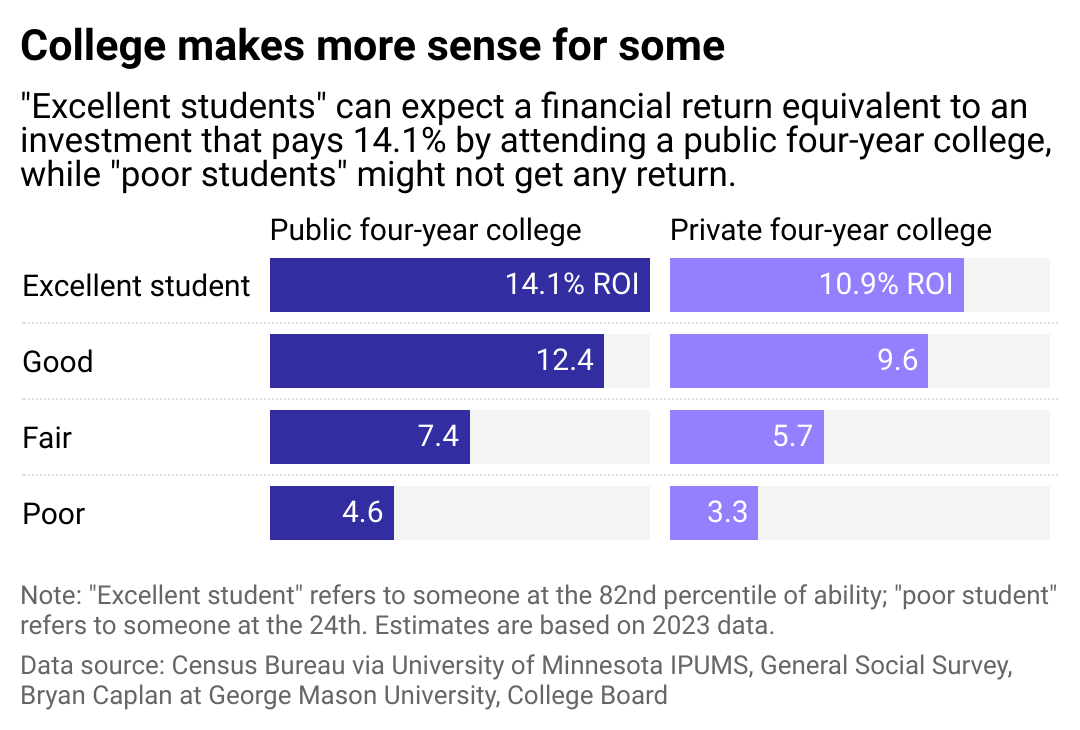
When companies or investors consider a project, they care about the internal rate of return, or IRR, a form of ROI. Investing in a project with a 5% internal rate of return is financially equivalent to putting your money in a savings account that pays 5% interest a year.
Stacker has built a statistical model that estimates how much people of different academic abilities and education levels can expect to earn and estimates the internal rates of return on pursuing a four-year degree. It considers the sum of all personal-level income, such as wages, bonuses, tips, rental income, and more. Borrowing from Bryan Caplan's aforementioned book, this analysis breaks students into four levels of academic ability, ranging from "excellent students," who have grades and test scores at roughly the 82nd percentile on tests, to "poor students," who are at roughly the 24th percentile of academic performance.
This model makes several simplifying assumptions. It assumes everyone who goes to a four-year college does so between 18 and 21, and anyone who drops out does so after two years. It also assumes full-time college students do not work and that everyone files taxes as single persons with no dependents and takes the standard tax deductions. It ignores the impact of state and local taxes, as well as living expenses, since people who do not go to college need housing too. Students who can live at home during college save a lot of money.
Overall, this analysis finds that college is a good bet, at least for those with a good academic record. Excellent students can expect an ROI of about 14.1% at public four-year colleges, while poor students can expect only a 4.6% return. For comparison, the S&P 500 Index, which tracks the performance of shares in the biggest listed companies in America, has provided a total return of around 10% a year over the past three decades.
The biggest reason some students can expect much better returns than others is graduation rates. Drawing from Caplan's research, this model assumes excellent students have a 66.5% chance of graduating with a bachelor's degree, while poor students have only a 6.1% chance.
These numbers also do not account for inflation, which would lower the expected returns on investment by two to three percentage points.
Better to have studied than not at all
Updated
Considering not everyone who enters college gets a degree, would even an attempt at graduating make a difference? Yes, says a different analysis by Stacker using GSS data, which incorporates educational background and a measure of academic ability in the form of a miniature vocabulary quiz called Wordsum. Even when college students drop out, it is likely they will earn more than their peers who never went at all.
Part of what colleges do is filter for people who are already bright. By including a measure of academic ability, this analysis limits the credit given to colleges for the earnings of their future graduates. It also helps account for the fact that people with high academic ability tend to have better career options than those who don't, regardless of what diplomas they might hold.
GSS data shows that both the educational credentials a person has and their academic fitness—as measured by a short vocabulary quiz—matter when it comes to earnings. For example, a person who scored a 5 out of 10 on the Wordsum quiz can be expected to have a family income of around $65,000 a year if they graduated from high school but never went to college, $69,000 if they went to college but did not graduate, and $105,000 if they earned a bachelor's degree.
The fact that college graduates earn so much more than their peers who dropped out, even controlling for academic ability (as measured by Wordsum), could be partly because they are above average on some traits outside of those measured by the data. It also suggests employers value college degrees. To paraphrase Bryan Caplan, a high schooler who goes on to earn a bachelor's degree in underwater basket weaving will likely earn much more money than their equally intelligent peers who never went to college. Graduating is the hard part.
One of the biggest barriers to higher education (and, consequently, graduation) is the cost.
An October 2021 Pew Research Center survey found that roughly 3 in 5 U.S. adults do not have four-year college degrees mainly because they couldn't afford them. Another major reason was that they needed to work and support their families instead of finishing their education. One way some students have navigated this has been by applying to multiple colleges—some are more generous with their financial aid packages than others. This analysis, however, assumes students on average are paying the same as their peers. Anyone who pays full price for a four-year degree at a private college will have a much harder time getting a positive financial return on their tuition.
One's field of study also matters. While this analysis doesn't break college graduates by their majors, a recent study with a similar methodology by Liang Zhang of New York University and two other scholars does. In general, Zhang's study found that engineering and computer science majors produce the best rates of return, exceeding 13%. Business, health, math, and science degrees followed with IRRs between 10% to 13%. Behind them are degrees in biology and social science, which typically return between 8% and 9%. Education and humanities produced the lowest IRRs, especially for men. However, their numbers are adjusted for inflation and do not factor in dropout rates.
Wages for high school graduates are on the rise
Updated
The economy is an ever-changing landscape and many things have shifted rapidly. Many recent developments have whittled away at the return on a college degree.
Pay for blue-collar jobs has been rising faster than pay for white-collar jobs. This increases the opportunity cost of college and lowers the ROI on degrees. For example, California enacted legislation in April 2024 requiring a $20 per hour minimum wage for fast-food workers. A person who eschews the job at McDonald's to go to college for four years would effectively be giving up $166,400 in pretax earnings, assuming they did not work while they studied.
Another major development is that interest rates have skyrocketed. Federal student loans for undergraduates now have a 6.53% interest rate, up from a low point of 2.75% in 2020, according to Federal Student Aid. Anyone who takes loans to go to college should know they could end up paying a lot more interest than people who went to college just a few years prior.
Despite these trends, college still has one more argument in its favor: leverage. Not many people would lend thousands of dollars to an 18-year-old to buy stocks, regardless of what the math says. But the federal government will happily lend money to that exact same 18-year-old if they want to spend it on tuition. A low financial return is better than none at all.
Conventional financial theory suggests that if the expected ROI is lower than the cost of financing, companies should pass on the project. Recent economic trends have made the decision to go to college harder than ever. College may still be a good investment, but only for the well-prepared.
Story editing by Carren Jao. Additional editing by Kelly Glass. Copy editing by Paris Close. Photo selection by Clarese Moller.
This story originally appeared on Learner and was produced and distributed in partnership with Stacker Studio.

