


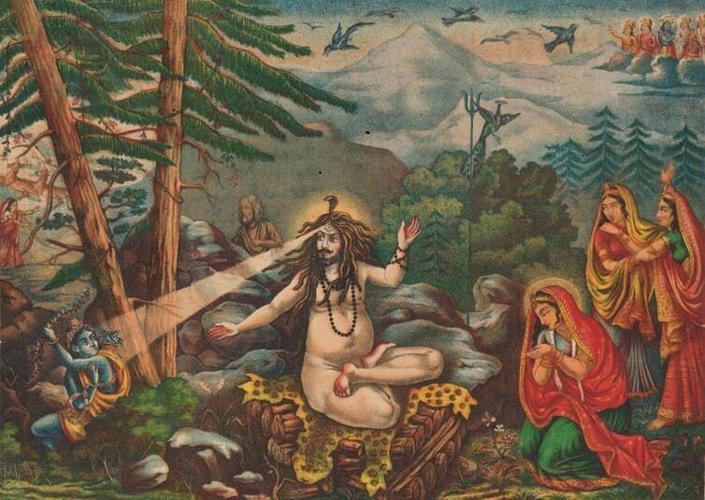
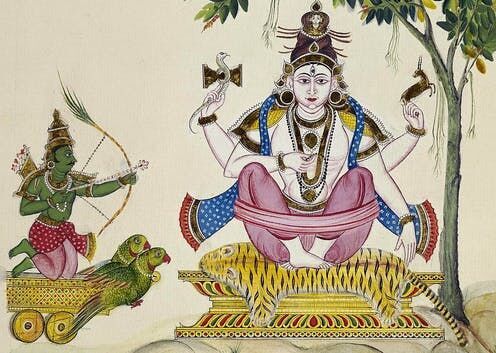
The love god Kamadeva prepares to shoot Shiva with a love dart. British Museum/Wikimedia Commons
With the coming of Valentine’s Day, images of a chubby Cupid aiming his arrows of love at unwary humans’ hearts seem to be everywhere.
The Cupid that Americans see splashed across greeting cards and chocolate boxes began life as a Roman God of love and desire, based on his Greek counterpart, Eros. The word erotic is even drawn from his name.
What is less well known in the Western world is that Eros has a Hindu equivalent: Kamadeva, the Hindu god of love, desire and infatuation. Indeed, as a scholar of Indic traditions, I find that there are often parallels between the sacred stories of Hindu deities and those found in cultures around the world, particularly Indo-European ones.
The Hindu Cupid also shoots his arrows into hearts. Kamadeva, however, is not a chubby cherub, but a handsome youth who rides upon a large green parrot named Suka. His bow is made of sugarcane, its bowstring is made up of honeybees and his arrows are made of flowers. Indeed, this description can be found as early as the Rigveda, the most ancient of Hindu scriptures, which dates back at least 3,000 years.
All these elements symbolize the sweetness of love. They also evoke the springtime, when new life emerges into the world. Kamadeva’s parrot, Suka, also represents spring, as well as romantic love, as parrots are often observed living in pairs.
Kamadeva, also known as Madana, is accompanied by his partner, Rati, who is, appropriately, the goddess of love.
What is probably the most famous story about the pair illustrates the tension between two of the most deeply held values in Hindu tradition. Romantic love, particularly within family life, is greatly prized. On the other hand, the highest ideal, liberation from the cycle of rebirth, is often seen as requiring spiritual aspirants to renounce worldly attachments — including conventional social relationships — in the pursuit of meditative solitude.
One of the most celebrated and revered Hindu deities, Shiva, embodies this tension, as he is both a great yogi and a loving husband and father. Once, when Shiva was deep in meditation, Kamadeva sought to pierce his heart with an arrow. Furious at having his meditation disturbed, Shiva blasted the hapless god of love with a powerful beam of energy emanating from his famous third eye.

Shiva did not appreciate having his meditation interrupted.
Kamadeva was not trying to pierce Lord Shiva’s heart out of whimsy. Rather, the story says, the world was being threatened by a monstrous demon, or asura, called Taraka, whom none of the gods was able to defeat.
According to a prophecy, only Kartikeya, the son of Lord Shiva and his wife, the Mother Goddess Parvati, would be able to defeat this demon. The problem was that Kartikeya had not yet been conceived. Given Shiva’s commitment to meditation, as the patron deity and embodiment of yoga, it was unlikely that this would happen any time soon.
Kamadeva was therefore dispatched by the gods for precisely this reason: to arouse Shiva’s love for Parvati and awaken him from his meditation so he could father the son who would save the world.
Though sometimes quick to anger, Shiva is portrayed as a merciful deity. Rati, inconsolable at the loss of her beloved, pleaded with Shiva to restore Kamadeva to life, which he did. Subsequently, Shiva and Parvati conceived their son, Kartikeya, who went on to destroy the demon.
The message of this story? That even in a tradition where asceticism and meditation are prized as paths to humanity’s highest goal — liberation from the realm of rebirth and its sufferings — erotic love has its place as a necessary part of life. Kamadeva is no mere distraction, but has a positive role to play in the world.
[3 media outlets, 1 religion newsletter. Get stories from The Conversation, AP and RNS.]
Jeffery D. Long does not work for, consult, own shares in or receive funding from any company or organization that would benefit from this article, and has disclosed no relevant affiliations beyond their academic appointment.
This article is republished from The Conversation under a Creative Commons license.
13 romantic dramas to stream for Valentine's Day
'The Age of Innocence' (1993)
Updated
Michelle Pfeiffer, left, and Daniel Day-Lewis in “The Age of Innocence.”
If you're liking HBO's "The Gilded Age," you will love "The Age of Innocence," Martin Scorsese's lush film based on Edith Wharton's novel of passion, propriety and regret in Old New York. Michelle Pfeiffer and Daniel Day-Lewis, particularly in a quiet but insanely steamy scene in a carriage, radiate impossibly gorgeous chemistry. (Streaming on Amazon Prime Video)
'Casablanca' (1942)
Updated
Ingrid Bergman, left, and Humphrey Bogart in a still from "Casablanca."
Is there a need to say anything about "Casablanca"? Bogie, Bergman and "As Time Goes By." Classic for a reason. (HBO Max)
'Bright Star' (2009)
Updated
Ben Whishaw, director Jane Campion and Abbie Cornish pose at a photo call for the film "Bright Star" at the Cannes film festival in France in May 2009.
Jane Campion, in the Oscar hunt this year for "The Power of the Dog," wrote and directed "Bright Star," an exquisite, heartbreaking drama about the poet John Keats (Ben Whishaw) and his doomed romance with his neighbor, Fanny Brawne (Abbie Cornish). It's as much an ode to poetry as it is to love. (Netflix)
'Crazy Heart' (2009)
Updated
Jeff Bridges poses with the Oscar for best performance by an actor in a leading role for "Crazy Heart" at the 82nd Academy Awards on March 7, 2010.
Even though "Crazy Heart" won a couple of Oscars (including best actor for Jeff Bridges), a lot of people may have missed this delicate character drama. It's worth tracking down. Bridges, as a worn-down country singer, gives one of his great career's best performances (a lovely companion piece to his work in "The Fabulous Baker Boys"). Maggie Gyllenhaal plays the journalist with whom he finds a gentle connection. (Amazon Prime)
'In the Mood for Love' (2000)
Updated
Maggie Cheung, left, and Tony Leung in the film "In The Mood For Love."
"In the Mood for Love" is Wong Kar-wai's masterpiece of romantic yearning. Set in 1962 Hong Kong, it's a simple story of two people (Tony Leung Chiu-wai, Maggie Cheung Man-yuk) whose spouses are having an affair — but oh, the lushness of its colors, the hypnotic velvet of its score, the poignancy of the main characters' quiet expressions. (HBO Max)
"The Photograph" (2020)
Updated
LaKeith Stanfield, left, and Issa Rae in "The Photograph."
In Stella Meghie's old-school drama "The Photograph," two lovely people (Issa Rae, LaKeith Stanfield) dig into the past while falling for each other in the present; it's a pleasure to fall along with them. (HBO Max)
'Portrait of a Lady on Fire' (2019)
Updated
Adele Haenel, left, and Noemie Merlant in “Portrait of a Lady on Fire.”
"Portrait of a Lady on Fire" is another swoony period romance, this time set on an island in 1770s France, where two women — one an artist (Noemie Merlant) hired to paint an engagement portrait of the other (Adele Haenel) — find unexpected passion together. It's a gorgeous slow burn; little happens, but everything happens, as writer/director Celine Sciamma immerses us in painterly beauty. (Hulu)
"Disobedience" (2018)
Updated"Disobedience" is another one that wasn't widely seen. This quiet but passionate film takes place within an Orthodox Jewish community in London, where two women (Rachel Weisz, Rachel McAdams) — one now married — secretly rekindle a long-ago-forbidden relationship. It's director Sebastian Lelio's first English-language film, and much of it is told wordlessly, with great generosity of spirit toward its characters. (Hulu)
'The French Lieutenant's Woman' (1981)
Updated
Meryl Streep is shown at the Los Angeles Film Critics Awards dinner in Beverly Hills, Calif., on Jan. 13, 1982. Streep won the best actress award for her role in "The French Lieutenant's Woman."
If you love romantic drama and you haven't seen "The French Lieutenant's Woman," here's a treat for you. Picture a young Meryl Streep and a young Jeremy Irons, in dual roles: They're playing actors filming a swoony period drama while carrying on an affair. (HBO Max)
"If Beale Street Could Talk" (2018)
Updated
Barry Jenkins ("Moonlight") makes gorgeous films, and "If Beale Street Could Talk," based on the James Baldwin novel, finds exquisite cinematic language for love and longing. It's a terribly sad story — a young couple (KiKi Layne, Stephan James) is separated when one is unjustly incarcerated — but love, in all its forms, shines brightly in every frame. (Hulu)
"Love & Basketball" (2000)
UpdatedYou don't have to be a sports fan to love "Love & Basketball," Gina Prince-Bythewood's warmhearted tale of two kids (Sanaa Lathan, Omar Epps) growing up, falling hard for basketball and for each other. And note that, though this one isn't a comedy, it does have the happiest of endings. (HBO Max)
"Loving" (2016)
Updated"Loving" is based on the true-life story of an interracial couple who just wanted to raise their family in their small Virginia town (and whose case led to the U.S. Supreme Court striking down state laws banning interracial marriage). This sensitive and lovely film is about a fight for justice and about two people (played with quiet chemistry by Joel Edgerton and Ruth Negga) who have found home in each other. (Netflix)
"Phantom Thread" (2017)
UpdatedIf you like your romantic dramas with an elegant dollop of weird, check out "Phantom Thread," Paul Thomas Anderson's tale of a midcentury London fashion designer (Daniel Day-Lewis) and his unexpected muse (Vicky Krieps). Gorgeous, mesmerizing and thoroughly odd; just try to look away. (Netflix)


