


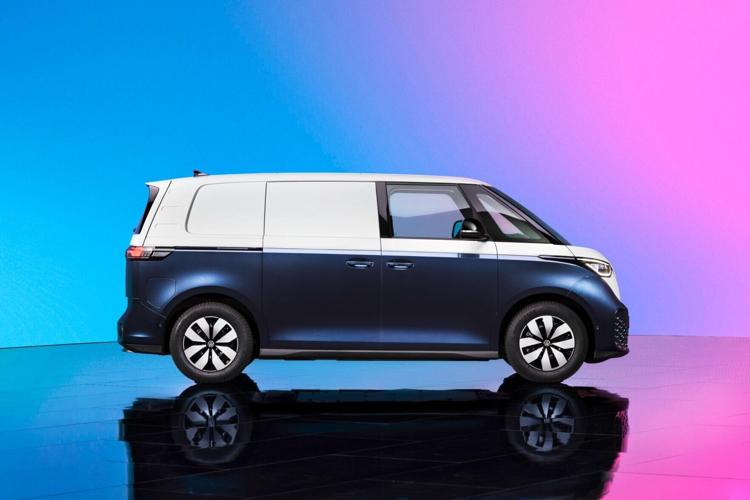


The ID. Buzz will also be available as a cargo van.
It's been promised for years. Now it's finally here. Volkswagen has unveiled the production version of the VW ID. Buzz, a 21st century version of the classic VW Bus. Unlike the noisy and underpowered original bus, the new version will be full electric with ample horsepower.
The Bus was a cultural icon on par with its smaller sister model, the VW Beetle. It was officially known as the Volkswagen T1 or Transporter but best known as the Microbus or, simply, the Bus. In America, it became associated with the Hippie movement, but the Bus also provided transportation for large families decades before the minivan was invented.
The classic Microbus has become a favorite among collectors. Nicely kept versions have sold for six-figure sums. The world's most valuable Hot Wheels car, worth as much as $150,000, is a tiny Microbus.

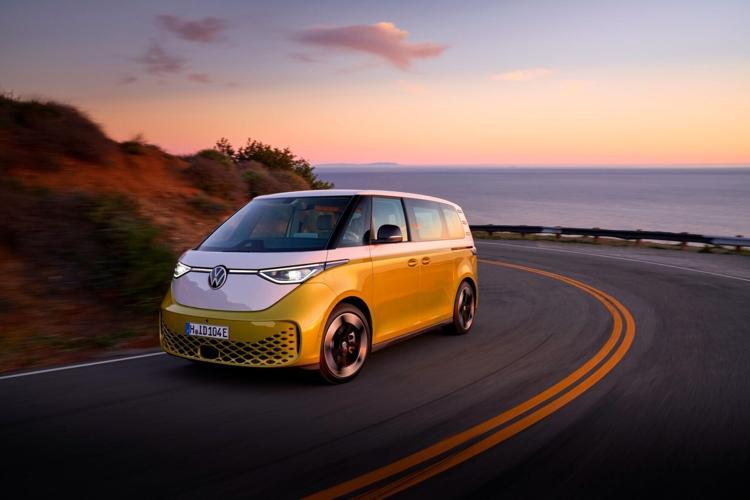
As on the original VW Bus the wheels are set far out to the ends.
While VW designers didn't want to simply recreate the look of the original van, the automaker said, many elements of the ID. Buzz's exterior are clearly inspired by it. The new van will be available with two-tone paint like the original. It also has short front and rear "overhangs," the distance between the wheels and the ends of the body, like the original. Besides giving the van an overall shape similar to the Microbus, the short overhangs also allow for more space inside the van.
Like the Beetle, the Microbus had a small engine mounted in the back. The new VW ID. Buzz, likewise, has its electric motor in the back powering the van's rear wheels. The motor in the ID. Buzz unveiled Wednesday will produce up to 201 horsepower, far more than the classic Bus's meager two-digit horsepower figures. Different versions of the Buzz with various power capabilities will be announced later, VW said.

The Volkswagen ID. Buzz isn't a straight copy of the original but shares its personality.
The ID. Buzz's battery packs are mounted under the floor. That gives the van a low center of gravity and, VW promises, particularly agile handling for a van. It shares much of its engineering with other new Volkswagen electric vehicles, such as the ID.4 crossover SUV.
Volkswagen Group, which owns the Volkswagen, Audi, Porsche and Bentley brands, among others, is pushing heavily into electric vehicles and expects 25% of its sales to be EVs by 2026. As of last year, they made up about 5% of VW Group's global sales. Currently, in the US, VW Group sells the electric Audi E-Tron models and Porsche Taycan models in addition to the ID. 4. Overseas, VW Group brands Škoda and Opel also offer electric vehicles, and Bentley plans to sell only electric cars by 2030.
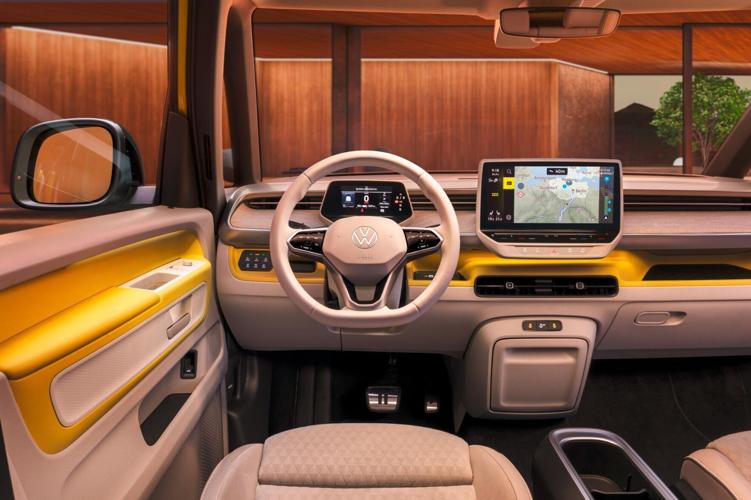
Inside, the ID. Buzz has features similar to those in the ID.4, such as a gear selection knob behind the steering that can be twisted to put the van into drive or reverse. A light bar running underneath the windshield uses colors to communicate to the driver things like an obstacle in the way or an upcoming turn for navigation. The gauge cluster is a rectangular digital screen. There is a 10-inch touchscreen for navigation and entertainment, and a 12-inch screen will be available as an option.

The interior shares some features with VW's other EV models.
The ID. Buzz will have no leather in its interior, using leather substitutes, instead. There will also be fabrics made entirely from recycled plastics.
The electric bus will be available globally in two lengths, standard and long wheelbase. Only the long wheelbase version will be sold in the US. The standard version will be able to seat five, but a six-seat version will come later. The long wheelbase version will have seating for as many as seven. VW will also be offering cargo van versions with seating for three in front — the driver will have an individual seat with a two-person bench next to them. A wall behind the occupants will keep the cargo area separate.
The ID. Buzz revealed on Tuesday will go on sale in Europe later this year. VW has not yet provided pricing. The technical details could be slightly different for the version that will be available in North America in 2024. That version will be revealed next year.
___

The states that consume the most gasoline
States That Consume the Most Gasoline
Updated
Photo Credit: Virrage Images / Shutterstock
In the ongoing efforts to combat global climate change, one of the most promising trends has been a growing shift away from carbon-emitting vehicles. Transportation produces 29% of greenhouse gas emissions in the U.S., according to the EPA, but hybrid and electric vehicles are growing in popularity and potentially poised to reduce that figure.
Part of this shift has come with encouragement from policymakers. Recognizing the role that fuel emissions play in contributing to the greenhouse gas effect and climate change, policymakers at all levels have been encouraging a transition toward lower- or zero-emission vehicles. Hybrid and electric vehicle owners are frequently eligible for government incentives like tax credits. States like California are planning to phase out new carbon-emitting vehicles from the market altogether by 2035. More recently, the Biden Administration and Congress have been making efforts to expand the national network of electric vehicle charging stations among other climate-related infrastructure projects.
Simultaneously, the market for hybrid and electric cars has never been larger. In October, electric vehicle market leader Tesla became one of only a handful of companies ever to reach a $1 trillion market capitalization, following a surge in sales and the announcement of a $4 billion partnership with Hertz to provide 100,000 rental vehicles. Meanwhile, entrenched auto industry manufacturers like GM, Toyota, BMW, and many others are racing to catch up to Tesla, offering an increasingly large variety of high-performing vehicles that have greater fuel economy and lower or no emissions.
And over the last few months, some consumers have been looking to the electric vehicle market for another reason: the rising price of gasoline.
Gasoline prices jumped sharply in 2021 following 2020 lows
Updated
Gasoline prices have been fairly volatile over the last two decades, and the trajectory of gas prices during the COVID-19 pandemic provides one example. At the beginning of 2020, the average cost of a gallon of gas was $2.58. By the end of April, after the pandemic had taken hold and with lockdown orders still in effect in many jurisdictions, gasoline dipped to $1.77 per gallon. After staying under $2.25 for the rest of 2020, gas prices have dramatically increased this year, rising to $3.32 per gallon as of October 2021.
Even with elevated gas prices, however, consumption is likely to remain high until more hybrids and electric vehicles are on the road. Studies have found that demand for gas is mostly inelastic, meaning that people tend to purchase the same amount of gas regardless of the price. However, there does appear to be some correlation between the costs of gasoline in a state and the amount of miles drivers travel on the road.
Residents tend to drive more in states with cheaper gas
Updated
The states with the least expensive gasoline relative to the national average are primarily found in the South. Reasons for this include these states’ proximity to major petroleum sources or refineries in Texas and the Gulf Coast region, which lowers distribution costs, and lower gas taxes. Many of these states, like Mississippi, Alabama, and South Carolina, are also among the leaders in per capita vehicle miles traveled annually. In contrast, states in the West and Northeast have much higher costs of gasoline, and their drivers spend less time on the road. For instance, California has the third-highest gas prices of any state in the U.S. and ranks 42nd in vehicle-miles traveled per person.
When it comes to gasoline consumption, vehicle-miles traveled is also a major indicator. Rural states, mostly in the South, Midwest, and Mountain West, rank highly on both gasoline consumption and miles traveled because of their lower density and lack of other transportation alternatives. To determine the states consuming the most gasoline, researchers at Commodity.com calculated per capita annual gasoline consumption in gallons using data from the U.S. Energy Information Administration and the U.S. Department of Transportation. In the event of a tie, the state with the higher per capita annual gasoline expenditures was ranked higher.
Here are the states consuming the most gasoline.
15. Iowa
Updated
Photo Credit: f11photo / Shutterstock
- Per capita annual gasoline consumption (gallons): 492
- Per capita annual gasoline expenditures: $1,203
- Total annual gasoline consumption (gallons): 1,553,573,619
- Total annual gasoline expenditures: $3,801,000,000
- Average price per gallon of gasoline (compared to average): -5.9%
- Per capita annual vehicle-miles traveled: 10,601
14. Kentucky
Updated
Photo Credit: Jonny Trego / Shutterstock
- Per capita annual gasoline consumption (gallons): 497
- Per capita annual gasoline expenditures: $1,237
- Total annual gasoline consumption (gallons): 2,223,504,645
- Total annual gasoline expenditures: $5,531,000,000
- Average price per gallon of gasoline (compared to average): -4.3%
- Per capita annual vehicle-miles traveled: 11,036
13. Tennessee
Updated
Photo Credit: Sean Pavone / Shutterstock
- Per capita annual gasoline consumption (gallons): 501
- Per capita annual gasoline expenditures: $1,209
- Total annual gasoline consumption (gallons): 3,418,976,274
- Total annual gasoline expenditures: $8,258,000,000
- Average price per gallon of gasoline (compared to average): -7.1%
- Per capita annual vehicle-miles traveled: 12,036
12. Montana
Updated
Photo Credit: Mihai_Andritoiu / Shutterstock
- Per capita annual gasoline consumption (gallons): 502
- Per capita annual gasoline expenditures: $1,390
- Total annual gasoline consumption (gallons): 537,487,105
- Total annual gasoline expenditures: $1,487,000,000
- Average price per gallon of gasoline (compared to average): +6.4%
- Per capita annual vehicle-miles traveled: 11,931
11. Texas
Updated
Photo Credit: Timothy Milan Kuret / Shutterstock
- Per capita annual gasoline consumption (gallons): 505
- Per capita annual gasoline expenditures: $1,159
- Total annual gasoline consumption (gallons): 14,645,221,408
- Total annual gasoline expenditures: $33,594,000,000
- Average price per gallon of gasoline (compared to average): -11.8%
- Per capita annual vehicle-miles traveled: 9,817
10. Arkansas
Updated
Photo Credit: Trong Nguyen / Shutterstock
- Per capita annual gasoline consumption (gallons): 505
- Per capita annual gasoline expenditures: $1,165
- Total annual gasoline consumption (gallons): 1,524,939,471
- Total annual gasoline expenditures: $3,520,000,000
- Average price per gallon of gasoline (compared to average): -11.2%
- Per capita annual vehicle-miles traveled: 12,242
9. Missouri
Updated
Photo Credit: Tupungato / Shutterstock
- Per capita annual gasoline consumption (gallons): 509
- Per capita annual gasoline expenditures: $1,209
- Total annual gasoline consumption (gallons): 3,127,887,990
- Total annual gasoline expenditures: $7,427,000,000
- Average price per gallon of gasoline (compared to average): -8.7%
- Per capita annual vehicle-miles traveled: 12,870
8. South Dakota
Updated
Photo Credit: Jacob Boomsma / Shutterstock
- Per capita annual gasoline consumption (gallons): 523
- Per capita annual gasoline expenditures: $1,325
- Total annual gasoline consumption (gallons): 464,451,253
- Total annual gasoline expenditures: $1,176,000,000
- Average price per gallon of gasoline (compared to average): -2.6%
- Per capita annual vehicle-miles traveled: 11,114
7. New Hampshire
Updated
Photo Credit: Jon Bilous / Shutterstock
- Per capita annual gasoline consumption (gallons): 532
- Per capita annual gasoline expenditures: $1,356
- Total annual gasoline consumption (gallons): 724,194,683
- Total annual gasoline expenditures: $1,845,000,000
- Average price per gallon of gasoline (compared to average): -2.0%
- Per capita annual vehicle-miles traveled: 10,121
6. South Carolina
Updated
Photo Credit: f11photo / Shutterstock
- Per capita annual gasoline consumption (gallons): 549
- Per capita annual gasoline expenditures: $1,261
- Total annual gasoline consumption (gallons): 2,834,788,130
- Total annual gasoline expenditures: $6,506,000,000
- Average price per gallon of gasoline (compared to average): -11.7%
- Per capita annual vehicle-miles traveled: 11,104
5. Delaware
Updated
Photo Credit: Jon Bilous / Shutterstock
- Per capita annual gasoline consumption (gallons): 561
- Per capita annual gasoline expenditures: $1,457
- Total annual gasoline consumption (gallons): 547,438,138
- Total annual gasoline expenditures: $1,423,000,000
- Average price per gallon of gasoline (compared to average): +0.0%
- Per capita annual vehicle-miles traveled: 10,382
4. Wyoming
Updated
Photo Credit: Jacob Boomsma / Shutterstock
- Per capita annual gasoline consumption (gallons): 569
- Per capita annual gasoline expenditures: $1,474
- Total annual gasoline consumption (gallons): 330,146,731
- Total annual gasoline expenditures: $855,000,000
- Average price per gallon of gasoline (compared to average): -0.4%
- Per capita annual vehicle-miles traveled: 17,530
3. Alabama
Updated
Photo Credit: Sean Pavone / Shutterstock
- Per capita annual gasoline consumption (gallons): 570
- Per capita annual gasoline expenditures: $1,301
- Total annual gasoline consumption (gallons): 2,798,198,295
- Total annual gasoline expenditures: $6,385,000,000
- Average price per gallon of gasoline (compared to average): -12.2%
- Per capita annual vehicle-miles traveled: 14,576
2. North Dakota
Updated
Photo Credit: Jacob Boomsma / Shutterstock
- Per capita annual gasoline consumption (gallons): 577
- Per capita annual gasoline expenditures: $1,498
- Total annual gasoline consumption (gallons): 440,308,622
- Total annual gasoline expenditures: $1,144,000,000
- Average price per gallon of gasoline (compared to average): +0.0%
- Per capita annual vehicle-miles traveled: 12,839
1. Mississippi
Updated
Photo Credit: Sean Pavone / Shutterstock
- Per capita annual gasoline consumption (gallons): 578
- Per capita annual gasoline expenditures: $1,324
- Total annual gasoline consumption (gallons): 1,722,554,239
- Total annual gasoline expenditures: $3,943,000,000
- Average price per gallon of gasoline (compared to average): -11.9%
- Per capita annual vehicle-miles traveled: 13,850

