


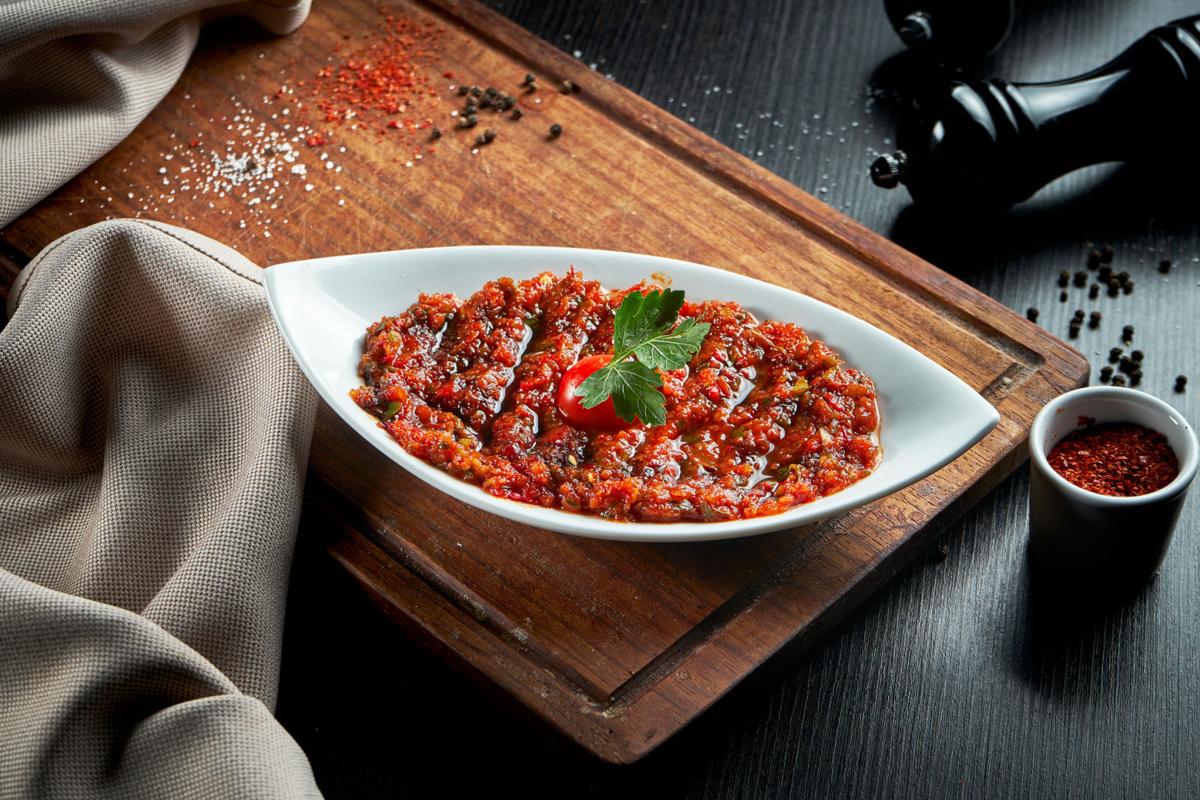
I love having jars and bottles of international condiments stashed in my fridge and pantry. Beyond America’s favorite, ketchup, I currently have gochuchang, sri racha, z’hug (the fierce Yemeni table sauce), chimichurri and a couple of others handy.
Last week, I added a Southwestern version of a sauce I learned about from a Ukrainian friend years ago. It’s called adjika, and it has its roots in Georgia, the country that straddles Eastern Europe and Western Asia. When my Ukrainian friend Sasha learned about it, Georgia was still part of the Soviet Union, and he used to vacation there, he told me. The region is famous for its superb wines, and I think that was the draw for him — he was what my mother would call “a feinschmecker,” the German word for someone who likes to eat and drink.
By the time Georgia seceded from the Soviet Union in 1991, Sasha had arrived in the United States. As much as he loved it here, he often missed the foods he enjoyed in Ukraine, and his palate’s homesickness led us into many interesting conversations about those foods.
Because his English was not strong, and I speak neither Ukrainian nor Russian, these conversations often involved complex pantomimes followed by questions — an elaborate gustatory game of charades. As he showed me how to make adjika, I reveled in the scent of Sasha’s pipe tobacco while he demonstrated the kind of chiles to use by removing his pipe from his mouth and pretending to fan his tongue furiously — you want very hot chiles, I gathered.
Well, hot chiles we have aplenty here in the Southwest. In fact, I had several varieties of dried chiles in the pantry, leftover from a previous culinary experiment, and I thought that using them up in a version of adjika would be a good use of them.
Some versions of adjika include grated carrot and grated apple for a hint of sweetness, plus grated onion to provide its own heat and sweetness. Those additions certainly expand the bulk of the finished product.
Moreover, as a food science point, sweetness softens and mellows heat. That’s why you can fix a too-hot curry by adding some sugar, honey or what have you to it.
Sasha’s adjika did not include carrots, apples or onions. Instead, he added a bit of honey to serve that function. Here in my Southwestern kitchen, I substituted agave syrup to serve the same purpose. If you don’t have agave syrup, substitute honey.
Unlike herb-based sauces such as chimichurri and z’hug, which have a relatively short shelf-life, Sasha’s adjika lasts a long time in the refrigerator. That’s handy for a small household like mine.
I use adjika in myriad ways. Sometimes I mix it with a little mayo to spread on the bread for sandwiches, or, if I’m feeling reckless, spread it on the bread alone. A tablespoon stirred into a cup of sour cream thinned with a bit of cream or milk makes a quick salad dressing that is a delightful and surprising change from ranch and other creamy dressings.
I also use it straight as a condiment for grilled or sautéed beef, pork or chicken, and sometimes on fish, especially salmon. And just a little on sliced cheddar cheese is a good nosh at the end of the day.
You will surely think up other uses when you have a jar of adjika in the refrigerator.
SOUTHWESTERN ADJIKA
Makes about 1½ cups
Use dried guajillos for medium heat, or fiery chiles de arbol if you are daring. This will keep in a lidded jar about six to nine months in the refrigerator if you use a clean spoon every time you dip some out. I’m betting it won’t last that long, though.
INGREDIENTS
8 ounces dried guajillos or chiles de arbol
4 cloves garlic
¼ cup pine nuts
1 to 2 tablespoons agave syrup or honey
1½ teaspoons coriander seed
1½ teaspoons coarse salt, such as kosher salt
1 heaping teaspoon dill seed
1 heaping teaspoon cumin seed
PREPARATION
Remove the stems and seeds from the dried chiles. You may want to wear gloves for this step, especially if you’re using chiles de arbol.
Place the chiles in a large bowl filled with warm water. Weigh them down with something heavy and let stand for four hours.
Drain the peppers and add them to the work bowl of a food processor or high-powered blender. Add the garlic, pine nuts, agave syrup or honey, coriander seed, salt, dill seed and cumin seed.
Process until the mixture is a coarse paste. Use immediately or refrigerate in a glass container with a tight-fitting lid.

