


When I worked on the Chicago Tribune’s food section, we ran a column called “Cheap Eats,” where staffers visited various hole-in-the-wall restaurants and wrote about their offerings. It was always a fun assignment, as the visits to such restaurants took me to parts of the city I otherwise had no reason to visit.
One such assignment took me to Pilsen, originally a German neighborhood which had, over the years, become a Hispanic hot spot. My dining partner and I found the tiny restaurant, which had only four or five tables, and a menu of items from Mexico’s Yucatan peninsula that I’d never tasted before.
The menu descriptions were minimal at best. I chose the cochinita pibil, figuring that any long-braised pork dish would be just the ticket on a wintry Chicago night. And boy, was that decision spot on.
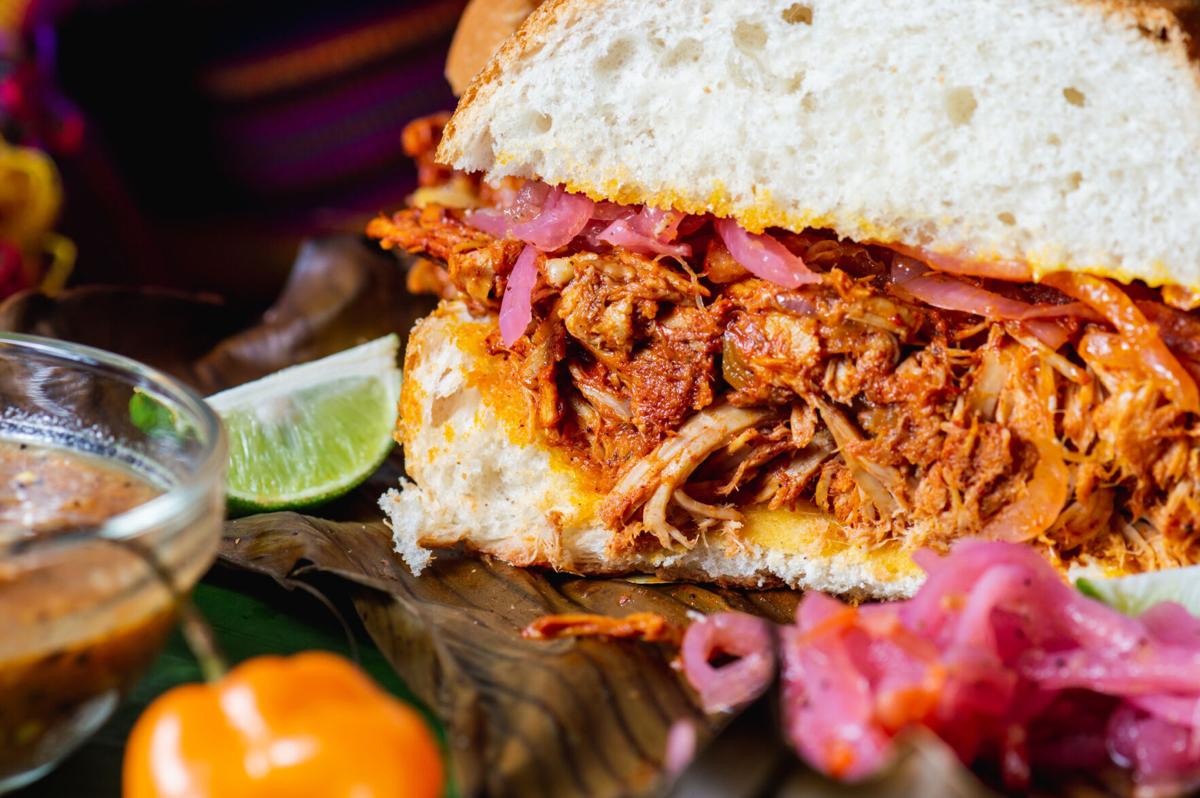
Bright with citrusy flavors and redolent of garlic and cumin, the plate of rice dressed with shredded pork arrived with garnishes of pickled onions, chopped cilantro and wedges of lime. Eating it was like fleeing Chicago’s brutal cold for a sunny beach vacation, even if only for a small time.
As it turns out, cochinita pibil is easy to make, and I’ve made it often in the intervening years when I needed a mental escape.
Over the years, I’ve adapted my cochinita pibil recipe, streamlining it to its barest essentials. While banana leaves are traditional and lend a fine flavor to the cochinita pibil, the dish is still superb without them.
The achiote paste, however, is an essential. Find it in Hispanic markets, or in well-stocked Asian grocery stores. It keeps almost indefinitely, and you’ll want it on hand to make cochinita pibil again soon.
If you have leftovers, they’ll last in the refrigerator for up to a week. But in my opinion, a better solution is to cook this for your family or a few friends. Four of us can put away all of this recipe in an evening of good conversation and laughter.Cochinita Pibil
Makes 4 to 6 servings
If you happen to see banana leaves when you’re shopping for the achiote paste, pick some up. They add a distinctive flavor to the cochinita pibil. Soften them by warming them briefly in the microwave before lining the foil packet with them. But if you can’t find them, don’t worry; your cochinita pibil will be splendid nonetheless. You can make this in the slow cooker if you wish: six to eight hours on low, or four to five hours on high.
Ingredients
3 to 4 pounds pork shoulder
1 cup freshly squeezed orange juice
½ cup lime juice, from 4 to 5 limes
6 cloves garlic, crushed and minced
1 teaspoon ground cumin
3 ounces red achiote paste, available in Hispanic markets
1 teaspoon salt
Chopped cilantro, for serving
Pickled red onions, for serving
Cheese, for serving
Lime wedges, for serving
Preparation
The night before or the morning of the day that you plan to serve this, mix the orange and lime juice, garlic and cumin with the achiote paste and salt in a blender until combined. Achiote stains, so rinse the blender jar as soon as you’ve finished.
Cut the pork into 2-inch cubes. Don’t worry about trimming the fat; it will render and keep the meet moist as it braises. You can always pick it off later. Put the pork in a non-reactive (glass, stainless steel or plastic) container or a zip-top gallon-sized freezer bag, then pour over the marinade mixture.
Mix well, cover and refrigerate for at least six hours and up to 24 hours.
Preheat the oven to 325°F.
Line a large casserole dish with a double layer of heavy-duty foil, or a triple layer of regular foil – you want a good seal. If you’re using banana leaves, soften them in the microwave and line the foil packet with them now. Pour in the pork and the marinade and close the foil tightly. Put the casserole in the oven and bake at 325°F for at least three hours. After three hours, check the meat; it should be falling-apart tender.
When the pork is tender, take it out of the oven and open the foil. Remove the meat with a slotted spoon to a bowl, then shred it with two forks. You don’t have to shred the pork, but it’s more adaptable if you do. Pour enough sauce over the meat to moisten it, but not so much that it’s soupy.
Serve the shredded pork over white rice, or as a filling for sandwiches, tacos or burros. However you serve it, garnish with chopped cilantro, pickled red onions and cheese. Serve with lime wedges.
Getting older often means making changes to ensure a robust quality of life.

