


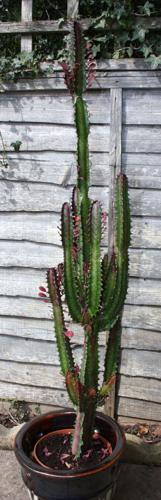
Q: A friend has been caring for my euphorbia houseplant while we are away, and he reports it has drooping stalks. I have been researching online, to no avail. He says the plant is still green.
A: Euphorbias should be treated much like cactus. They need well-drained soil and can suffer from fungal diseases if left in too much water for too long. Your plant is showing signs of a vascular problem in that it cannot provide enough water pressure to keep some of the stems upright. Wilting like this can be a sign of underwatering but it can also be a sign of overwatering or disease when the stems are clogged with fungi.
If you can rule out under watering, then consider your container. From your photo, it appears the container doesn’t have a way to drain and if that’s true, it can be part of the problem. You might try cutting off a wilted stem and look at the cross section to see if it appears to be diseased. It would likely be discolored if it were diseased.
If so, it’s possible you can cut off the infested parts and still have a surviving plant. Be sure to disinfect your pruners between cutting diseased tissue and healthy parts in case it can be spread on your tools. You can use a diluted bleach solution or rubbing alcohol solution (one part to nine parts water).
Once you cut off the diseased parts, the first thing to do is see if your plant container can be replaced with one that drains so any excess water can be diverted from the root zone. If a disease has spread to the main stem, there might not be anything to do for your plant. Time will tell.
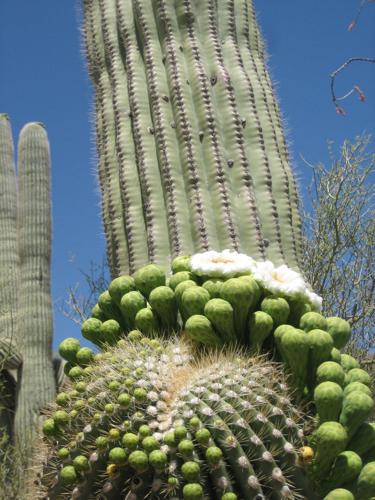
Q: We have three saguaros in our front yard, two, four and 10 feet tall. All appear to be healthy. The tallest one will get only two or three blooms each year. Before they can open they all dry up and fall off. Do you know what would cause this? Other saguaros in the area will have buds that open up into flowers. The 10-foot saguaro was transplanted into our yard about six years ago.
A: Dropping flower buds are sometimes associated with environmental stress, so first I’m curious to know if they are receiving enough irrigation. Some saguaros planted in our landscapes don’t end up in ideal locations so we might need to take better care of them than those in the wild desert.
Typically, they don’t need much water but they do need some. The recommendation is once every two weeks in the summer, every three to four weeks in the spring and fall, and none in the winter. Of course, you can skip the months where we get significant rain during the monsoon season. If you can rule out the water problem, consider what other factors in your environment could be affecting the area where they are growing.
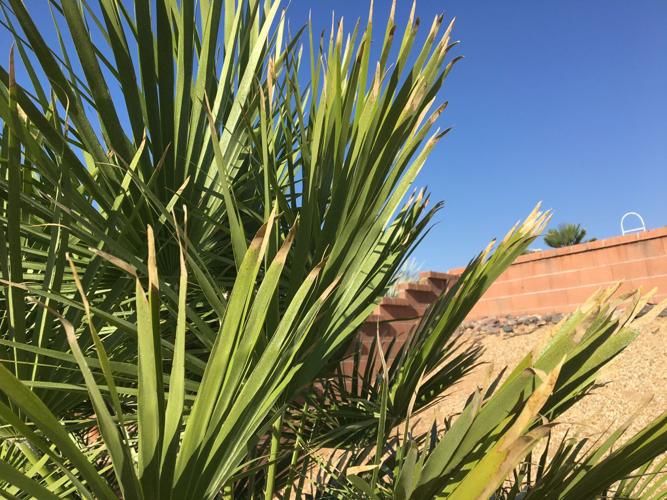
Q: I have a palm tree where the frond tips are turning yellow. I know that the lower fronds usually turn yellow or brown due to age, but the yellowing tips are throughout the entire tree. I have not changed any watering or fertilizing schedules. Any thoughts on why this yellowing is occurring?
A: Frond tips turning yellow and brown are often a symptom of drought and excess salt in the soil around the roots. Fortunately, the cure for both of these is the same, more water.
A good soak once every few months will help wash the salt out of the root zone. The rest of the time these trees should be getting water every seven to 10 days in the summer, 10 to 14 days in the spring and fall, and every two to three weeks in the winter. Each time the water should reach a depth of 36 inches. With proper irrigation and an occasional soak, you will soon see how we can be good fronds for the palms.
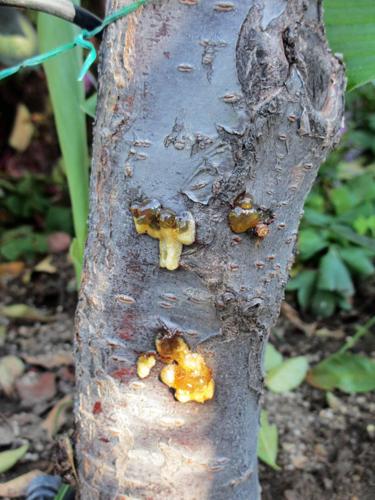
Q: I planted three Flowering Yoshino Cherry trees from pots about four years ago. Watered and fertilized the same for all these years. Two of the trees are doing okay. For some reason, one of the cherry trees started to drops its leaves. There is some kind of white sap coming out from the lower part of this one tree.
I do not know if the sap has anything to do with the tree dying. Do you know what might be causing the tree to look wilted and leaves to drop? This started before the high temperatures we have been getting.
A: Cherry trees and related fruit trees may ooze sap and drop leaves in response to injury. The injury can be due to freeze damage, insect feeding, disease, wounding from tools, hail, or sun scald of the bark. If you see any sawdust around the wound or in the sap, insects become a prime suspect.
The location of the wounds may be significant since some insects usually attack the lower trunk, others the upper branches. If you only see the cracking on the sunniest sides of the tree, the scalding is more likely.
From your photo, there doesn’t seem to be any obvious injuries from tools. If you experienced any freezing last winter or hail damage, they are possibly to blame. Please let me know if you come up with any more clues to help solve this puzzle.

