


Q: What are these bugs on this milkweed?
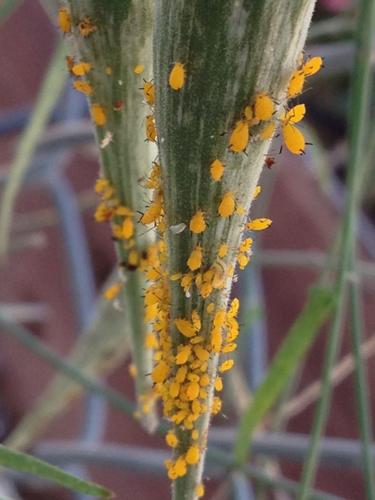
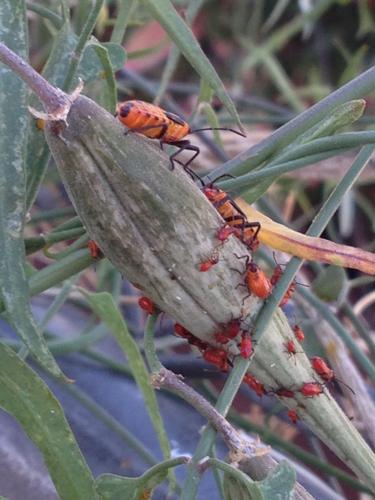
A: The red and black ones are milkweed bugs. That might seem like a snarky answer but it’s the official common name for these insects otherwise known as Oncopeltus fasciatus. They can also be found on oleander plants, which might explain why the yellow insects are called oleander aphids (Aphis nerii).
Both species are commonly found on milkweed and oleander plants. Insects tend to favor specific plants or plant families when they feed. Milkweed and oleander are relatives from the same plant family and known for their sap that contains cardiac glycosides, which are poisonous. The insects that ingest it as a food source are able to sequester it and become protected to some extent.
If you watch other animals preying on these insects, you may notice they spit them back out. The red and yellow coloration is nature’s way of warning predators to leave them alone but not everyone understands the warning signs without a taste test.
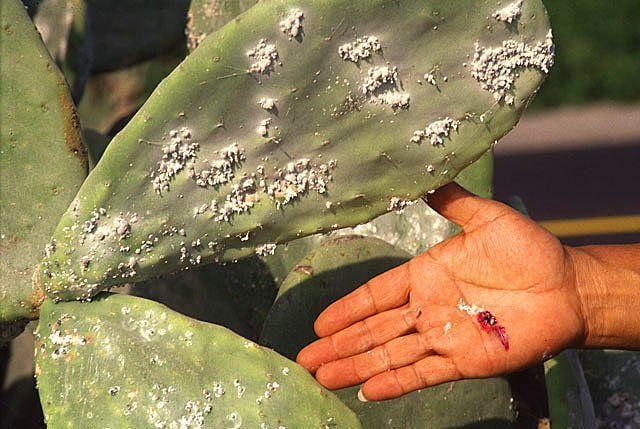
Q: We have infested-with-mealybugs prickly pears on a border with a neighbor who insists that the only way to control the infestation is to use a Bayer Tree and Shrub chemical. I so dislike and try to avoid these solutions. Can you direct me to an online intelligent discussion that isn’t sponsored by Bayer? Or do you have a nonpoisonous alternative?
A: I suspect what you are seeing isn’t mealybugs but rather Cochineal scale (Dactylopious coccus) on your prickly pear cactus. The easiest treatment is spraying them with a hose. You can also use a soap solution (1 tablespoon per gallon of water).
While the Bayer product will kill these insects, it is also likely to kill beneficial insects in the area that may be feeding on the scale insects. You and your neighbor shouldn’t expect to eradicate these insects. They are very common in our area and will likely continue to feed on the cactus no matter what method you choose.
Fortunately, they aren’t likely to kill these plants if you spray them with a hose periodically.
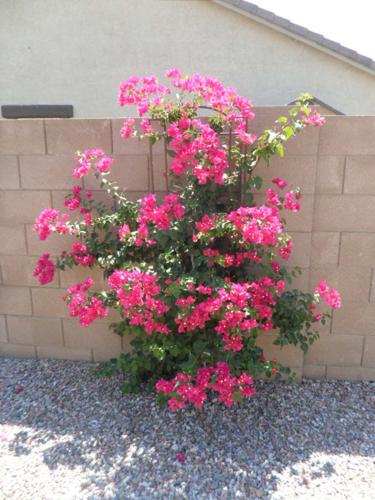
Q: I have six bougainvillea plants in my back yard. I have three on the east side and three on the west side planted about a year ago. Last summer the ones on the west side looked great and ones on the east side looked really bad. This summer the ones on the east side look great (see picture), the ones on the west side (not shown) look really bad.
We feed them and spray for bugs but still no luck. The water system goes off every other day at 7 a.m. and 3 p.m. My wife also waters them with the hose. But we can’t seem the get them to look good at the same time. Do you have any ideas as to what we can do?
A: Bougainvilleas are fairly tough plants once established and by the time they are a year old they should be doing well. The trouble last summer could have been from the shock of transplanting them. The plants on the east side appear to be getting western afternoon sun. That is where they do best and your plants on that side look great.
The plants on the west side appear to be getting eastern morning sun and might be shaded in the afternoon by the wall. Since full sun is prescribed for these plants, it could be a factor for the ones that may be shaded. It’s hard for me to say from the photos (not shown) how much shade they get but it’s something to keep in mind.
From your description, the trouble this year may be due to overfertilizing and overwatering. Once or twice each year is all you need to fertilize and watering should be done less often and deeper than your current schedule. Try switching your irrigation schedule to once every seven to 10 days to a depth of 12 to 18 inches in the summer. Then you can reduce the irrigation to once every two weeks in the fall and every three weeks in the winter.
Bougainvilleas have few pest problems. The one I see in your photo (not shown) is damage caused by leaf-cutting bees. These bees are native pollinators and should be protected as best we can. Their need to cut circular holes in the leaves of some plants to build their nests may be disturbing to see but won’t cause great harm to your plants.
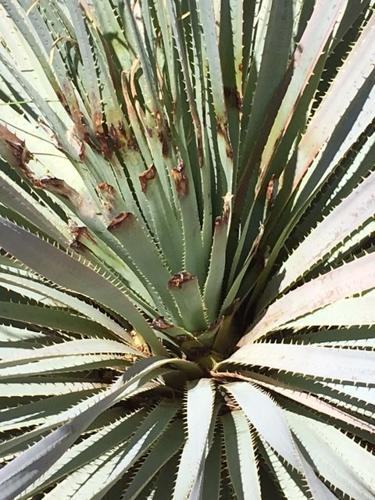
Q: The leaves/stalks in the center of my desert spoon plants are being eaten away about 6 inches up from the base. I don’t see any problem from the base and only water them about once per month with a hose. What is causing the problem and what can I do to make them healthy again?
A: It appears your desert spoons are a food source for a four-legged critter, probably javelina. These animals will feed on a variety of cacti and succulents. The solution is fencing or some sort of a detour around the plants you are trying to protect. Keep up the good care you are already providing and see if you can devise some fencing system that suits your landscape plan.

