



Q: We planted two different kinds of tomatoes in a planter. The larger variety is thriving. The smaller variety has tomatoes that grow in green and no problems, but as they begin to ripen, the end farthest from the stem turns black.
A: The problem you described is called blossom end rot and it is associated with a calcium deficiency.
While the occurrence of blossom end rot may indicate calcium deficiency, in reality, the soil may have adequate calcium. However, for various reasons the plant may not be able to take up enough calcium to supply the rapidly developing fruit. As a result, efforts to manage this problem fall into two categories: pre-plant and post-plant.
Prior to planting, the main preventative measure is to have a soil test done to determine if there is adequate calcium. Limestone (a source of calcium) should only be applied if soil test results recommend it. When limestone is needed, best results are achieved when the limestone is worked into the soil 2 to 3 months prior to planting.
After tomatoes are planted, you can minimize the potential for blossom end rot by doing the following:
Once transplants become established, encourage the production of a large root system by keeping plants a little on the dry side for a few weeks (until they begin to flower and set fruit). A large root system is better able to take up the calcium needed for the healthy development of the tomato fruit.
After fruit set begins, keep soil evenly moist. (Avoid extreme fluctuations in moisture levels. Do not overwater!)
Apply a layer of mulch to help maintain even moisture and keep soil cooler.
Do not over fertilize. Especially avoid high-nitrogen fertilizer as it can cause problems with the uptake of calcium.
Do not cultivate closer than 1 foot to plants to avoid damaging roots.
If tomatoes develop blossom end rot, spray the foliage with calcium chloride or calcium nitrate when symptoms first appear. Follow the instructions on the label. Removing fruit with symptoms is also recommended.
The good news is that tomato plants self-adjust after the first fruit are set, and later fruit are typically not affected by this disorder.
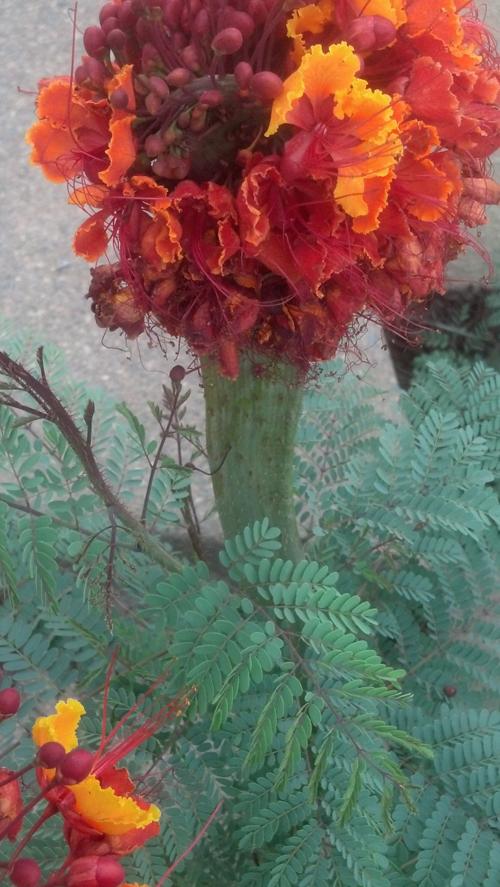
Q: We’ve had this plant in our yard for at least seven or eight years, and this year it sprouted this unusual branch. It’s about 1.25-inches wide and the thickness of a normal “round” branch. We have never seen this before. Is this normal? Or is there something wrong with this plant?
A: The odd branch is not normal but it’s also not a big deal. We call it fasciation and it is abnormal growth in which the growing tip becomes elongated perpendicularly to the direction of growth producing flattened, ribbon-like or crested tissue. Some plants have mutations like this periodically and are prized aesthetically for this feature.
You might occasionally see saguaro cacti with this fasciation. We have one on campus near Old Main that draws a lot of attention. Viruses, mites, or environmental factors sometimes cause the mutations.
Q: I live in Sonoita and we have about a basketball-size swarm of bees that has been hanging in our desert willow tree for a week. I’d like to just let them be, in hopes that they will move on. But since it’s been a week I wanted to check to see if we should do something.
A: Honeybee swarms typically move on within 72 hours so I understand your concern that this one stuck around for a week or so. The fact that it is a swarm out in the open rather than a colony in a cavity makes me think it will eventually move on.
If you would like to contact a beekeeper to remove them for you there are some that provide this service for a fee. We keep a list of beekeepers at our office that includes members of the Tucson Beekeeper Facebook group so you can access the list on their site as well.
Q: I am taking care of a neighbor’s plant, Great Cascade Lophospermum. It’s planted in a pot and bought recently. It’s not looking good and has browning leaves. I’ve been watering daily and it only gets morning sun. Is there something else I could be doing? Is this a good plant for our area?
A: Lophospermum species are native to higher elevations in Mexico so it may be suffering from the heat. If you can put it in a shady location that receives indirect light that might help.
As far as watering goes, make sure the soil is moist throughout the day. These plants require moist soil all the time and as I am sure you know, containers can dry out fairly quickly in the desert. If it is drying out before the end of the day you might need to water twice a day or more.

