

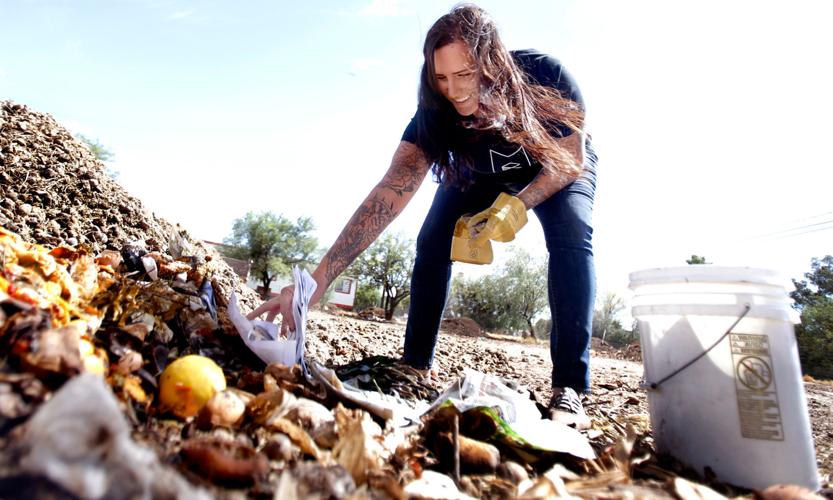

Desa Rae had composted waste for her gardens for much of her life, but she had to give it up when she moved into a Reid Park-area condominium complex a few years ago.
Rae tried to get a community compost bin started, but without success.
Then a friend told her about Scraps on Scraps. It’s a 17-month-old company that picks up green waste from residential areas and drops it off for composting by the Community Food Bank of Southern Arizona. “I thought, ‘Oh my god, that’s perfect for me,’” says Rae.
She pays for the biweekly pick-up service and allows about eight of her neighbors to add their waste to her buckets.
Rae became an early customer of the service, which is owned by two 20-something Tucson sisters who started the service out of a sense of stewardship as much as to launch a business.
A SCRAP OF AN IDEA
Shannon Sartin, who works in government affairs, saw the potential one day when she finished eating a banana.
“I had been living in Seattle, which has residential green-waste pick-up,” she explains.
She moved back to Tucson and found herself with a “twinge of guilt. I was standing over a garbage can with a banana peel in my hand.”
She and her sister, Moira, a University of Arizona student of women’s nutrition and health, talked about how Tucsonans didn’t have an easy way to keep food scraps out of their garbage and landfills.
An average family generates about 25 pounds of compostable waste every two weeks, says Shannon Sartin. In Tucson, there is no dedicated residential pick-up service for green waste that includes landscape trimmings, food scraps and untreated paper.
Green waste buried in landfills decays into air-polluting methane, says Erin Tunze, operations manager for Scraps on Scraps.
“Methane is worse than carbon dioxide” as a gas that changes the climate, sayd Tunze. “Scraps on Scraps is cutting that off at the source and not sending food waste to landfills.”
Friends told the Sartins that the idea of people paying to have green waste hauled away wouldn’t fly in Tucson. Shannon says she found a more enthusiastic reception in the local sustainability movement.
The sisters took sign-ups at farmers markets, then got a boost when they won the Get Started Tucson competition in May 2014. They beat out four other business owners in the entrepreneurial pitching contest and took away more than $10,000 in prize money and services.
COMPOST 101
Compost is decomposed organic matter, according to information on the Tucson Organic Gardeners website.
“Compost, when added to soil, retains water, adds valuable nutrients and neutralizes the alkalinity of desert soils,” it says. Scraps on Scraps gives the material it collects to the Las Milpitas Community Farm, run by the Community Food Bank.
Food waste is part of the mix that includes spent grains from a local brewery, trimmings from the gardens and manure from the farm’s chickens and neighborhood cows and horses.
The compost enriches the beds at the farm, which is used by the food bank’s clients and the surrounding community.
“(Scraps on Scraps) contributions help what’s being done at the farm by getting more food scraps into the compost piles, which helps to create a more well-rounded end product,” says Chris Mazzarella, who invited the Sartins to bring their collections to the farm.
“Compost is a crucial component for successful growing in our desert climate,” says Mazzarella, who until March was the farm manager, “so their contribution ultimately turns into food for our gardeners.”
That’s part of what the two like about their business: It’s a way to feed people, protect the environment, and provide jobs. The pair currently has four employees, but hope to add more positions as the business grows. Shannon won’t say how many customers they have now, but estimates that the company picks up as many as 80 buckets a week. Others are dropped off at farmers markets.
“Our ultimate goal is to get two percent of Tucson households, which is 6,000 houses,” says Shannon.

