


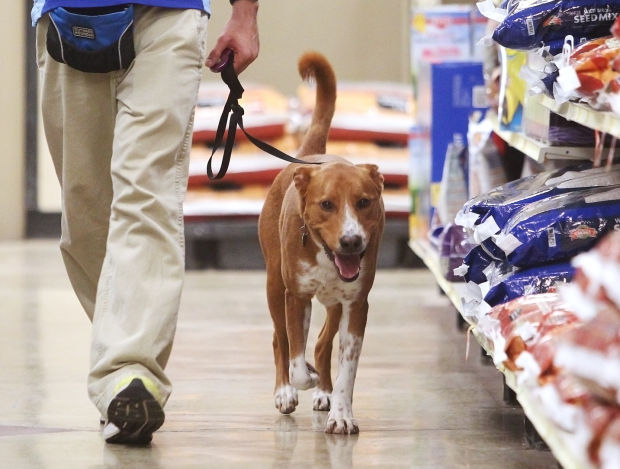
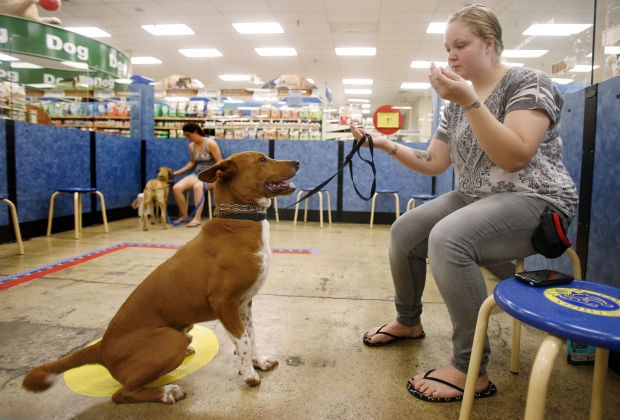

Boston was one of four dogs starting a training class at PetSmart in central Tucson last Saturday. His tail never stopped wagging.
Just jumping into the car and going for a drive was exciting enough. But even better was getting a treat for making eye contact with his foster mom, Fern Clark, who directs Big Heads, Bigger Hearts Rescue.
Jeremy Brown, an area trainer for PetSmart, started the class by working on getting the dogs to focus. Boston aced the eye contact.
"He's a happy dog," Brown said later. "He just had a bad start. We're working to try to solve the problems other people started." Brown said he's seeing more rescued animals come for training, either with new owners or foster families.
"What's neat about it is that there's so many more people out there that actually care and want the dogs to succeed," Brown said.
While Brown was teaching Saturday, the PetSmart at 4740 E. Grant Road bustled with people shopping with their dogs. Volunteers with rescue groups offered cat adoptions on the east side of the store and dog adoptions on the west side.
"What's cool is that we have new rescue groups pop up all the time," said Brown, who is also optimistic about PACC's progress in saving more animals. "Within the last couple of years they have really changed a lot of things," he said, referring to the county shelter's move toward no-kill. "It's amazing, actually."
PACC's live release rate was 38 percent in fiscal 2008, and 76 percent last year. It was 84 percent in August.
Two weeks is the average length of stay for a dog at PACC, said Karen Hollish, PACC's development director. A purebred puppy may go out within hours, she said, while a pit bull mix could stay six months.
PACC takes in all of its animals without charge in addition to picking up strays and taking in injured, abandoned and abused animals.
"We get some absolutely perfect dogs whose families for whatever reason couldn't care for them anymore," she said. Other animals may have never been trained. Behavior can also deteriorate over time‚ especially in crowded conditions.
PACC currently houses 1,000 animals in a 46-year-old building intended to house 300. Next month, voters will be asked to approve Proposition 415, a $22 million bond that would be used to build a larger, more modern shelter.
"Because we're so crowded a dog that doesn't get along with other dogs, we don't have a place to put them," she said.
With the addition of a veterinarian dedicated exclusively to the care of shelter animals, that leaves behavior as the last big challenge to adoptions, she said.
Volunteers often get attached to animals who stay for awhile, especially those who are struggling.
"It's awesome that the volunteers step up to help those dogs. They're doing something we just don't have the resources to do. If anyone wants to contribute to a behavior fund they can contact me," said Hollish, whose position was added to supplement public support by raising money from private donors and grants.
She estimated that fosters saved hundreds of lives this summer.
Boston, described by Clark as a "giant puppy without manners," had been scheduled to be euthanized the same afternoon as Lucky.
Clark left with both.
For now, she's keeping Boston with her to give him some stability after being bounced around too much.
Part of that includes training, which so far has been covered by donations from PACC volunteers and people who saw him on Facebook.
Boston has a lot of potential, Clark says. "His story is whatever you make it when you adopt him."

