


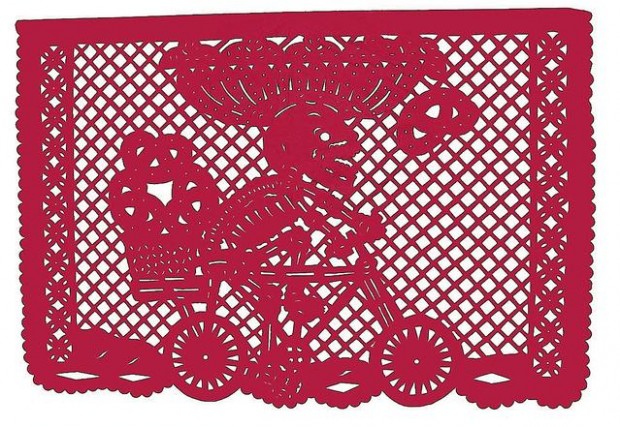
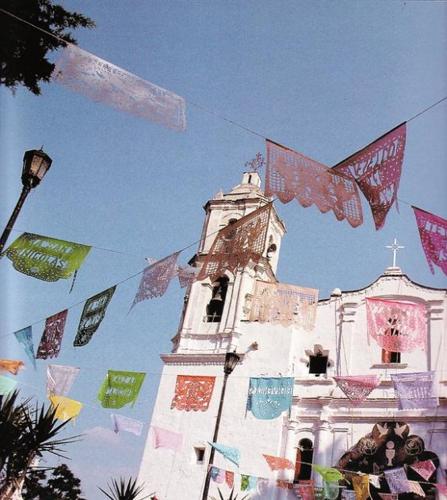
In Mexico, no festival or celebration is complete without the colorful punched-paper banners known as papel picado. As Tucson gears up for its annual Cinco de Mayo celebration, bright banners of papel picado will undoubtedly decorate many locations.
But for the most up-close-and-personal look at this popular art form, nothing beats a visit to "Papel Picado: The Tradition of Cutting Paper," an exhibit on on display through June 30 at the Tucson Museum of Art's Palice Pavilion.
During festive periods, long banners of papel picado are traditionally strung across streets, pathways, patios and ceilings.
The colors and designs in the paper reflect the nature of the celebration. For instance, there may be skeletons for the Day of the Dead and stars or Christmas trees for Christmas.
Banners for Cinco de Mayo and other patriotic holidays will be cut from tissue paper in the colors of the Mexican flag: red, white and green.
Although papel picado is found throughout Mexico, several villages in the state of Puebla are particularly renowned for this art form.
In San Salvador Huixcolotla and Tecamachalco, the tradition has been handed down for generations, and the intricacy of the designs and the skills of the artists are unsurpassed.
Although no one knows for sure when it began, by the early 1800s the tradition of cutting papel picado was well established in Puebla.
There is evidence that the indigenous people were creating designs in a paper they made from the bark of the amate tree even before the arrival of the Spanish.
However, the Spanish name for tissue paper, papel de china, or paper from China, provides an important clue as to origin of the art form as we know it today. Since trade between Asia and Mexico began in the second half of the 16th century, the raw material for papel picado — tissue paper — probably arrived in Mexico sometime after that.
To create papel picado, the artist first draws a master design on a single sheet of paper. This will serve as the template for cutting multiple images. Once the master template has been prepared, it is placed on top of a stack of tissue paper. An artist typically cuts 40-50 sheets at a time. The stack of paper is loosely tacked to a board, which has been covered with a thin sheet of lead foil. Now the artist is ready to begin cutting his design.
Cuts are made using a mallet and razor-sharp chisels of varying shapes and sizes. The artist positions the chisel and then strikes it with the mallet, driving it through the multiple layers of paper. Clean cuts are important to obtain the desired results.
Although the tradition of making papel picado from tissue paper has a long history, today some artists are choosing to incorporate new materials such as plastic or Mylar.
Like all art forms, the papel picado tradition continues to change and evolve.
However it is likely that these bright and colorful banners — in one form or another — will be adding their festive flair to celebrations for years to come.
Tune-up your mind
Look for these related books:
"Magic Windows" by Carmen Lomas Garza (Children's Book Press, $9.95)
"Making Magic Windows" by Carmen Lomas Garza (Children's Book Press, $7.95)
"Mexican Papercutting" by Kathleen Trenchard (Sterling Publishers, $14.95).
Discovery detours
Ask at the front desk for a copy of the Think, Seek and Find activity sheet to guide your looking at the papel picado exhibit. Hopefully, you'll have time to look at the rest of the wonderful collection in the Palice Pavilion.
If so, you will also want to request a copy of the Palice Pavilion Family Guide. Both are available free of charge.
Make your own papel picado, or cut paper banners
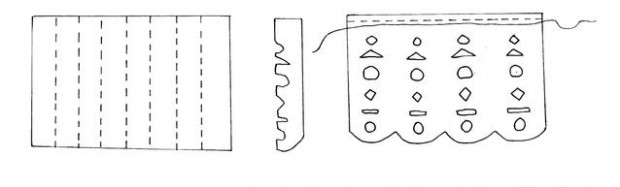
Cut at least 10 rectangles of tissue paper (in a variety of colors). They can be any size you want, but 8-x-10-inch works well. Place one rectangle of tissue paper on the table horizontally. Fold it accordion style from the side, making 5-8 folds.
Using a pair of scissors, cut a series of repeating shapes from the folded edges of the tissue.
Leave 1 inch at the top of the tissue paper uncut to attach the string.
Unfold the tissue paper to reveal the pattern. Flatten the tissue paper on the table, and have an adult help you iron it to remove the folds.
Cut each of your tissue paper rectangles in this way.
To prepare for hanging, lay the end of a long piece of string horizontally across the top of the paper where you reserved the 1 inch of paper. Fold the edge of the paper over the string to create a flap.
Glue the edge of the flap down with the string under the flap. (Caution: just a little glue will do it!)
Add each of your cut-paper banners to the string in this way, leaving about an inch of string between them. Hang your banners from the ceiling in your room or anywhere you'd like to create a festive mood.
Want to get even more elaborate in your cuts? The book "Making Magic Windows" (available from Crizmac) has instructions for many more ways to cut papel picado, as do some of the Web sites listed below.
Think tank
Discussion questions for the whole family to consider:
Traditionally, papel picado was made of tissue paper, with the idea that it would fade and disintegrate over time serving as a reminder of the fleeting nature of life itself.
In recent years, some artists have begun cutting papel picado (or more properly "plástico picado") from sheets of plastic.
This new version is more durable, but the material doesn't allow for as much detail or the intricate cuts that the paper variety does.
Some critics also complain that papel picado is meant to be temporary and that changing the materials changes the very nature of the art.
Suppose you were buying some of the festive banners for a party at your house. Would you choose the traditional paper or the new, plastic type? What factors would influence your decision?
Fuel for Thought
Did you know . . .
Although it's a common misconception, Cinco de Mayo is not Mexico's Independence Day. Mexican's reserve that honor for Sept. 16, the anniversary of the day in 1810 when Father Hidalgo rang the church bells in his little church in Guanajuato and gave his famous grito, or call for everyone to fight for liberty.
Cinco de Mayo is a celebration of the courage of the Mexican people during the battle of Puebla on May 5, 1862. It marks the victory of a Mexican army of untrained commoners over a much larger French (and exiled Mexican conservatives) army.
The victory did not win the war, but it did show the courage and strength of the Mexican troops and became a symbol of Mexican unity and patriotism.
Although not forgotten in Mexico, today Cinco de Mayo is celebrated much more widely by the Mexican-American community in the United States as an expression of pride in their cultural heritage.
For the mouse-bound
www.TucsonMuseumofArt. org
www.nps.gov/tuma/ PapelPicado.html
www.dltk-kids. com/world/ mexico/mpapel_picado.htm
Wheels are turning
Parents and Caregivers: These activities can help your child meet Arizona's educational standards. Visit www.crizmac.com and click on the Roads Scholar link to see the specific standards addressed.
What: Tucson Museum of Art's "Papel Picado: The Tradition of Cutting Paper," an exhibit on view through June 30
Where: 140 N. Main Ave.
When: 10 a.m.-4 p.m. Tuesday through Saturday, noon-4 p.m. Sunday
Admission: $8 for adults; $6 for ages 60 and older; $3 for students, age 13 and older; members and children under 12 admitted free. Free admission for everyone on the first Sunday of every month.
Information: 624-2333, or visit www.tucsonmuseumofart.com online.
Et cetera: Picture This! Art Sundays are held on the first Sunday of every month from 1 to 3 p.m. and offer free art-making fun for kids 6-12 years old and their adult companions.

