



William Daniels was a deputy sheriff for Cochise County in the Arizona Territory in the late 1800s.
He could easily have been immortalized on modern-day television or in early wild west novels as a lawman whose persistence got him his man. That never happened, but his is still a story worth telling.
in December 1883, a bank robbery in Bisbee turned into what became known as the "Bisbee Massacre." A gang of five men rode out of town with loot from the bank, leaving behind four dead victims.
Deputy Sheriff Daniels was a member of one of the posses that went after the murderers. Some accounts have the deputy searching for them after others had given up. Whether that is true or not, he did bring in at least one of the men, and all of them were captured, tried, convicted and sentenced to hang.
The following appeared in the Arizona Daily Star, March 29, 1884, and give a summary of the events:
DEATH PENALTY.
The Execution of the Bisbee Murderers
Now that the last act of the drama has been closed by the legal putting to death of the men, who on the night of December 7th killed or terrorized the people of the peaceful town of Bisbee, and for weeks subsequent defied the law, and in mountain fastnesses laughed to scorn those who essayed their capture. Only by the fatality of indiscretion so prone to follow on a murderer’s heels, were they at length tracked, captured, tried and hung. The actors were of that class commonly known as rustlers, now fortunately almost extinct in Arizona. Their headquarters were at Clifton and contiguous country. Here deeds of violence were committed, and but few men dared attempt to bring the perpetrators to the bar of the law. Occasionally a desperado died at the hands of an arresting officer, or was killed in a brawl with his fellows.
In November last, six men known to the people of the Gila, over whom they terrorized, as John Heith, O. W. Sample, W,. Delaney, Dan Dowd, Dan Kelly and Tex Howard, met near Clifton and decided to raid the town of Bisbee, distant about sixty miles. With that end in view, John Heith and Tex Howard went to Bisbee to spy out the ground, and to better decide upon future action. While there for the furtherance of their plans, Heith formed a partnership with a man named Wade to open a dance house, which, as they mutually agreed, was to be in operation by December 8th, inasmuch as that day would be the monthly pay day of the Copper Queen mining Company. The employees of the mine were paid in checks on San Francisco, and these were, at a slight discount, cashed by the banking house of Castanada & Co. To do this, considerable ready cash was required, and was on hand for use on the day named.
This was well know to Heith and Howard. The latter, accordingly, at the time appointed, notified their accomplices then in camp at Buckle’s ranch, about fifteen mile from Clifton. Heath, in the meantime, remained in Bisbee to watch the course of events, and, if possible, on the morning subsequent to the robbery to mislead pursuing officers. On the night of the seventh of December as per arrangement, Kelly, Howard, and Sample entered Castanada store. Down and Delaney remained outside.
Howard, with a cocked revolver in each hand, ordered all present to hold up their hands and say nothing under penalty of death. Kelly ordered the safe opened, which upon being done, was emptied of its contents. Sample at the same moment, robbed Castanada, who was lying sick in a back room. In the meantime Delaney and Dowd, stationed as guard, were busy with the work of death, and killed all who had the temerity to approach. The first victim was Deputy Sheriff T. D. Smith, then followed two men by name of Toppenheimer and Nolly, and lastly Mrs. Roberts, a woman far advanced in pregnancy, who stood watching the scene from her doorway across the street.
After the accomplishment of the robbery the gang mounted their horses and rode rapidly in the direction of the Soldiers’ Holes, a well known watering place in Sulphur Springs Falley. Here they divided their booty, which consisted of some $3,000 in money and carious articles of jewelry. They then parted, Dowd and Delaney going into Sonora, Howard and Sample north to Clifton, and Kelly east in the direction of Deming.
Suspicious circumstances pointed to Heith as an accomplice; he was therefore immediately arrested, but declared his innocence and refused to divulge his connection with the affair, and as he was in his saloon at the time of the robbery, he was by some thought to be innocent. Sample and Howard arrived at Clifton at midnight on the 14th. They went immediately to the saloon of Deputy Sheriff Hill, and on being told where he was sleeping, they roused him up and recounted with considerable bombast their exploit at Bisbee, and exhibited a gold watch and a lot of money in proof of what they said. They told the directions taken by their confederated and outlined their own future plans. They accepted an invitation to drink, then re-mounted and rode up the San Francisco river. But no sooner were they gone than Hill called up Under Sheriff Hovey and repeated to him the story as gleaned from the murderers.
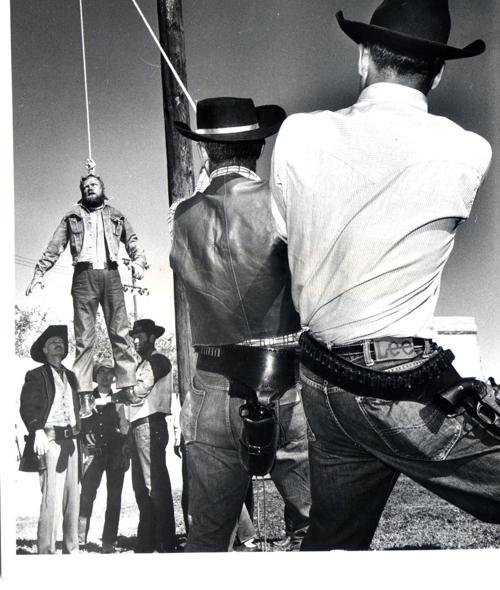
Their capture was at once decided upon. consequently at daylight the authorities at Deming were notified to watch for Kelly, who as expected reached there that morning and was arrested. Howard and Sample were taken by a sheriff’s posse under Deputies Hovey and Hill, near their camp on the Little Blue river about forty miles above Clifton. Delaney was arrested at the minds Priates in Sonora, and Dowd was arrested by Deputy Sheriff Daniels at Corralitas, likewise in Sonora. All were in due time securely lodged in the Tombstone jail. an extra session of the court was called to try them on indictments found. Kelley, Sample, Dowd, Delaney and Howard were put on trial at the same time. They were convected and sentenced to death. Keith was tried subsequently and convicted of manslaughter. Of this the people of Tombstone generally disapproved. They believed that he too, merited death. Consequently on the night following his conviction, February 22, a posse of men gained entrance to the prison, took Heith out and hung him to the nearest telegraph pole.
Yesterday was the day fixed for the hanging of the condemned men, and although the execution was within the prison walls, it drew a great crowd to Tombstone in the vain hope of being able to witness the hanging of five men, notorious to evil deeds among Arizona’s worst.
___
THE PROCESSION.
LATER.—Promptly at one o’clock p. m. the procession to the scaffold moved from the condemned cell, headed by Rev. Fathers Antonio, Jovanceau and Gallagher, and Sheriff Ward. Each prisoner was attended to the gallows by an officer of the law. The caps and nooses were adjusted by Sheriff R. H. Paul, of Pima county, and Deputy Sheriff J. F. Crowley, of Wilcox. Tex Howard and Wm. Delaney were cool and composed, and smilingly greeted their numerous acquaintances in the jail yard. Red Sample and Dan Kelly faltered and showed a little nervousness, the former almost losing his muscular control. He managed, however, to speak as follows: “Well, my friends,
I BID YOU GOOD BYE.
I am to be hung for a crime I never committed. Keith had nothing to do with the Bisbee murders, and he never put up a job with any of us. I desire aChristian burial, and hop to meet you all in Heaven.” Dan Kelly said, “I also desire a Christian burial, and that Father Gallagher shall take charge of our bodies.” The rest said “I say what he says,” referring both to Sample and Kelly. There was a pause of a few seconds, when Kelly cried
“LET HER LOOSE,”
and the Sheriff immediately followed with “ready.” The drop fell at exactly eighteen minutes after one o’clock. Dow’s struggled were very marked, while the bodies of the others scarcely twitched. At one fifty-five the bodies were cut down and removed to the morgue, whereupon an examination being made, it was discovered that Red Sample’s neck was dislocated, and that the others died of strangulation.
Daniels later became a customs inspector and traveled about Arizona in the course of his work. This was dangerous because of Apache raids. (We won't get into the Apaches' motivations that led to this. It happened.)
This danger proved fatal for Daniels. He died June 10, 1885, (possibly June 9) as reported in the Daily Tombstone, Saturday, June 11, 1885. The Arizona Daily Star for that date was missing from microfilm records.
The Daily Tombstone report:
INDIAN NEWS.
AN EYE-WITNESS OF THE DEATH OF W. A. DANIELS
The Air Filled with Vague Rumors of Other Murders in the County.
A Determined Effort Being Made to Suppress the Present Outbreak.
A reporter of The Tombstone met Mr. Milton Gillam this morning on his return from Bisbee, and are able to give a pretty good account of the killing of W. A. Daniels. He states that he and Daniels left here on Monday and arrived in Bisbee that night. The next morning Daniels and Gillam went out to Forrest’s ranch to see if they could get some horses so that a body of men could be mounted in Bisbee, and take the Indian trail that Daniels had seen they day before. When they arrived there no horses could be got as they were all out on the range somewhere on the range. A 14-year-old boy of Forrest started out to look for the horses, and Daniels and Gilman, after promising Mrs. Forrest, who was very much alarmed, that they would come back and stay at the house that night, started out to see of they could find any new trails, and had ridden about 10 miles when they struck no less than 50 different trails which were very fresh. Daniels said he felt sure that the Indians were in Dixie’s cañon, and they rode a piece in that direction, when Gilman looking up the cañon saw several Indians and the smoke of their camp fires, and called Daniels attention to it, when Daniels looked through a pair of field glasses and said Milt there’s a thousand of them up there. Let’s get out of here, and they wheeled and ran, but were cut off by a band of 7 or 8 Indians that they had not seen before. Daniels then fired 2 shots at them with his revolver, and Gilman fired 4 shots from his Winchester, they Indians meanwhile keeping up a regular fusillade. Gilman and Daniels were riding side by side when Daniel’s horse leaped into the air and fell breaking its neck, and falling broke its riders neck. In the meantime the little Forrest boy rode up and emptied his rifle at the Indians without effect. As soon as Daniels fell an Indian went up to him and shot 7 shots into his head and then mashed his jaw with the butt of his gun. They took his coat, vest, saddle and bridle. Gilman and the boy rode down the road until they met three teamsters with their wagons who were hauling lumber to Bisbee, and three horsemen from Bisbee coming over the hill at this time scared the Indians off. All hands then went and got Daniel’s body and took it to Forrest’s and thence to Bisbee. Mr. Gilman and the boy had a very narrow escape, and he attributes the saving of his life to the boy Forrest.
Mr. Gillam's name was occasionally reported as Gilman, but these appear to be the same man.
Thus ended the life of one of the lesser celebrated lawmen of the Arizona Territory. William Daniels may not have been immortalized in song and story, but he made his mark.

