


Happy Birthday, Tucson: 244 years of Old Pueblo history
In honor of Tucson's 244th birthday on Aug. 20, we present a history of the Old Pueblo first published in 2015.
1854 Gadsden Purchase
Updated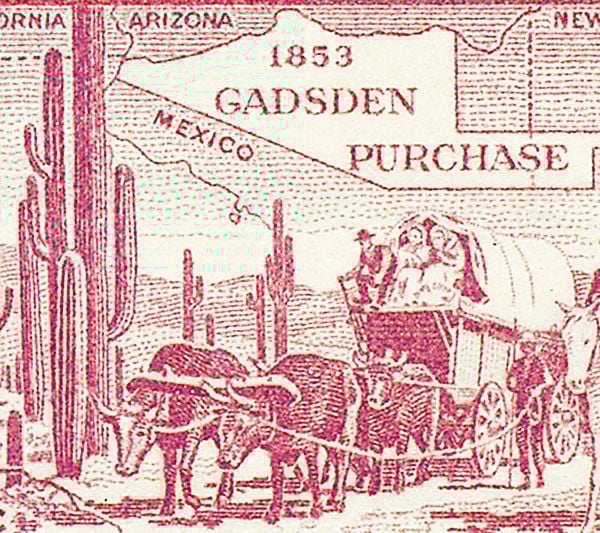
Leaving its stamp on history: This 3-cent U.S. stamp was issued on Dec. 30, 1953, to mark the 100th anniversary of the Gadsden Purchase.
1854 Gadsden Purchase
The Tucson Presidio was part of the 29,670-square- mile swath acquired for $10 million from Mexico — primarily to build a southern transcontinental railroad line. Arizona became a separate U.S. territory in 1863 and, after a contentious political process, finally gained statehood in 1912.
1880 The railroad arrives
Updated
Estevan Ochoa was born in 1831, in Chihuahua, Mexico
1880 The railroad arrives
Tucson was the territory’s largest community with 7,000 residents when the Southern Pacific brought new goods and people, including U.S. President Rutherford B. Hayes. Tucson freight company owner Estevan Ochoa introduced territorial legislation in 1877 to facilitate the railroad's completion.
1891 University of Arizona opens
Updated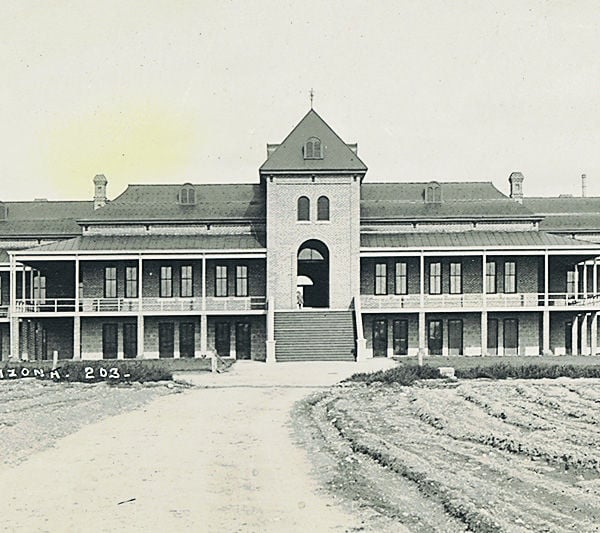
Old Main, the original building on the campus of the University of Arizona.
1891 University of Arizona opens
Many Tucsonans wanted the territorial capital back, a designation lost to Prescott in 1877. Instead, the 1885 Arizona legislature awarded the Old Pueblo a university, a decision that left some residents extremely disgruntled. Six years later, the first classes were held in the building now known as “Old Main.”
1920 Tucson loses “Metropolis of Arizona” status
Updated
A pair of Sunshine Climate Club models command this replica of the Butterfield Stage due to arrive in Tucson. Their prospector friend is Vigilante Harry Blacklidge. Driver of the coach (left) is Judy Martin and her shotgun guard is Pat Coleman.
Greater water supplies, more agriculture and several other reasons helped Phoenix zoom ahead of Tucson in population by 1920. In response, Old Pueblo businesses established the Sunshine Climate Club to bring health seekers and tourists to town.
1922 Urban lifestyle gets its start
Updated
Undated photo of Harold Bell Wright.
1922 Urban lifestyle gets its start
Some real estate agents credited best-selling author Harold Bell Wright with initially seeing the attractiveness of low-density desert living that helped inspire "sprawl" in the valley. He purchased 160 acres of remote property at the southeast corner of Speedway and Wilmot Road and built a home where he lived for almost a decade. In 1950, Wright’s property became the subdivision bearing his name.
1923 Steward Observatory opens on the UA campus
Updated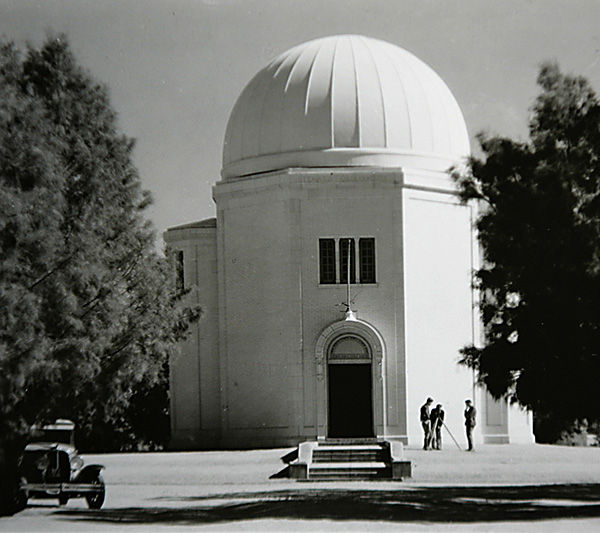
Copy of a photo of Steward Observatory March 1930, photo by R.B. Streets, department of Plant Pathology University of Arizona, Special Collections
1923 Steward Observatory opens on the UA campus
The building with a 36-inch telescope, first proposed by noted scientist Andrew Ellicott Douglass in 1916, was delayed in part because of World War I. Funded by Lavinia Steward, it helped focus attention on Tucson and by 1967 the community was labeled “the astronomy center of the world.”
1927 Airport moves to Davis-Monthan
Updated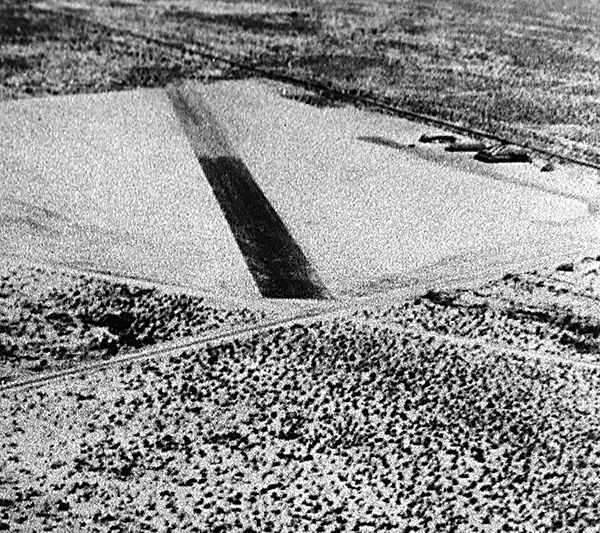
Davis-Monthan air field in 1927.
1927 Airport moves to Davis-Monthan
Tucson opened the first municipally owned airport in the United States in 1919 on South Sixth Avenue where the rodeo grounds are now. Within a few years planes were too big and more space was needed. On Sept. 23, 1927, four months after flying solo across the Atlantic Ocean, Charles Lindbergh flew in to dedicate the new Davis-Monthan airfield.
1933 Designation of Saguaro National Monument (east)
Updated
Visitors look out on the Saguaros National Monument in the early 1960s.
1933 Designation of Saguaro National Monument (east)
Efforts to protect Tucson’s magnificent natural setting included the establishment of the Desert Botanical Laboratory on Tumamoc Hill in 1902 and creation of Tucson Mountain Park in 1929. Setting aside saguaro-covered rolling terrain on Tucson’s east side was a goal of UA President Homer L. Shantz and many others. It was finally accomplished on March 1, 1933. The west unit was designated in 1961. Both became a national park in 1994.
1950 “Short road” opens up Mount Lemmon
Updated
A truck pulling a trailer gets an early start on the Labor Day holiday as it travels up the Mount Lemmon highway near Windy Point.
1950 “Short road” opens up Mount Lemmon
In 1928 and 1930, Pima County voters said "no" to replacing the long, circuitous route to Mount Lemmon through Oracle. Finally, with federal funds and prison laborers, including World War II conscientious objectors, the road was finished in 1950. Shortly thereafter, motorists by the thousands could enjoy 10 picnic areas, several campgrounds and Rose Canyon Lake at Tucson’s “Summer Paradise.”
1951 Hughes Aircraft comes to town
Updated
Hughes Aircraft plant under construction south of Tucson in September, 1951. It is now Raytheon Missile Systems.
1951 Hughes Aircraft comes to town
Metropolitan Tucson’s economy was boosted tremendously when the Hughes plant, now Raytheon, opened. Employing thousands of the area's 140,000 residents, the company helped diversify the local economy, increase wages and attract other aerospace and technology companies.
1960 El Con Mall debuts
Updated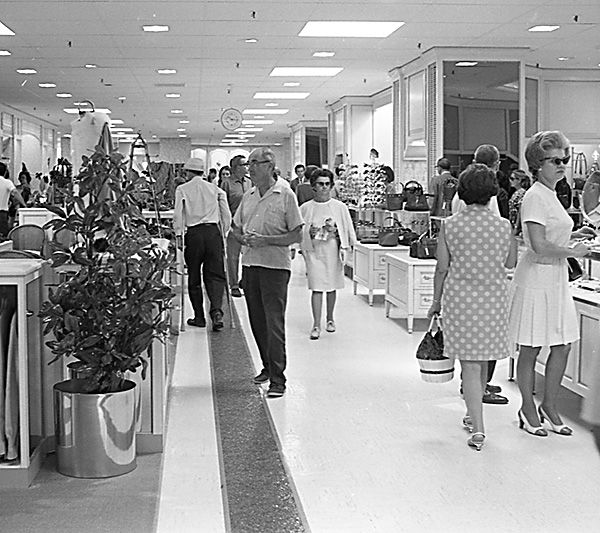
Customers inside the new Levy's store at El Con Mall on Sept. 15, 1969.
1960 El Con Mall debuts
Expanding development, the automobile era and cheap land on the outskirts helped place downtown retailers in a precarious position by the mid-’50s. Their situation was exacerbated when El Con debuted with several large stores and plenty of free parking. The adjacent and iconic El Conquistador Hotel was demolished in 1968 to allow the mall to expand.
1965 Urban renewal begins
Updated
The Tucson Convention Center starts to take shape as construction continues on December 4, 1970.
1965 Urban renewal begins
After earlier rejecting a much larger proposal, the Tucson City Council approved a 79-acre urban renewal project that controversially forced the relocation of hundreds of families and small businesses. The project, completed in the 1970s, included governmental buildings, the Tucson Convention Center and the La Placita retail complex. The project's goal was to help revitalize downtown by attracting tourists and residents.
1966 The copper capital of the world
Updated
Alvin Fulton maneuvers a machine carrying copper cathodes at the Johnson Camp Mine in Cochise County east of Benson, Ariz., Thursday Aug. 14, 2008.
1966 The copper capital of the world
Mining's role in Southern Arizona preceded the Gadsden Purchase. By the 1960s, an annual “Copper Days” celebration recognized the importance of the industry, which employed almost 9,000 people in Pima County at its peak in the 1970s. Today the figure is approximately 2,300.
1974 Oro Valley incorporates
Updated
In May, 1975, after more than a year in existence, the Town of Oro Valley got a sign from the Arizona Dept of Transportation along Oracle Road, also known as State Route 77. As the Tucson Citizen noted in 1975, "Motorists looking for an on Oro Valley business district are in for a surprise: There isn't one." How things have changed. Now, much of Oracle Road in Oro Valley is flanked by stores, large and small.
1974 Oro Valley incorporates
The move by Oro Valley's 650 residents in 1970 was opposed by Tucson and county officials. After a four-year legal battle, the community became the third municipality in Pima County with many residents hoping its population would not exceed 4,500. Today, more than 41,000 people call Oro Valley home.
1976/1977 Water rate hikes and a recall election
Updated
Homeowners Bob and Judy Schumann say after moving to the desert from the midwest, they wanted to use desert landscaping in their backyard.
1976/1977 Water rate hikes and a recall election
Seeking a sustainable rate structure, the Tucson City Council voted to dramatically raise water rates. In response, three council members were recalled while another resigned. Rates went up anyway, and lawns were soon being converted into the desert landscaping that today distinguishes the city from our neighbors to the north.
1984 Voters defeat Rillito-Pantano Parkway proposal
Updated
Runoff from north of the River is just beginning to feed in to the Rillito as a lone rider pedals east along the River Road Trail following a short but intense rain shower with hail on Friday, September 9, 2011 in Tucson, AZ. Photo is shot from the new La Cholla bridge.
1984 Voters defeat Rillito-Pantano Parkway proposal
After political decisions cancelled earlier urban freeways, the Pima County Board of Supervisors sought voter approval for a northside east-west parkway. Backed by many business and development industry leaders, the proposal was handily defeated at the polls. Thus, Tucson has no urban freeways besides I-10 and I-19.
1993-1999 Central Arizona Project water wars
Updated
No Title Central Arizona Project canal. 4-9-01.
1993-1999 Central Arizona Project water wars
Original plans for using CAP water in Tucson called for “direct delivery,” or sending the water to a west-side treatment plant, then delivering it to customers. Concerned about some chemicals to be added, supporters of recharging CAP water into the ground were partially successful at the ballot box. As a result, huge recharge basins were developed in Avra Valley and help to ensure sufficient water for Tucson even in drought conditions.
2010 Spring training baseball leaves town
Updated
Bob Doty loads up a bunch of Diamondbacks bags into a moving van as they are clearing out and packing up to head to Phoenix Wednesday March 31, 2010.
2010 Spring training baseball leaves town
Some of major league baseball's greatest players thrilled locals as well as tourists during 64 years of spring training. That ended when the Arizona Diamondbacks and Colorado Rockies departed in 2010 for new stadiums in the Phoenix area. The Chicago White Sox left two years earlier. AAA teams moved on as well, leaving Tucson without professional baseball.

