


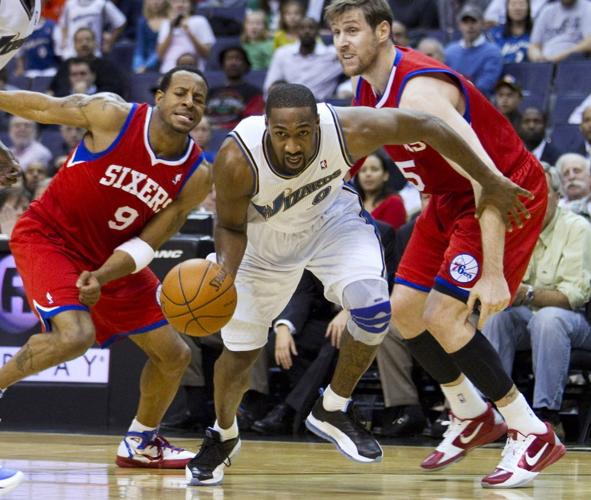
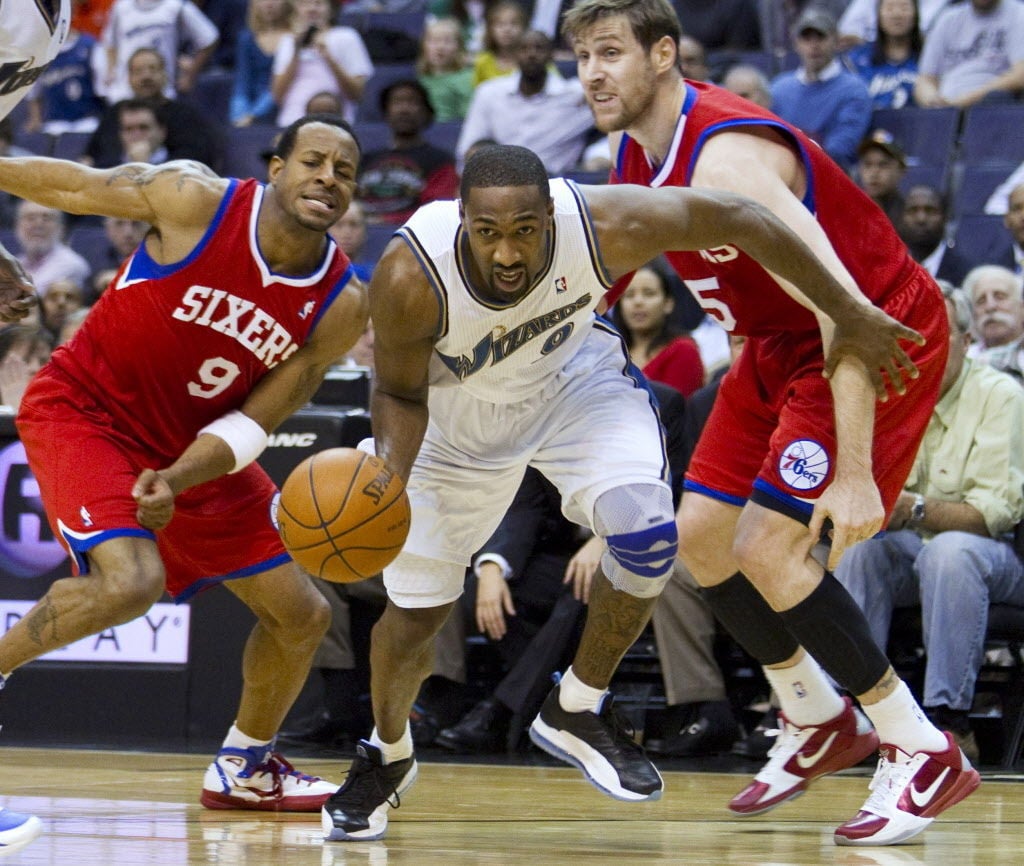
NBA draft flashback: Unique Arenas used draft snub as motivation
His name is Gilbert Arenas.
His name is also “Agent Zero” and “Hibachi.” Both were self-anointed nicknames.
During a live broadcast of an Arizona-UCLA game a couple years ago, colorful color commentator Bill Walton declared “Gilbert lost his mind” as the camera panned to Arenas in the Pauley Pavilion crowd.
Bill Walton said someone else lost their mind. Let that sink in.
This is Gilbert Arenas, one of the truly unique personalities to ever call himself a Wildcat.
His big personality, though, matched his talent. Well, most of the time. He was good for the Wildcats, and at times great in the NBA, before his career faded as injuries mounted and personality concerns arose.
But all in all, it’s hard not to say Agent Zero had a successful career in the NBA.
Here’s a look back at Arenas’ path to the NBA draft.
At Arizona: Two guards came to Arizona in its 1999 recruiting class.
One was Jason Gardner, widely considered a top-10 recruit. The other was Arenas, who was under the radar, widely rated outside the nation’s top-100 by most recruiting sites. Arenas, from Van Nuys, California, picked Arizona over Kansas State and DePaul.
Arenas certainly didn’t stay under the radar.
The 6-foot-3-inch guard came in and quickly established himself as a talent to watch. He scored 14 points in his first career game — a start — against Kansas State, ironically, and just kept getting better from there.
As a freshman, he scored 15.4 points per game in helping Arizona to a No. 1 seed in the 2000 NCAA tournament, where the Wildcats would lose in the second round to — sound familiar? — Wisconsin.
In 2001, with everyone returning — Gardner, Luke Walton, Richard Jefferson, Michael Wright and Loren Woods, to be exact — the Wildcats had one of the best seasons in program history, finishing 28-8 and making it to the national title game, losing to Duke by 10. Arenas led the team in scoring, with 16.2 per game.
That would be Agent Zero’s final year in Tucson.
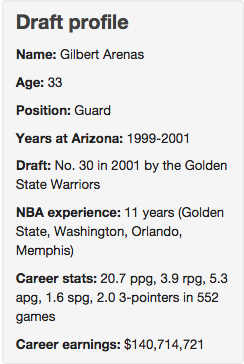
The draft: Considered a likely first-round pick, Arenas decided to leave for the NBA after two years with the UA, saying at the time, “When I came here two years ago without much recognition, I always thought I’d play here for four years. But after two great years in Tucson, I feel like I’m ready to take the next step and play in the NBA.”
Arenas joined teammates Jefferson and Wright in declaring. At the NBA pre-draft camp in Chicago, Arenas impressed scouts, further establishing himself, presumably, as a mid-to-late first-round pick.
“Look what kind of year he had,” Arenas’ father told the Star. “He’s definitely a first-round (pick). There’s no doubt about that.”
Despite the perception, Arenas was still without the skill set of a point guard, and at 6-3, undersized for a shooting guard. As a result, Arenas fell out of the first round, and was selected with the second pick of the second round by the Golden State Warriors.
From the archives: “I didn’t think I would drop into the second round, but it’s exactly perfect for me (to go there). I’m just going to have to work harder. By the end of the year, I will be one of the top five players in this class.” — Arenas to the Star in 2001
As a pro: It didn’t take long for Arenas to prove everybody wrong, again.
He became a full-time starter in Golden State by the end of his rookie year, and in Year Two, he was already scoring 18.3 points per game.
After two seasons with the Warriors, Arenas signed with the Washington Wizards on a six-year, $60 million contract. There, he thrived. His three-year stretch from 2004-07 is probably the best stretch of any former Wildcat in the NBA — Arenas scored 27.7 points per game and made three All-Star games. In 2008, he signed a six-year extension with the Wizards worth $124 million.
Starting in 2009, things went downhill. Arenas first got into trouble for taking a firearm into the Wizards arena, and then found trouble again in 2010 when he brandished a firearm at a teammate following a gambling dispute. As a result, he was suspended for the season.
Arenas would only play two more seasons in the NBA — with the Orlando Magic and Memphis Grizzlies — before spending a season playing for the Shanghai Sharks in China.

