


If you go to this year’s Arizona Insect Festival, try not to get pollen on you.
During Sunday’s entomology extravaganza at the University of Arizona, people in elaborate bug costumes will be buzzing through the crowd, pollinating giant replicas of local, autumn crops to demonstrate the crucial connection between insects and the food we eat.
“It’s just a way of showing people that there’s this other world out there,” said Alex Lombard, the artist and entomology master’s student who dreamed up the idea. “It opens people’s eyes to what’s going on around them.”
The demonstration highlights four lesser-known local pollinators and some of their preferred flowers. There is a fig wasp pollinating a fig, a squash bee pollinating a squash, a Sonoran bumblebee pollinating a chile and a bee fly pollinating an onion.

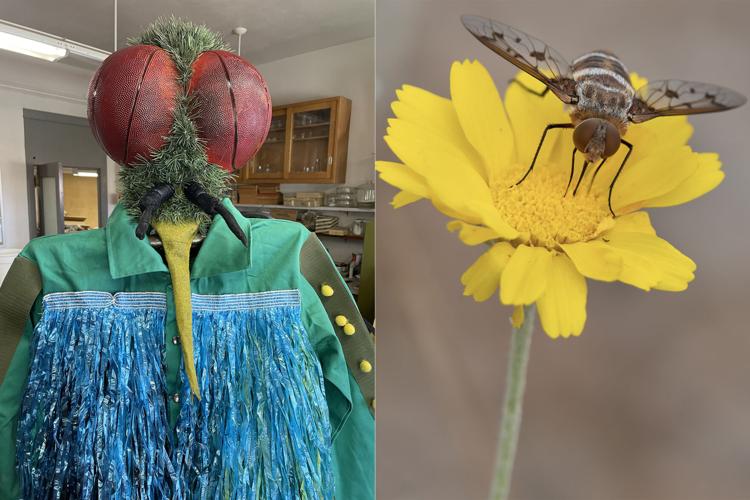
A bee fly costume, left, and the insect that inspired it.
Those are all food-crop flowers that are in season right now, Lombard said, so local gardeners shouldn’t be surprised to see a few of these impressive pollinators in real life.
“They’re such weirdos, too,” she said admiringly.
If she had to pick a favorite, Lombard said she is partial to the bee fly, a pretty bug with a “gruesome” parasitic behavior that involves flicking its eggs into the burrows of solitary ground-nesting bees so its young can feed on the bee’s eggs and larvae.
The costumed bugs at the festival will be accompanied by insect experts in lab coats to help explain the action and answer questions.

Charles Bradley holds a tray of insect specimens while dressed in a squash bee costume that will be featured at Sunday’s Arizona Insect Festival.
The giant flower parts are anatomically correct and labeled, so everyone knows what they’re looking at. The bug actors will also be carrying around the literal fruits of their labor, so festival goers can see actual examples of the produce produced by all this pollination.
Lombard said the Sonoran bumblebee should be especially fun to watch, as it vibrates its wings to shake pollen out of its flower like salt from a saltshaker.
In this case, Lombard said, the pollen is made from balls of felt that are stuck to the flowers and bugs using Velcro strips.
She said it took about two months and about a half-dozen regular volunteers to design and build the costumes and replica flowers.

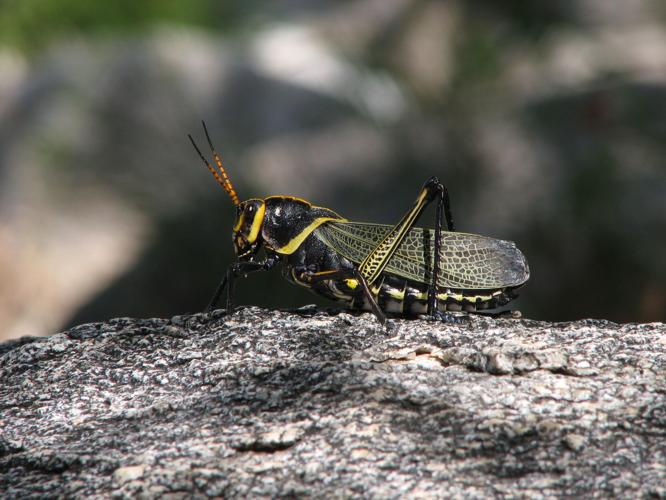
Meet the theme insect of this year’s Arizona Insect Festival: the Western horse lubber, the largest grasshopper in the U.S.
As of Tuesday, Lombard was still recruiting volunteers to dress up as bugs and bug experts – “no credentials needed!” she said.
She still isn’t quite sure how Sunday’s demonstrations are going to work just yet, but she’s hoping for some audience participation and prepping for a little chaos. “It will be fun,” she said.
The Arizona Insect Festival is hosted by the U of A’s Department of Entomology at the Environment and Natural Resources 2 Building on Sixth Street just east of Park Avenue.

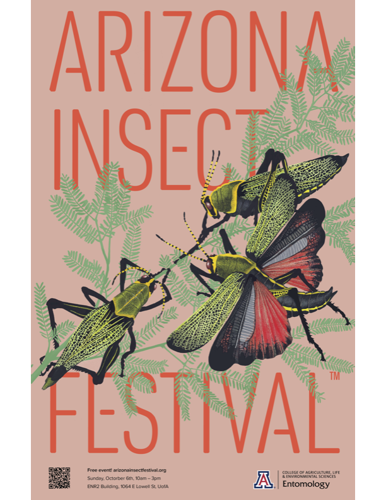
The poster for this year’s Arizona Insect Festival, 10 a.m. to 3 p.m. Sunday at the University of Arizona’s Environment and Natural Resources 2 Building.
The kid-friendly event runs from 10 a.m. to 3 p.m. and features live insect exhibits, educational displays, vendor booths and hands-on activities. Admission is free, and so is parking at the adjacent Sixth Street Garage and elsewhere on the U of A campus.
This year’s theme insect is the Western horse lubber, the largest grasshopper in the U.S. The shiny black bug with neon stripes is found across the Southwest and Mexico, where it can grow to 3 inches long or more.
Event organizers will have a cage filled with lubbers on Sunday, so festival goers can hold a hopper or at least see one up close.

Volunteers Barry, left, and Ainsley Copeland assemble giant onion flowers for a pollination demonstration at Sunday’s Arizona Insect Festival.
Lombard’s pollination demonstration is a fitting collaboration with the insect festival’s presenting sponsors: Slow Food Southern Arizona, a group that promotes healthy regional cuisine made with local ingredients, and the Tucson Bee Collaborative, dedicated to the study and protection of native bee species.
Like the festival itself, Lombard said, the pollinator costumes and cardboard flowers were designed with one goal in mind: to illuminate the world of bugs and the important role they play.
“We have such an incredible amount of insect diversity in Southern Arizona. It’s nice to point that out,” she said.

