


Thirteen years after the massive Deepwater Horizons spill fouled the Gulf of Mexico, regulators and industry have reduced some risks in deep water exploration in the gulf but some troublesome safety problems persist, according to a new study by the National Academy of Sciences.

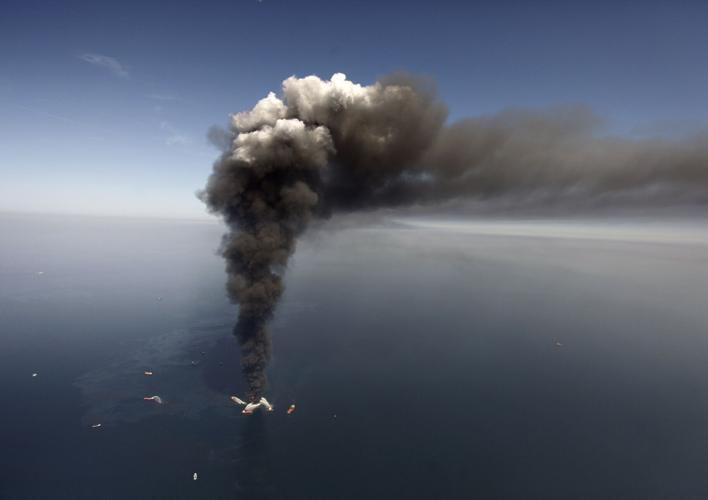
A large plume of smoke rises from fires on BP’s Deepwater Horizon offshore oil rig in April 2010 in the Gulf of Mexico, more than 50 miles southeast of Venice on Louisiana’s tip.
The creation of a specific federal agency for offshore oil drilling safety, an industrywide safety center and new technology have all helped reduce risks, the report said. But federal inspectors remain relatively powerless over contractors on rigs, which are 80% of the workers.
The report also noted the lack of an industrywide safety culture that integrates accident prevention into everyday work.
“There are a lot of things that are happening that are really good, but the industry is not at a place” where it should be, said panel chairman Richard Sears. He was a longtime Shell executive who was the chief technical adviser to the federal panel that initially investigated the 2010 explosion on the BP rig that killed 11 people and caused America’s biggest oil spill — more than 130 million gallons.
A culture that gave lip service to safety but didn’t really integrate it into the way it does business was part of the problem with the accident, Sears and others said. Some companies are treating safety the proper way — including giving flash bonuses to workers who stopped drilling because of potential dangers — but others “that don’t seem to get it,” he said.
“They have not figured out how to naturally embrace safety in particular … in who they are and what they do” but instead treat it like a box to check off, Sears said.

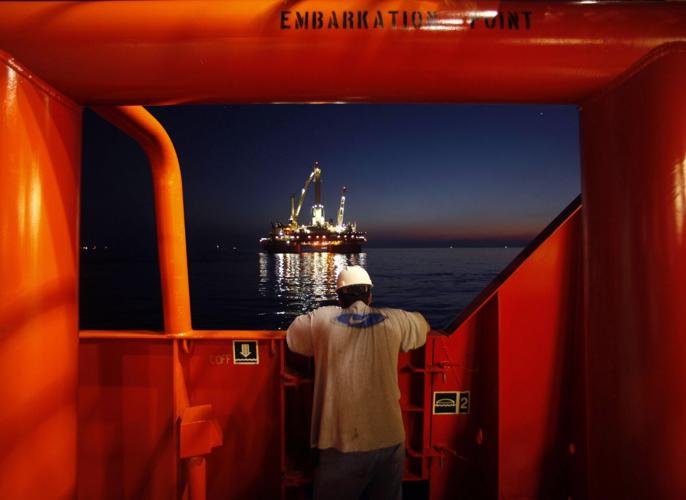
Wilson Ruiz, a crew member of the Joe Griffin, looks out at the oil slick as a containment vessel onboard positioned near the Q4000, background center, is lowered over the oil leak, at the site of the BP Deepwater Horizon offshore oil rig collapse May 6, 2010, in the Gulf of Mexico.
That’s far different from the more uniform industrywide safety culture seen in commercial airlines and nuclear power plants, he said.
There’s a “long list” of specifics on safety culture process that “other high-risk industries” like aviation have done but the drillers have not, said Steve Murawski, a University of South Florida marine ecologist who was a top NOAA scientist during the spill.
Federal safety inspectors lost a court case giving them power to directly regulate contractors so when they find a problem on an offshore rig they can ding the operator but not the contractor who is actually creating the problem, Sears said. It’s then up to the operator to crack down on the contractor, and it becomes complicated and not as effective, he said.
The report said that was one of the problems on the Deepwater Horizons rig.
Murawski, who wasn’t part of the study team, said the report highlights many of the recommendations that still haven’t been put into effect 13 years after that disaster, especially changes to a key oil spill law. He also said the report shows the need for greater transparency into industry actions.
Another outside scientist involved in the spill, Christopher Reddy of the Woods Hole Oceanographic Institution, said he was impressed by “the amount of positive change since 2010” but then that was offset by the safety culture issue.

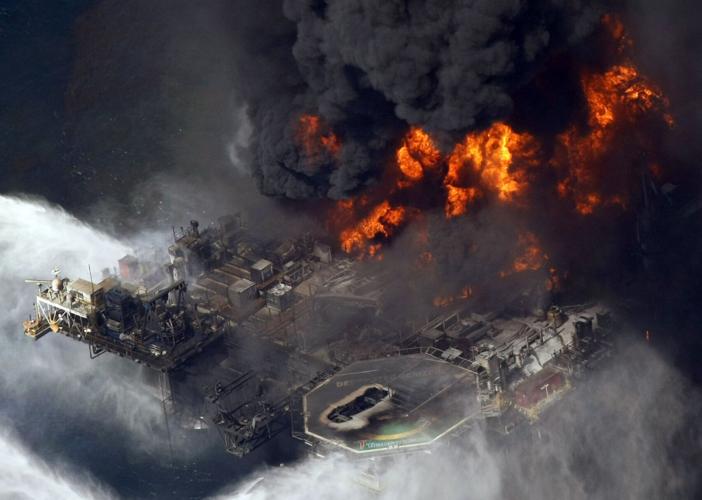
A plume of smoke rises from BP's Deepwater Horizon offshore oil rig April 21, 2010, in the Gulf of Mexico.
“The oil and natural gas industry and the federal government have together taken great strides to enhance the safety of offshore drilling operations,” American Petroleum Institute Vice President Holly Hopkins said.
National Academy President Marcia McNutt, who was a top Obama administration official dealing with the spill in 2010, said her concern is that officials are preparing for the last disaster, not the next one.
Still, McNutt said, the public should find the report “at least partially reassuring that this isn’t high school or elementary school shootings in terms of sticking your head in the sand and ignoring the problem.”
Today in history: April 20
Video
Updated1914: The Ludlow Massacre
Updated
In 1914, the Ludlow Massacre took place when the Colorado National Guard opened fire on a tent colony of striking miners; about 20 (accounts vary) strikers, women and children died.
1916: Wrigley Field
Updated
In 1916, the Chicago Cubs played their first game at Wrigley Field (then known as Weeghman Park); the Cubs defeated the Cincinnati Reds 7-6.
1945: World War II
Updated
In 1945, during World War II, allied forces took control of the German cities of Nuremberg and Stuttgart.
1972: Apollo 16
Updated
In 1972, Apollo 16′s lunar module, carrying astronauts John W. Young and Charles M. Duke Jr., landed on the moon.
1986: Vladimir Horowitz
Updated
In 1986, following an absence of six decades, Russian-born pianist Vladimir Horowitz performed in the Soviet Union to a packed audience at the Grand Hall of the Tchaikovsky Conservatory in Moscow.
1988: Kuwait Airways Hijacking
Updated
In 1988, gunmen who had hijacked a Kuwait Airways jumbo jet were allowed safe passage out of Algeria under an agreement that freed the remaining 31 hostages and ended a 15-day siege in which two passengers were slain.
1999: Columbine
Updated
In 1999, the Columbine High School massacre took place in Colorado as two students shot and killed 12 classmates and one teacher before taking their own lives.
2003: Baghdad
Updated
In 2003, U.S. Army forces took control of Baghdad from the Marines in a changing of the guard that thinned the military presence in the capital.
2010: Deepwater Horizon
Updated
In 2010, an explosion on the Deepwater Horizon oil platform, leased by BP, killed 11 workers and caused a blow-out that began spewing an estimated 200 million gallons of crude into the Gulf of Mexico. (The well was finally capped nearly three months later.)
2011: Air Travelers
Updated
Ten years ago: The U.S. government announced new protections for air travelers when airlines lose their bags, bump them off flights or hold them on the runway for hours.
2016: Chyna
Updated
Five years ago: Pro wrestler Chyna (Joan Marie Laurer) was found dead in her Redondo Beach, California, apartment; she was 46.
2016: New Orleans
Updated
Five years ago: Five former New Orleans police officers pleaded guilty to lesser charges in the deadly shootings on a bridge in the days following Hurricane Katrina in 2005.
2016: The $20 Bill
Updated
Five years ago: Treasury Secretary Jacob Lew announced that Harriet Tubman, an African-American abolitionist born into slavery, would be the new face on the $20 bill, replacing President Andrew Jackson. (The redesign of the bill was delayed during the administration of President Donald Trump, who had called the move “pure political correctness”; the effort was resumed by the Biden administration.)
2020: Brian Kemp
Updated
One year ago: Georgia Republican Gov. Brian Kemp announced plans to restart the state’s economy by lifting some coronavirus restrictions before the end of the week; the plan would allow gyms, hair salons, bowling alleys and tattoo parlors to reopen as long as owners follow strict requirements. Dr Anthony Fauci, the government’s top authority on infectious diseases, warned again that resuming business too soon risked a fresh spike in virus infections.

