



CAPE CANAVERAL, Fla. (AP) — For the first time in nearly a decade, U.S. astronauts are about to blast into orbit aboard an American rocket from American soil. And for the first time in the history of human spaceflight, a private company is running the show.
Elon Musk's SpaceX is the conductor and NASA the customer as businesses begin chauffeuring astronauts to the International Space Station.
The curtain rises next Wednesday with the scheduled liftoff of SpaceX’s Falcon 9 rocket and Dragon capsule with two NASA astronauts, a test flight years in the making.
NASA Administrator Jim Bridenstine on Wednesday said the U.S. is on the "cusp of launching American astronauts on American rockets from American soil yet again," as Doug Hurley and Bob Behnken prepare for their commercial spaceflight aboard the SpaceX Crew Dragon capsule next week.
The drama unfolds from the exact spot where men flew to the moon and the last space shuttle soared from Kennedy Space Center.
While Florida's Space Coast has seen plenty of launches since the shuttle's farewell tour in 2011 — even at the height of the coronavirus pandemic — they were for satellites, robotic explorers and space station supplies. The only route to orbit for astronauts was on Russian rockets.
NASA’s newest test pilots, Doug Hurley and Bob Behnken, are launching from home turf with SpaceX presiding over the countdown.

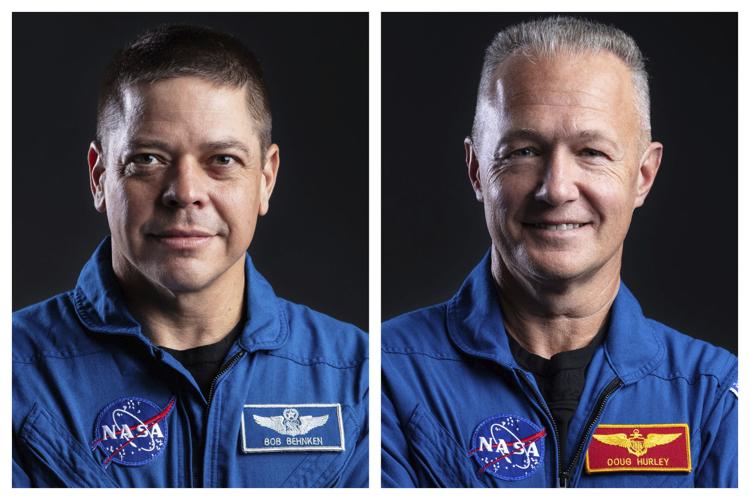
This combination of photos made available by SpaceX shows astronauts Bob Behnken, left, and Doug Hurley at SpaceX Headquarters in Hawthorne, California.
“Getting a chance again to see human spaceflight in our own backyard," Behnken said. “That’s the thing that’s most exciting for me.”
The cosmic-size shift to private companies allows NASA to zero in on deep space travel. The space agency is busting to return astronauts to the moon by 2024 under orders from the White House, a deadline looking increasingly unlikely even as three newly chosen commercial teams rush to develop lunar landers. Mars also beckons.
“We’re building momentum toward a much more exciting future,” said John Logsdon, founder of George Washington University’s Space Policy Institute and a professor emeritus.
The Russian launch site in Kazakhstan is out of the way and out of sight. Launching crews again from Florida is sure to fire up the public, Logsdon noted.
Adding to the appeal is the flash generated by Musk, SpaceX’s chief executive, designer and founder who shot his red Tesla Roadster into outer space two years ago during the first flight of a supersized Falcon Heavy rocket.
In a touch of Musk showmanship — he also runs the electric car company — Hurley and Behnken will ride to the launch pad in a gull-winged Tesla Model X, white with black trim just like the astronauts’ spacesuits and the rocket itself.
The Dragon riders appreciate Musk’s hands-on approach.
"On more than one occasion he has looked both Bob and I right in the eye and said, ‘Hey, if there’s anything you guys are not comfortable with or that you’re seeing, please tell me and we’ll fix it.’” Hurley said.
While trumpeting the return of astronaut launches, NASA is urging spectators to stay away because of the pandemic. But beaches near Kennedy are now open, and the local sheriff is welcoming visitors even though inside the space center, the number of guests will be severely limited. Among the exceptions: both astronaut wives — who have flown in space themselves — and their young sons. Vice President Mike Pence, chairman of the National Space Council, is also going, and possibly President Donald Trump.
"It’s going to be a great inspiration to the country next week to see you two go aloft from the Kennedy Space Center,” Pence told the astronauts Tuesday.
It will be just the fifth time NASA astronauts strap into a spanking new U.S. space system for liftoff — following Mercury, Gemini, Apollo and shuttle. NASA owned and operated all those spacecraft, built by contractors to NASA's precise specifications. The commercial crew program, by contrast, calls for private businesses to handle and own it all, with input and oversight by NASA.
Only three countries have launched humans — Russia, the U.S. and China in that order — making SpaceX’s attempt all the more impressive.
“My heart is sitting right here,” SpaceX President Gwynne Shotwell said, pointing to her throat at a news conference earlier this month, “and I think it’s going to stay there until we get Bob and Doug safely back from the International Space Station.”
Hurley, 53, a retired Marine, and Behnken, 49, an Air Force colonel, will spend one to four months aboard the orbiting lab, currently down to a three-man, half-size crew. They’ll lend a hand with experiments and possibly spacewalks, before ending their mission with an Atlantic splashdown, a scene not seen for a half-century.
As liftoff looms, the two are hesitant to consider their place in space history. “It seems premature until we’ve pulled it off,” Behnken said.

NASA Administrator Jim Bridenstine said the U.S. needs its own access to the space station in order to take full advantage of the $100 billion lab — the sooner, the better, pandemic or no.
When shuttle Atlantis soared for the final time on July 8, 2011, with Hurley as the pilot under commander Chris Ferguson, NASA envisioned a gap of three to five years.
Ferguson now works for Boeing, the other company hired by NASA in 2014 to transport crews. Plagued with software problems, Boeing’s Starliner capsule is still a year from launching with Ferguson and two NASA astronauts.
While disappointed Boeing is trailing, Ferguson said he'll cheer Hurley and Behnken from the sidelines. The SpaceX duo will lay claim to a small U.S. flag that flew on NASA’s first and last shuttle flights, and was left on the station by Ferguson and Hurley for the first commercial crew to arrive.
“Regardless of who might get there first, it’s a win for America," Ferguson said.
NASA’s commercial crew effort builds on industry’s space station shipments, now in the eighth year. SpaceX led the field with its original Dragon cargo capsules. Musk’s California-based company was also first out the gate with its souped-up, tricked-out Dragon crew capsule.
Crew Dragon made its debut early last year, launching successfully to the space station with a test dummy named Ripley after the “Alien” films' hardcore heroine. But the next month, the capsule exploded on the engine test stand at Cape Canaveral, a monumental setback.

A SpaceX Falcon 9 rocket with the company's Crew Dragon spacecraft is rolled out of the horizontal integration facility at Launch Complex 39A as preparations continue for the Demo-2 mission, Thursday, May 21, 2020, at NASA's Kennedy Space Center in Cape Canaveral, Florida.
Boeing’s Starliner capsule made its premiere last December with Rosie the mannequin, but ended up in the wrong orbit. Boeing will repeat the demo this fall, on its own dime, before putting Ferguson and the others on board.
Wayne Hale, a retired space shuttle flight director and program manager who serves on the NASA Advisory Council, views SpaceX’s upcoming astronaut flight as an experiment with lessons carrying over to Artemis, NASA’s new-generation, moon-landing effort.
Hale and others contend SpaceX and Boeing could be flying astronauts by now if Congress had provided more funding early on. The contracts with NASA are worth billions. NASA's inspector general has estimated the per-seat cost for SpaceX at $55 million, while the price of a Russian Soyuz seat has averaged $80 million in recent years. Boeing's Starliner will top that: an estimated $90 million a pop.
An earlier NASA test pilot, Robert Crippen, wishes at least one space shuttle had kept flying until a replacement was ready. The longest previous hiatus between astronaut launches stretched six years — from Apollo-Soyuz in 1975 to the shuttle’s debut in 1981 with Crippen and John Young.
Crippen also wishes the shuttle’s replacement was more futuristic-looking and landed on a runway.
The capsule has the familiar cone shape, but inside touchscreens replace the customary, countless switches. The walls are gleaming white, not dull gray. There’s even a curtained-off toilet.
It has built-in escape engines designed to fling the capsule off the rocket in an emergency, from the time Hurley and Behnken strap in until they reach orbit.
“This crew will have a good escape system,” Crippen said. “John and I had our ejection seats, but they wouldn’t have done much for us on liftoff," sending them straight through the rockets' trail of fire.
A capsule is generally simpler and thus safer than a winged spacecraft like the shuttle, Hurley and Behnken noted. In terms of launch power, the relatively small Falcon 9 has far less than the space shuttle did, another layer of safety.
But it’s still just the second flight of the crew capsule, and “the statistics will tell you that’s riskier than the 15th flight or 20th flight of the vehicle,” said Hurley, a former fighter pilot.
At the suggestion of its technicians, SpaceX added photos of Hurley and Behnken to every work order as a constant reminder that lives — not just freight — are at stake.
“I don’t think I need to remind my employees how important this is,” Shotwell, the company president, said. “They remind themselves.”

Shoot for the stars: 11 things you didn’t know about applying to be a NASA astronaut
Shoot for the stars: 11 things you didn’t know about applying to be a NASA astronaut
Help wanted
Updated
Currently, NASA has 48 astronauts in its corps and is seeking more applicants.
Sign of the times
Updated
According to WHTR, the application closed on March 31 and included, for the first time, an online assessment portion.
Stem's the word
Updated
One of the basic application requirements to be an astronaut in the next class of Artemis Generation is a master’s degree in a STEM-related field. According to the NASA website, “The requirement for the master’s degree can also be met by: Two years (36 semester hours or 54 quarter hours) of work toward a Ph.D. program in a related science, technology, engineering or math field; A completed doctor of medicine or doctor of osteopathic medicine degree; Completion (or current enrollment that will result in completion by June 2021) of a nationally recognized test pilot school program.
Learning to fly
Updated
Being an astronaut for NASA requires a bit of flight experience, specifically, “at least 1,000 hours of pilot-in-command time in jet aircraft,” according to NASA’s website. They can also have at least two years of professional experience related to their degree which can include jobs like teaching kindergarten.
Extras
Updated
Space.com notes that astronaut candidates (known by the acronym ASCAN) can help themselves in the application process by having other skills like scuba diving, wilderness experience and fluency in a foreign language (Space.com notes that all astronauts are required to speak Russian).
Height requirement
Updated
ASCANs should be between 62 and 75 in. (5’2” to 6’3” in.) to meet NASA’s “anthropomorphic requirements,” Science Direct notes. According to the NASA website, these contemporary requirements are much more flexible. During the first flight in 1959, astronauts had to be shorter than 5 feet 11 inches to fit in the Mercury spacecraft.
Get your sea legs before space
Updated
According to Science Direct, ASCANs have to also pass a swim test, become SCUBA certified and pass a military water survival test. CBS notes that the swim test includes swimming three lengths of a pool and treading water for 10 minutes in a flight suit and tennis shoes.
If at first you don't succeed
Updated
Many astronauts don’t get accepted on the first try, Space.com says. In fact, Clay Anderson applied 15 times and waited two more years before becoming an astronaut and serving as a member of the Expedition 15 crew aboard the International Space Station in 1998.
I can see clearly now
Updated
Perfect vision is crucial for ASCANS—even if they need a little help to achieve it. Part of the physical requirements to be an astronaut are 20/20 vision either with or without glasses or contacts.
A shrinking application pool
Updated
The NASA application, according to Wired, drew in more than 18,000 applicants. Of those applicants, Wired reports that around 14,000 will meet the basic requirements. A review panel of experienced astronauts then whittles down the applicant pool to 500. After reference checks and a first round of interviews, the pool goes from 500 to 100 to around 50 or 60 who go on to the second round of interviews. After the intense space-flight physical, between eight and 14 applicants will become astronauts and begin training
Age ain't nothing but a number
Updated
Astronauts have been a wide range of ages according to CBS. Most fall between the ages of 26 and 46, with the average being about 34 years.

