


NEW YORK — Smoke from Canadian wildfires poured into the U.S. East Coast and Midwest on Wednesday, covering the capitals of both nations in an unhealthy haze, holding up flights at major airports, postponing Major League Baseball games and prompting people to fish out COVID-19 pandemic-era face masks.
While Canadian officials asked other countries for more help fighting over 400 blazes nationwide that displaced 20,000 people, air quality with what the U.S. rates as hazardous levels of pollution extended into central New York, northeastern Pennsylvania and, later, the New York metropolitan area. Massive tongues of unhealthy air extended as far as North Carolina and Indiana, affecting millions of people.

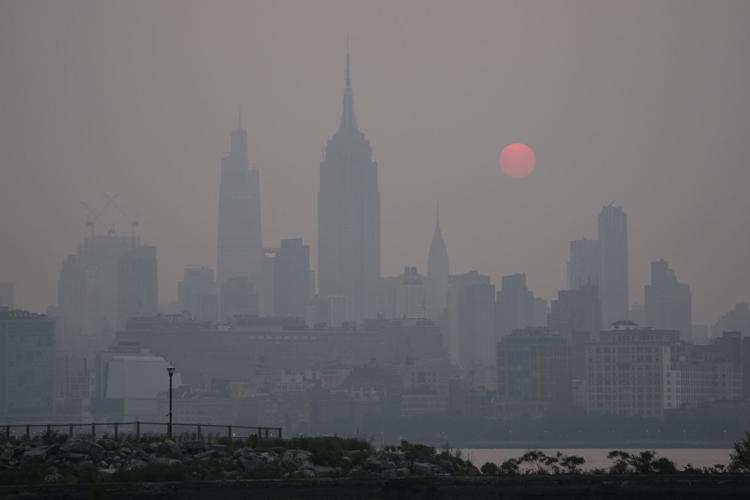
The sun rises over a hazy New York City skyline Wednesday as seen from Jersey City, N.J. Intense Canadian wildfires are blanketing the northeastern U.S. in a dystopian haze, turning the air acrid, the sky yellowish gray and prompting warnings for vulnerable populations to stay inside.
“I can taste the air,” Dr. Ken Strumpf said in a Facebook post from Syracuse, New York, which was enveloped in an amber pall. The smoke, he later said by phone, made him a bit dizzy.
In Baltimore, Debbie Funk sported a blue surgical mask as she and husband, Jack Hughes, took their daily walk around Fort McHenry, a national monument overlooking the Patapsco River. The air hung thick over the water, obscuring the horizon.
“I walked outside this morning, and it was like a waft of smoke,” Funk said. She said the couple planned to stay inside later Wednesday, as officials urged.
Canadian officials say this is shaping up to be the nation’s worst wildfire season ever. It started early on drier-than-usual ground and accelerated very quickly, exhausting firefighting resources across the country, fire and environmental officials said.
Smoke from the blazes in various parts of the country has been lapping into the U.S. since last month but intensified with recent fires in Quebec, where about 100 were considered out of control Wednesday — which, unsettlingly, was national Clean Air Day in Canada.

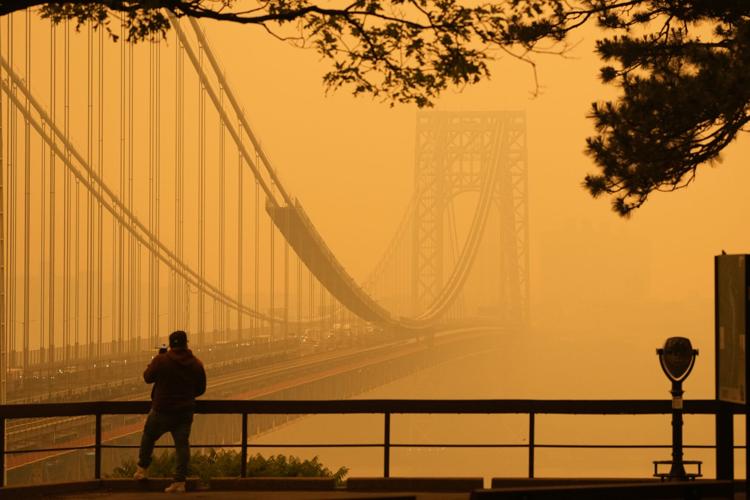
A man talks on his phone as he looks through the haze Wednesday at the George Washington Bridge from Fort Lee, N.J.
The smoke was so thick in downtown Ottawa, Canada’s capital, that office towers just across the Ottawa River were barely visible. In Toronto, Yili Ma said her hiking group canceled a planned hike this week, and she was forgoing the restaurant patios that are a beloved summer tradition.
“I put my mask away for over a year, and now I’m putting on my mask since yesterday,” the 31-year-old lamented.
Quebec Premier François Legault said the province currently has the capacity to fight about 40 fires — and the usual reinforcements from other provinces are strained by conflagrations in Nova Scotia and elsewhere.
Canadian Interagency Forest Fire Centre spokesperson Jennifer Kamau said more than 950 firefighters and other personnel arrived from the U.S., Australia, New Zealand and South Africa, and more will arrive soon.
In Washington, White House press secretary Karine Jean-Pierre said President Joe Biden sent more than 600 firefighters and equipment to Canada. His administration has contacted some U.S. governors and local officials about providing assistance, she said.
Canadian Prime Minister Justin Trudeau said on Twitter that he spoke by phone with Biden and “thanked him for all the help Americans are providing as we continue to fight these devastating wildfires.”
The largest town in Northern Quebec — Chibougamau, population about 7,500 — was evacuated Tuesday.
U.S. National Weather Service meteorologist Zach Taylor said the current weather pattern in the central and eastern U.S. is essentially funneling in the smoke. Some rain should help clear the air somewhat in the Northeast and Mid-Atlantic this weekend or early next week, though more thorough relief will come from containing or extinguishing the fires, he noted.

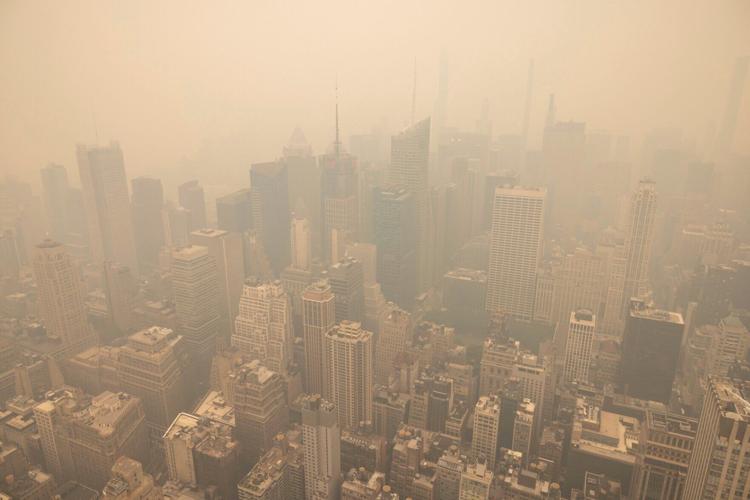
New York City is covered in haze Wednesday as photographed from the Empire State Building observatory as smoke from Canadian wildfires pours into the U.S.
Across the border, New York Gov. Kathy Hochul warned the public to “prepare for this over the long haul.” She said 1 million N95 masks would be available at state facilities. New York City Mayor Eric Adams told residents to limit outdoor activities and parks officials closed beaches as smoke smudged out the skyline. The Bronx and Central Park zoos closed early and brought animals inside.
The Federal Aviation Administration paused some flights bound for LaGuardia Airport and slowed planes to Newark Liberty and Philadelphia because the smoke was limiting visibility. It also contributed to delayed arrivals at Dulles International Airport outside Washington, where a heavy haze shrouded the Washington Monument and forced the cancellation of outdoor tours.
On Broadway, “Killing Eve” star Jodie Comer had difficulty breathing and left the matinee of “Prima Facie” after 10 minutes; the show restarted with an understudy, show publicists said. “Hamilton” and “Camelot” canceled Wednesday evening performances, with “Hamilton” publicists saying the deteriorating air quality “made it impossible for a number of our artists to perform.” In Central Park, outdoor Shakespeare in the Park performances were put off through Friday.
Major League Baseball put off games in New York and Philadelphia, and even an indoor WNBA game in Brooklyn was called off.
Schools in multiple states canceled sports and other outdoor activities, shifting recess inside. Live horse racing was canceled Wednesday and Thursday at Delaware Park in Wilmington. Organizers of Global Running Day, a virtual 5K, advised participants to adjust their plans according to air quality.
New Jersey closed state offices early, and some political demonstrations in spots from Manhattan to Harrisburg, Pennsylvania, were moved indoors or postponed. Striking Hollywood writers were pulled off picket lines in the New York metropolitan area.
The smoke exacerbated health problems for people such as Vicki Burnett, 67, who has asthma and has had serious bouts with bronchitis.
After taking her dogs out Wednesday morning in Farmington Hills, Michigan, Burnett said, “I came in and started coughing and hopped back into bed.”

