


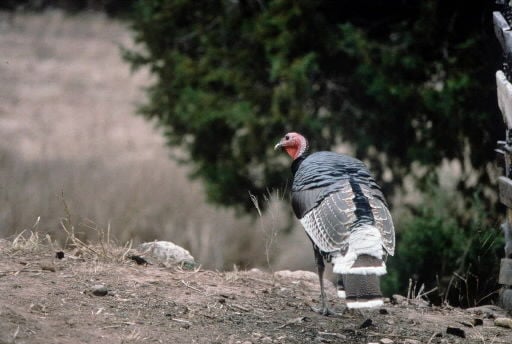
SIERRA VISTA — After 25 years of hard work and determination, the mountains of southern Arizona are teeming with turkeys once again.
The Gould’s wild turkey has, since 1983, been the center of an effort to re-establish the species in what is believed to be it’s native habitat: the sky islands in mountain ranges of southern Arizona.
John Millican, president of the Huachuca Gould’s Chapter of the National Wild Turkey Federation, has been studying the birds for two decades.
The Arizona Game and Fish Department had been trying to introduce wild turkeys to the area since the 1950’s without success, Millican said. Initially, a different subspecies, call Merriam’s turkeys, were brought from northern Arizona to try and populate the Huachuca Mountains.
“Those birds never did very well,” Millican said.
The habitat found in the southern Arizona mountains did not have the large number of ponderosa pine trees that the Merriam’s need for roosting, he said. That, coupled with long periods of drought, spelled the end of the short residence of Merriam’s in southern Arizona.
So, 30 years later, focus was switched from the mountains of northern Arizona to Mexico, where Gould’s turkeys were living in areas close to the border, in habitats similar to that of the Huachuca Mountains.
“In the early ’80s, Fort Huachuca and the Arizona Game and Fish Department worked with Mexico, and they decided that they were going to try to put Gould’s turkeys into (the area),” he said. “The feeling was that maybe those turkeys that were indigenous to Arizona were more closely related to the Gould’s turkey than they were to the Merriam’s turkey.”
Standing up to 4 feet tall and weighing up to 24 pounds, the Gould’s turkey is the largest subspecies of turkey found in the country.
“They’re not the heaviest, but they’re the tallest,” he said.
They’re also surprisingly strong.
“I was putting one in a box, and somebody wanted to take a picture,” Millican recalled, “and I just kept thinking, this bird is going to flop.”
The first phase of the plan to establish a population in the Huachucas began in 1983, with the transplanting of nine Gould’s from Yecora, Sonora, Mexico, and 12 more four years later.
The move was a success. Along with Fort Huachuca Wildlife Biologist Sheridan Stone, Millican, who also works for the Arizona Game and Fish Department, began tracking the moves of the Gould’s.
“We were seeing them at the top of Miller Canyon, all the way down to almost Sonoita,” he said.
By the end of the 1990s, numbers of Gould’s in the Huachucas had increased to more than 100. During that time, DNA tests confirmed the flock of birds were even more special than previously thought.
“This was the only pure Gould’s strain known in the United States, so therefore there was a large interest,” he said.
Soon, the Arizona Game and Fish Department began tracking the turkeys and was able to determine which areas they moved to that provided the best environment to live and nest.
Using this information, researchers were able to determine other areas where the turkeys would flourish.
“We’d release them into other mountain ranges, starting in 200 with the Galiuro Mountains,” Millican said. “To date, we’ve moved approximately 200 turkeys from the Huachuca Mountains into all the sky island mountain ranges in southeastern Arizona.”
The project has been so successful, that in 2002, the state issued the first hunting tag for a Gould’s turkey.
Since then, a small number of hunting tags for Gould’s have been issued every year, with the funds from special tags going directly back into Gould’s research.
“The revenue generated since 2002 has been probably around $60,000,” he said. “This year, we have the highest number of permits we will offer.”
A total of 14 Gould’s turkeys will be up for grabs this April, when the hunting season occurs in the Huachuca Mountains. The Chiricahua Mountains also will issue tags for the second time, and the Pinalenos are expected to have their first hunt in 2010.
“We’ll probably never have the numbers to open huge amounts of permits,” he said.
The number of roost trees limits the size the population can grow to.
“We figure that, in the Huachucas alone, there’s probably 300 to 400 Gould’s turkeys,” Millican said. “What started here in the Huachucas, with a total of 21 birds, has really turned into a success story.”

