

Photos: St Luke's Assisted Living
- Updated
High school students and elders at St Luke's assisted living home learn from each other as they spend time together
St Luke's Assisted Living
- A.E. Araiza / Arizona Daily Star
- Updated
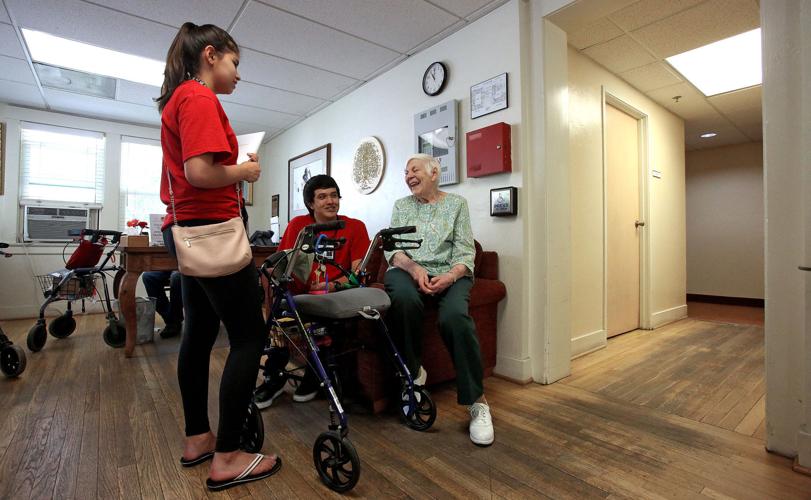
High school students Sienna Telles, left, and Jordan Ortega, both 17, listen to Lois Ilsemann, 87, as she talks about her life when she lived in Pennsylvania as students, who are part of the University of Arizona Med-Start program, spend time at St Luke's Home, at 615 E Adams St. It is part of the home's intergenerational focus where elders talk with aspiring medical professionals. The home, which is locally owned, has a partnership with the UA medical program.
St Luke's Assisted Living
- A.E. Araiza / Arizona Daily Star
- Updated
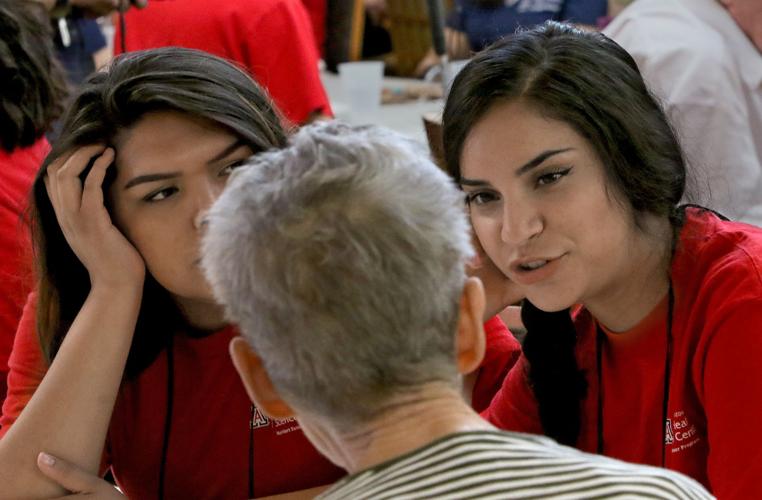
University of Arizona Med-Start students Taylor Tayah,17, left, and Paola Arreguin, 16, converse with Marilyn Swan, 79, who is a resident at St Luke's Home, at 615 E Adams St. It is part of the home's intergenerational focus where elders teach aspiring medical professionals about the aging process.
St Luke's Assisted Living
- A.E. Araiza / Arizona Daily Star
- Updated
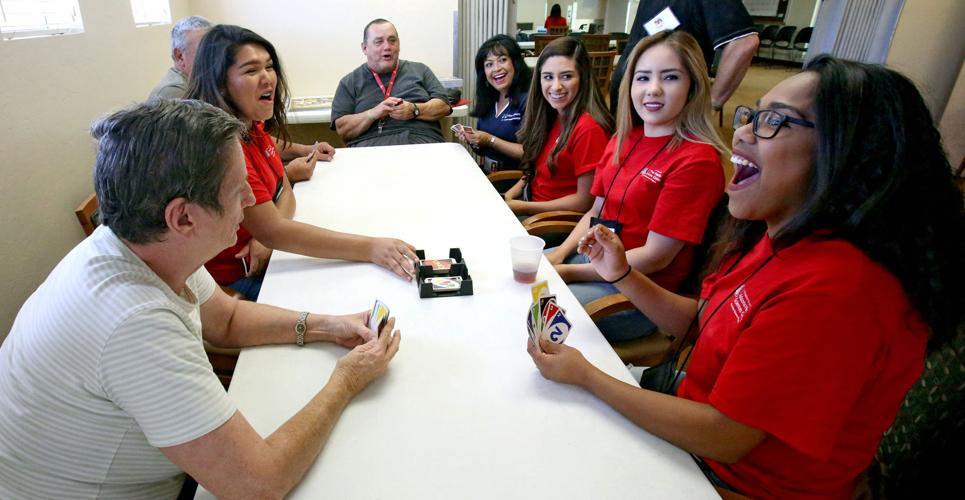
High school students find out just how cutthroat a game of Uno can be as students who are part of the University of Arizona Med-Start program spend time with elders at St Luke's Home. It is part of the home's intergenerational focus where elders teach aspiring medical professionals about the aging process.
St Luke's Assisted Living
- A.E. Araiza / Arizona Daily Star
- Updated
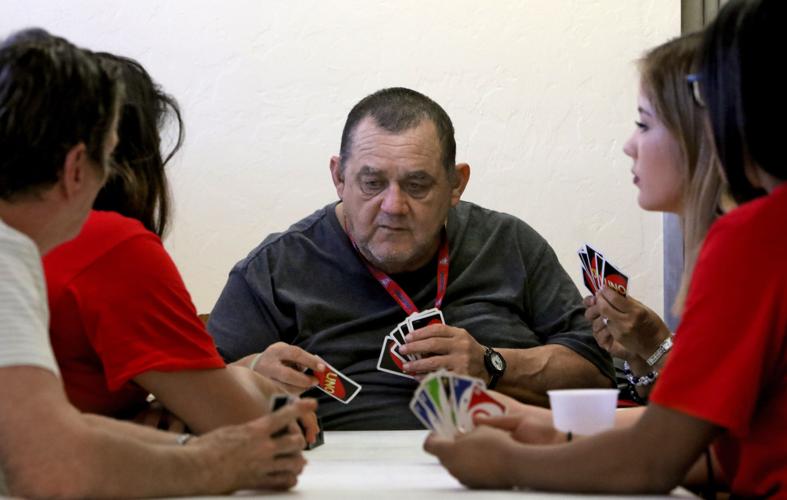
Alex Dalton, 63, plays a rousing game of Uno with high school students who are part of the University of Arizona Med-Start program spend time at St Luke's Home.

St Luke's Assisted Living
- A.E. Araiza / Arizona Daily Star
- Updated
Elaine Coons, 90, talks about her experiences at St Luke's Home. It is part of the home's intergenerational focus where elders talk with aspiring medical professionals from the University of Arizona.
St Luke's Assisted Living
- A.E. Araiza / Arizona Daily Star
- Updated
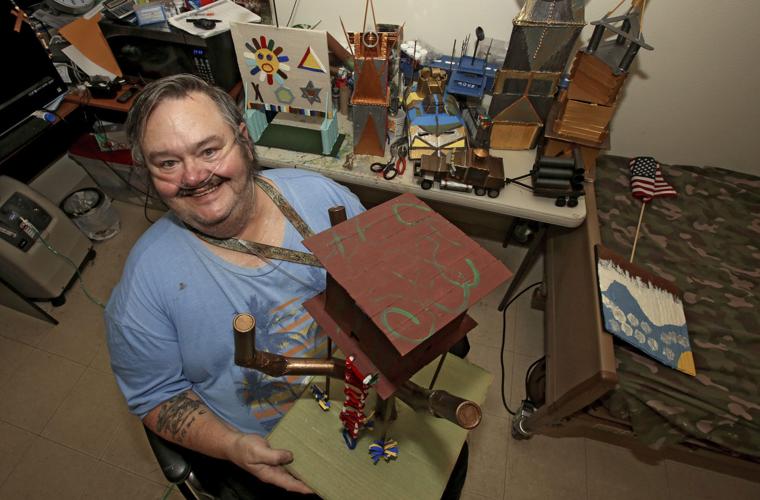
Artist Ernie Estep displays some of his work in his room at St Luke's Home. Estep currently has art pieces in a show at Solar Culture. The home, which is locally owned and caters to low income residents, has a partnership with the University of Arizona medical programs.
St Luke's Assisted Living
- A.E. Araiza / Arizona Daily Star
- Updated
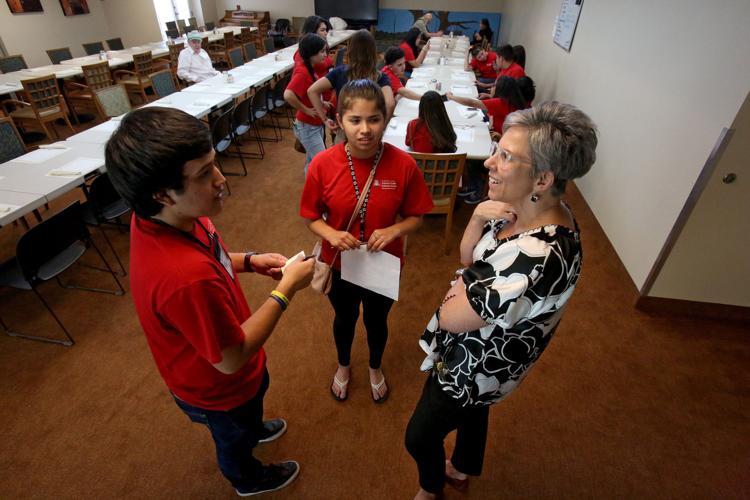
Jordan Ortega and Sienna Tellas, both 17, who are part of the University of Arizona Med-Start program, talk with L'Don Sawyer, the chief executive officer at St Luke's Home. The students talked to Sawyer about what they learned from their experience with the elders .
St Luke's Assisted Living
- A.E. Araiza / Arizona Daily Star
- Updated
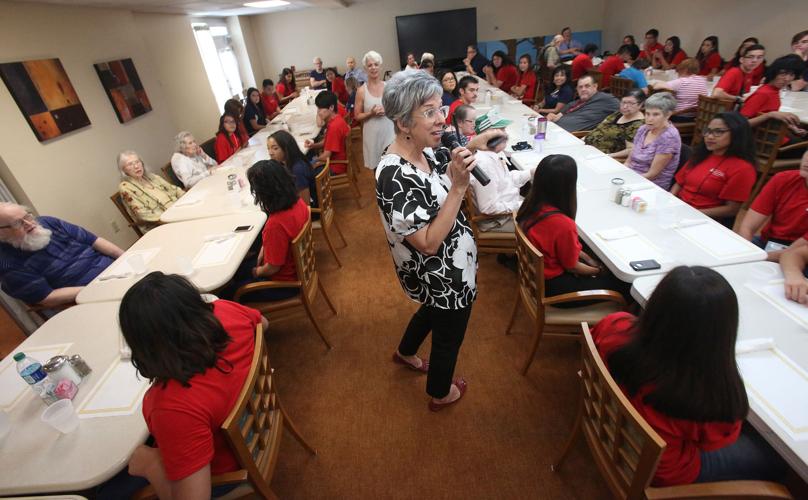
L'Don Sawyer, the chief executive officer at St Luke's Home, addresses elders and visiting high school students who are part of the University of Arizona Med-Start program prior to lunch at the home.
St Luke's Assisted Living
- A.E. Araiza / Arizona Daily Star
- Updated
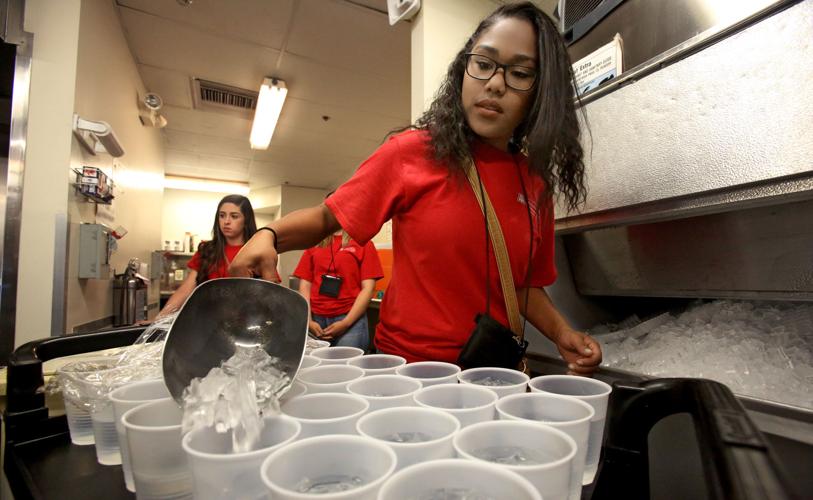
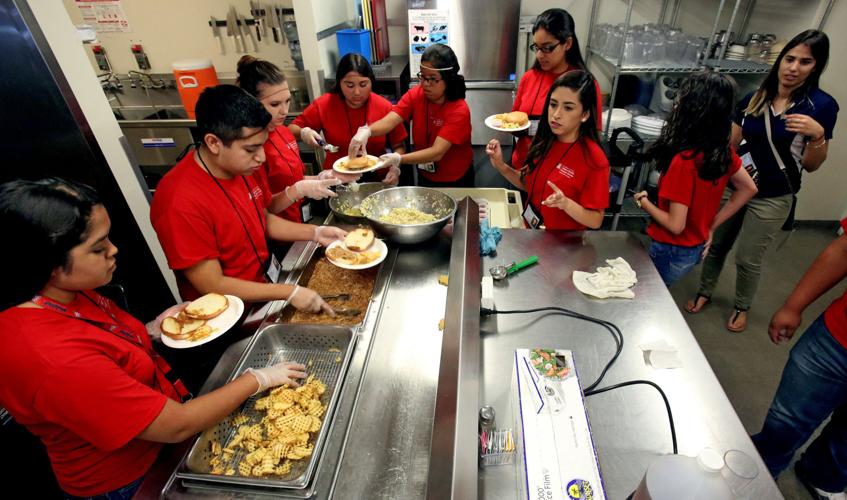
Jackie Morales, 17, helps get lunch ready as she and fellow high school students, who are part of the University of Arizona Med-Start program, spend time at St Luke's Home.
St Luke's Assisted Living
- A.E. Araiza / Arizona Daily Star
- Updated
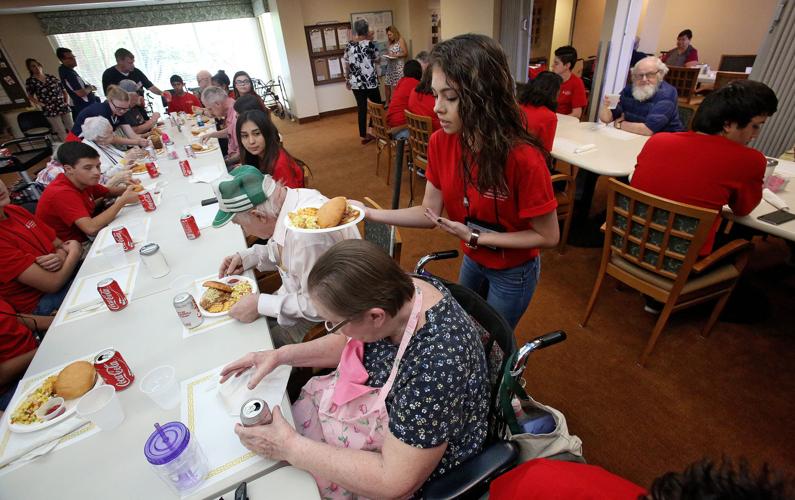
High school students, who are part of the University of Arizona Med-Start program, help coordinate and serve the lunch for elders and fellow students at St Luke’s Home. The home, which is locally owned and caters to low income residents, has a partnership with the UA medical program.
St Luke's Assisted Living
- A.E. Araiza / Arizona Daily Star
- Updated
High school student Desiree Heidke, 17, who is part of the University of Arizona Med-Start program, serves lunch at St Luke's Home. It is part of the home's intergenerational focus where elders teach aspiring medical professionals about the aging process.
- By Howard Fischer Capitol Media Services
- Updated
Sometime this week you’ll find out when you can finally visit grandma in the nursing home or your uncle who lives in assisted living.
That’s because these facilities are required to have written plans in place by the end of the week, Sept. 4, for how and when they will once again allow face-to-face visits with their residents. In most cases, no visits have been permitted since the COVID-19 emergency was declared in March.
In Arizona’s counties currently listed as having a “minimal” or “moderate” chance of coronavirus spread — nine at last count, including Pima County — the rules require all congregate care settings to offer limited outdoor visitation. Screening of visitors for symptoms, and wearing of cloth masks, will be required.
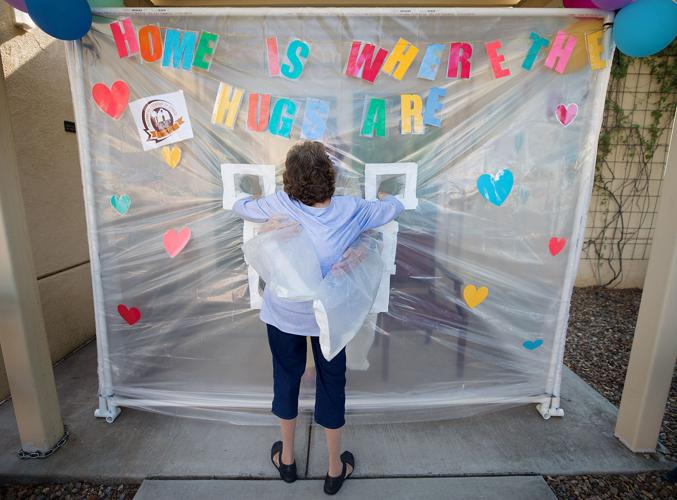
There is a mandate for 6 feet of distance between residents and visitors, so there won’t be hand holding.
There is a second option for anywhere in the state, regardless of how widespread its viral infection. Facilities there can allow in-person visits from anyone who presents results of a test taken within the last 48 hours showing a negative result for COVID-19, if that person signs a form saying he or she has been isolated since and is free of symptoms.
Taking that test may be a hurdle. But it’s one worth pursuing, said Dana Kennedy, state director of AARP.
“Let’s face it: In Arizona right now it’s really hot,” she said. “So that outdoor visit may not be safe.”
There are other advantages, as well, for visitors who present a negative COVID-19 test.
“If the person lives in a private residence, they could actually go into their residence and visit with them for 15 minutes,” Kennedy said. “And then they’re supposed to move to a congregate setting after that 15 minutes.”
But at that point, she said, “they can stay and visit as long as they like.”
“This was something that was really important to families,” said Christina Corieri, the health care policy advisor to Gov. Doug Ducey.
“They wanted to be able to see the individual’s personal living space, assess what the situation looks like,” she said. Then, after getting that look around, family members can continue their visit in whatever area is designated for getting together.
Kennedy pushed the governor to form the special task force to create standards for visitation, even as the virus remains active in Arizona.
There have been options for maintaining some type of contact, with facilities setting up phone calls and, often, video chats with family. Residents whose rooms have first-floor windows facing out to the street also had the chance to see their relatives, albeit through closed glass.
But there are limits to that.
“People are dying of loneliness and isolation,” Kennedy said.
Moreover, “people with some form of dementia, they may not understand why their loved one is not visiting them,” she said.
Plus, there’s the fact that the shutdown of visits occurred pretty much overnight.
“Families didn’t get enough closure,” she said. “So I think this (upcoming change) is really meaningful.”
With no end to the virus in sight — and no clear deadline for when residents and families would be able to see each other again — Kennedy said it became crucial to come up with some interim solution.
The task force’s final plan isn’t as simple as Kennedy had hoped the process would be. She said families will still need to “jump through a few hoops” to get visitation.
“But they’re all reasonable requests if you want to see your loved one during the middle of a pandemic,” Kennedy said.
Corieri said there are limits. “You couldn’t necessarily walk in at 1 in the morning,” she said.
Facilities can limit not only the times visits will be allowed but also how long they can last and how many people can visit on any given day, Corieri said.
And even in cases where the visitor produces a negative test result for COVID-19, Corieri said there is still a requirement for “minimal contact.”
As to whether potential visitors will be able to get test results back within 48 hours, Corieri said Sonora Quest says it can get results turned around within 24 hours. Ditto, she said, at Arizona State University, which is offering saliva tests.
At the University of Arizona there are tests available for antibodies. But these are being promoted for health-care workers, first responders and other employees considered at high risk for exposure to the virus.
If it turns out the 48-hour turnaround requirement for tests is too aggressive, Corieri said the task force remains active and can consider modifications.
Overall, she said the governor supports the plan.
“We think that these guidelines offer a safe way to reopen visitation in these facilities while still protecting the residents, and reuniting these families who we know that personal contact is so important to,” Corieri said.
“If these guidelines need tweaking we will continue to be open to it,” she said. “That is why we have another meeting of the task force scheduled in less than three weeks so that we can have that open feedback loop to hear how things are going and where we can continually improve.”

- Special To The Arizona Daily Star
- Updated
I was humbled and moved to tears to see how many Arizona Daily Star readers read and worried about my recent fall that led to vertigo. My inbox must have stretched to accommodate all my email.
I was surprised to see how many strangers as well as old friends still use our valiant postal service that delivered a recipe for chicken soup and special prayers. Many fellow vertigo sufferers shared their horrors and vertigo-busting tips, and all wished me well. I answered every one though it took a long while.
It worked. Except for that first jolt of morning dizziness when I go from horizontal to upright and the world dances, I am pleased to report that I am healing and have learned to walk again. I still use a walker or cane when I am feeling wobbly, but from flat-on-my-back to no longer screaming when I sit up is a big improvement.
My thanks to those who cared, or are still caring, for me. And who teach me safe ways to learn to walk again and coax me to move or yell at me for not walking (there is only one of those!)
Mobility is taken for granted until it is lost. As I myself aged and began to research aging, I learned about safe and healthy ways to stay active. But the main reason that I exercised and took a morning walk was my almost morbid fear of losing mobility.
I bemoaned the fact that my once super active mother fell in her garden and broke her hip. She developed what I am struggling to avoid: fear of falling.
Falls are one of the most dangerous events one of us oldies can have. But physical therapy and balance exercises can both help prevent falls and show us ways to recover from them. If you are wobbly, dizzy or unsteady on your feet get thee to a balance clinic.(t)
THE WAIT IS OVER
At long last, my book, “A Traveler’s Guide to Geriatrica” will be published on Tuesday, Nov. 10. Let me share an announcement sent to a bunch of hopefully eager readers I know.
Dear Friend, Relative, Colleague, Reader,
This is a thrice postponed birth announcement I am delighted to finally send to you!
After a prolonged gestation period caused by the COVID-19 pandemic, my book on aging will be published and will finally see the light of day on November 10, 2020. You can now preorder “A Traveler’s Guide to Geriatrica” by Marilyn Heins MD, illustrated by Dave Fitzsimmons and published by 3adimpressions at Amazon Books.
Books make great gifts. Writing and publishing “Geriatrica” was a gift to me. It gave me a purpose. It engaged my mind …or what’s left of it! I learned a lot. It was fun, especially working with the funniest illustrator on the planet. And it was a delight to work with the two nicest guys in publishing, Rick Wamer and Donn Poll. If you have some spare “pandemic time” on your hands, think about reading it. Or clean out the garage.
And what about me now? The Arizona Daily Star, my favorite newspaper, has offered to let me continue to write an occasional column. I will do that until I get really old or decide to take up knitting or parachuting instead.
Readers, stay healthy and interested in our world. It will need everybody’s concern as we come out of the pandemic and rebuild our world.
St Luke's Assisted Living
- A.E. Araiza / Arizona Daily Star
High school students Sienna Telles, left, and Jordan Ortega, both 17, listen to Lois Ilsemann, 87, as she talks about her life when she lived in Pennsylvania as students, who are part of the University of Arizona Med-Start program, spend time at St Luke's Home, at 615 E Adams St. It is part of the home's intergenerational focus where elders talk with aspiring medical professionals. The home, which is locally owned, has a partnership with the UA medical program.
St Luke's Assisted Living
- A.E. Araiza / Arizona Daily Star
University of Arizona Med-Start students Taylor Tayah,17, left, and Paola Arreguin, 16, converse with Marilyn Swan, 79, who is a resident at St Luke's Home, at 615 E Adams St. It is part of the home's intergenerational focus where elders teach aspiring medical professionals about the aging process.
St Luke's Assisted Living
- A.E. Araiza / Arizona Daily Star
High school students find out just how cutthroat a game of Uno can be as students who are part of the University of Arizona Med-Start program spend time with elders at St Luke's Home. It is part of the home's intergenerational focus where elders teach aspiring medical professionals about the aging process.
St Luke's Assisted Living
- A.E. Araiza / Arizona Daily Star
Elaine Coons, 90, talks about her experiences at St Luke's Home. It is part of the home's intergenerational focus where elders talk with aspiring medical professionals from the University of Arizona.
St Luke's Assisted Living
- A.E. Araiza / Arizona Daily Star
Artist Ernie Estep displays some of his work in his room at St Luke's Home. Estep currently has art pieces in a show at Solar Culture. The home, which is locally owned and caters to low income residents, has a partnership with the University of Arizona medical programs.
St Luke's Assisted Living
- A.E. Araiza / Arizona Daily Star
Jordan Ortega and Sienna Tellas, both 17, who are part of the University of Arizona Med-Start program, talk with L'Don Sawyer, the chief executive officer at St Luke's Home. The students talked to Sawyer about what they learned from their experience with the elders .
St Luke's Assisted Living
- A.E. Araiza / Arizona Daily Star
L'Don Sawyer, the chief executive officer at St Luke's Home, addresses elders and visiting high school students who are part of the University of Arizona Med-Start program prior to lunch at the home.
St Luke's Assisted Living
- A.E. Araiza / Arizona Daily Star
High school students, who are part of the University of Arizona Med-Start program, help coordinate and serve the lunch for elders and fellow students at St Luke’s Home. The home, which is locally owned and caters to low income residents, has a partnership with the UA medical program.
St Luke's Assisted Living
- A.E. Araiza / Arizona Daily Star
High school student Desiree Heidke, 17, who is part of the University of Arizona Med-Start program, serves lunch at St Luke's Home. It is part of the home's intergenerational focus where elders teach aspiring medical professionals about the aging process.
- By Howard Fischer Capitol Media Services
Sometime this week you’ll find out when you can finally visit grandma in the nursing home or your uncle who lives in assisted living.
That’s because these facilities are required to have written plans in place by the end of the week, Sept. 4, for how and when they will once again allow face-to-face visits with their residents. In most cases, no visits have been permitted since the COVID-19 emergency was declared in March.
In Arizona’s counties currently listed as having a “minimal” or “moderate” chance of coronavirus spread — nine at last count, including Pima County — the rules require all congregate care settings to offer limited outdoor visitation. Screening of visitors for symptoms, and wearing of cloth masks, will be required.
There is a mandate for 6 feet of distance between residents and visitors, so there won’t be hand holding.
There is a second option for anywhere in the state, regardless of how widespread its viral infection. Facilities there can allow in-person visits from anyone who presents results of a test taken within the last 48 hours showing a negative result for COVID-19, if that person signs a form saying he or she has been isolated since and is free of symptoms.
Taking that test may be a hurdle. But it’s one worth pursuing, said Dana Kennedy, state director of AARP.
“Let’s face it: In Arizona right now it’s really hot,” she said. “So that outdoor visit may not be safe.”
There are other advantages, as well, for visitors who present a negative COVID-19 test.
“If the person lives in a private residence, they could actually go into their residence and visit with them for 15 minutes,” Kennedy said. “And then they’re supposed to move to a congregate setting after that 15 minutes.”
But at that point, she said, “they can stay and visit as long as they like.”
“This was something that was really important to families,” said Christina Corieri, the health care policy advisor to Gov. Doug Ducey.
“They wanted to be able to see the individual’s personal living space, assess what the situation looks like,” she said. Then, after getting that look around, family members can continue their visit in whatever area is designated for getting together.
Kennedy pushed the governor to form the special task force to create standards for visitation, even as the virus remains active in Arizona.
There have been options for maintaining some type of contact, with facilities setting up phone calls and, often, video chats with family. Residents whose rooms have first-floor windows facing out to the street also had the chance to see their relatives, albeit through closed glass.
But there are limits to that.
“People are dying of loneliness and isolation,” Kennedy said.
Moreover, “people with some form of dementia, they may not understand why their loved one is not visiting them,” she said.
Plus, there’s the fact that the shutdown of visits occurred pretty much overnight.
“Families didn’t get enough closure,” she said. “So I think this (upcoming change) is really meaningful.”
With no end to the virus in sight — and no clear deadline for when residents and families would be able to see each other again — Kennedy said it became crucial to come up with some interim solution.
The task force’s final plan isn’t as simple as Kennedy had hoped the process would be. She said families will still need to “jump through a few hoops” to get visitation.
“But they’re all reasonable requests if you want to see your loved one during the middle of a pandemic,” Kennedy said.
Corieri said there are limits. “You couldn’t necessarily walk in at 1 in the morning,” she said.
Facilities can limit not only the times visits will be allowed but also how long they can last and how many people can visit on any given day, Corieri said.
And even in cases where the visitor produces a negative test result for COVID-19, Corieri said there is still a requirement for “minimal contact.”
As to whether potential visitors will be able to get test results back within 48 hours, Corieri said Sonora Quest says it can get results turned around within 24 hours. Ditto, she said, at Arizona State University, which is offering saliva tests.
At the University of Arizona there are tests available for antibodies. But these are being promoted for health-care workers, first responders and other employees considered at high risk for exposure to the virus.
If it turns out the 48-hour turnaround requirement for tests is too aggressive, Corieri said the task force remains active and can consider modifications.
Overall, she said the governor supports the plan.
“We think that these guidelines offer a safe way to reopen visitation in these facilities while still protecting the residents, and reuniting these families who we know that personal contact is so important to,” Corieri said.
“If these guidelines need tweaking we will continue to be open to it,” she said. “That is why we have another meeting of the task force scheduled in less than three weeks so that we can have that open feedback loop to hear how things are going and where we can continually improve.”
- Special To The Arizona Daily Star
I was humbled and moved to tears to see how many Arizona Daily Star readers read and worried about my recent fall that led to vertigo. My inbox must have stretched to accommodate all my email.
I was surprised to see how many strangers as well as old friends still use our valiant postal service that delivered a recipe for chicken soup and special prayers. Many fellow vertigo sufferers shared their horrors and vertigo-busting tips, and all wished me well. I answered every one though it took a long while.
It worked. Except for that first jolt of morning dizziness when I go from horizontal to upright and the world dances, I am pleased to report that I am healing and have learned to walk again. I still use a walker or cane when I am feeling wobbly, but from flat-on-my-back to no longer screaming when I sit up is a big improvement.
My thanks to those who cared, or are still caring, for me. And who teach me safe ways to learn to walk again and coax me to move or yell at me for not walking (there is only one of those!)
Mobility is taken for granted until it is lost. As I myself aged and began to research aging, I learned about safe and healthy ways to stay active. But the main reason that I exercised and took a morning walk was my almost morbid fear of losing mobility.
I bemoaned the fact that my once super active mother fell in her garden and broke her hip. She developed what I am struggling to avoid: fear of falling.
Falls are one of the most dangerous events one of us oldies can have. But physical therapy and balance exercises can both help prevent falls and show us ways to recover from them. If you are wobbly, dizzy or unsteady on your feet get thee to a balance clinic.(t)
THE WAIT IS OVER
At long last, my book, “A Traveler’s Guide to Geriatrica” will be published on Tuesday, Nov. 10. Let me share an announcement sent to a bunch of hopefully eager readers I know.
Dear Friend, Relative, Colleague, Reader,
This is a thrice postponed birth announcement I am delighted to finally send to you!
After a prolonged gestation period caused by the COVID-19 pandemic, my book on aging will be published and will finally see the light of day on November 10, 2020. You can now preorder “A Traveler’s Guide to Geriatrica” by Marilyn Heins MD, illustrated by Dave Fitzsimmons and published by 3adimpressions at Amazon Books.
Books make great gifts. Writing and publishing “Geriatrica” was a gift to me. It gave me a purpose. It engaged my mind …or what’s left of it! I learned a lot. It was fun, especially working with the funniest illustrator on the planet. And it was a delight to work with the two nicest guys in publishing, Rick Wamer and Donn Poll. If you have some spare “pandemic time” on your hands, think about reading it. Or clean out the garage.
And what about me now? The Arizona Daily Star, my favorite newspaper, has offered to let me continue to write an occasional column. I will do that until I get really old or decide to take up knitting or parachuting instead.
Readers, stay healthy and interested in our world. It will need everybody’s concern as we come out of the pandemic and rebuild our world.
As featured on

Perhaps most unique about the residence is that it's the official academic assisted-living center of UA Health Sciences.


View this profile on Instagram#ThisIsTucson 🌵 (@this_is_tucson) • Instagram photos and videos
Most viewed stories
-
Over 40 free events happening in Tucson this December! ⛄
-
Save the date! Here's the ultimate list of Tucson holiday events 🎄
-
Where to get your tamales this holiday season, recommended by our readers
-
A large list of fun and festive events in December! 🎄❄️
-
17 festive holiday markets that support Tucson artisans
-
Get fresh bread and flaky, buttery croissants at the MSA Annex's new micro-bakery 🥖
-
30 fun events happening this weekend, November 21-23!