


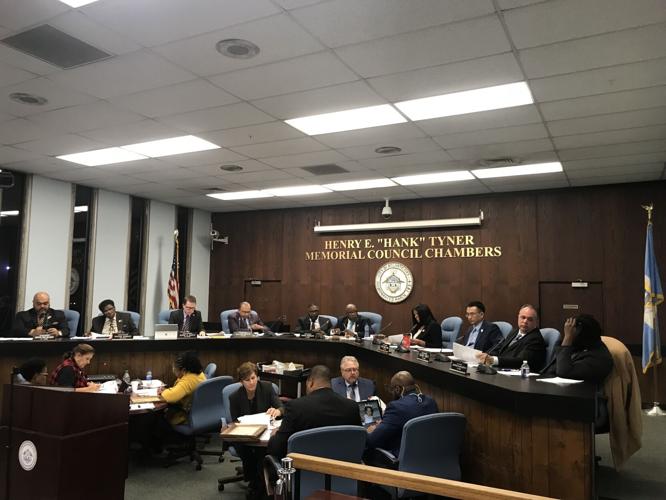
ATLANTIC CITY — The final City Council meeting of the year was a clear departure from what is typically a dry, matter-of-fact routine required of governing bodies before the calendar turns.
An allegation of bullying made by a recently sworn-in council member and a couple of uncomfortable exchanges between officials overshadowed an otherwise productive quorum Friday night at City Hall.
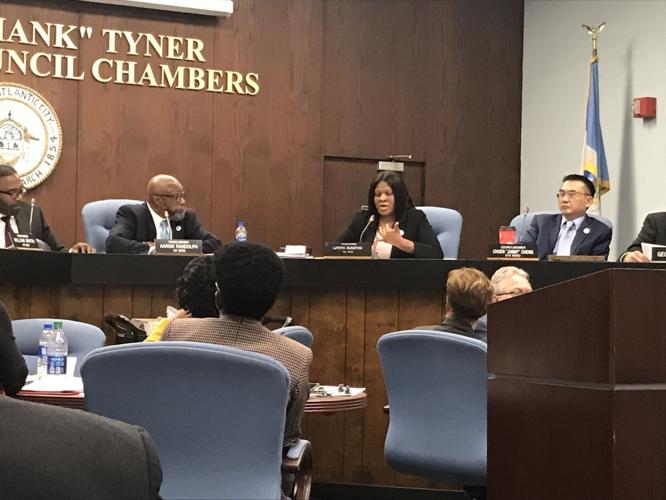
Second Ward Councilwoman LaToya Dunston, in her first council meeting since being appointed in November, claimed she was asked to complete unusual requirements, such as filling out an employment application, taking a drug test and being fingerprinted, all while not having access to an office or her city-issued email address and cell phone for several weeks.
City policy does not require elected officials to be drug tested, fingerprinted or complete an application.
“Being a woman, I feel like I’ve been mistreated. I have to be honest and put it on record,” Dunston said. “The bullying, the tormenting, all of it. It hasn’t been smooth, and I want the public to know that I don’t feel like I’ve been supported. I really, truly believe I was mistreated, on purpose, regardless if it’s personal or (because) I’m a woman.”
Dunston was appointed Nov. 12 to fill an unexpired term until Dec. 31. She filled the vacancy left by Mayor Marty Small Sr., who was sworn in as the city’s chief executive in October. She is the only woman on the nine-member council.
“If you felt that way, I didn’t know because I felt that I’ve reached out to you as much as I possibly could,” said Council President Aaron “Sporty” Randolph.
Dunston did not respond to multiple attempts to clarify to whom in City Hall she was referring or to offer any evidence of her claim.
Questions about legal contracts
Dunston’s allegation came out during a requested departure from the way City Council typically handles agenda business at most meetings when she asked that several legal contracts be voted on individually, as opposed to being grouped together and moved as a block by the governing body.
Dunston said she felt she did not have adequate time to digest the information she was about to vote on.
With the state in control of the city and council subcommittees deliberating agenda items beforehand, Randolph attempted to explain that all members get the information packet a few days in advance and have the same amount of time to review it. He rejected Dunston’s proposal to table the legal contracts until January.
“We have to move on those contracts because they’re on (the agenda) and it’s the end of the year,” Randolph said.
At-large Councilman George Tibbitt jumped in and said he had only received his packet the day before after repeated attempts. Fourth Ward Councilman William “Speedy” Marsh, in his last meeting, interrupted Tibbitt and accused him of “saying something not true,” which later led to a testy back-and-forth between the two longest serving members of City Council.
Tibbitt went on to question why the legal contracts were being voted on in December when council typically did so at other times of the year in the past.
Small responded that it was the administration’s decision to sync up the payment of legal bills with the city’s calendar year budget.
“We are going in a totally different direction,” said Small, who served as chair of the revenue and finance committee while he was council president. “I never understood why we started paying our legal people in March.”
At-large Councilman Moisse “Mo” Delgado reiterated Dunston’s request to hold off on voting on the contracts and suggested a special meeting before the end of the month to provide enough time for each member to review them.
Small took exception “that for the first time in four years, people have questions about legal contracts,” and said that he was often the only council member in the room deliberating financial matters with prior mayoral administrations.
“I don’t know where all this is coming from,” he said. “Actually, I’m shocked.”
Despite the objections and “no” votes recorded by Delgado and Dunston, council approved the spending authorizations for the legal contracts. The total of the contracts authorized spending up to nearly $2 million for legal services ranging from bond counsel to municipal defense matters in 2020.
Council pulls marijuana-related resolution
In other business, City Council pulled a resolution in opposition to marijuana- related businesses on the Boardwalk without explanation. The proposal cited public safety and a desire to create a family atmosphere on the Boardwalk.
However, council narrowly approved a resolution urging the state Legislature to act on a stalled bill that would permit open alcohol containers in certain areas of Atlantic City, including the Boardwalk. Despite abstentions from three members (Delgado, Randolph and 3rd Ward Councilman Kaleem Shabazz) and a “no” vote from Tibbitt, the measure passed.
Tom Forkin, chairman of the city’s Alcohol Beverage Control board, and the Police Department have expressed support for the open container law. On Friday, Forkin’s reappointment to the ABC board was pulled from the council agenda, and his three-year term expires Dec. 31.
The city also accepted $1 million in funding from the Casino Reinvestment Development Authority to be used for the demolition of blighted properties.

