



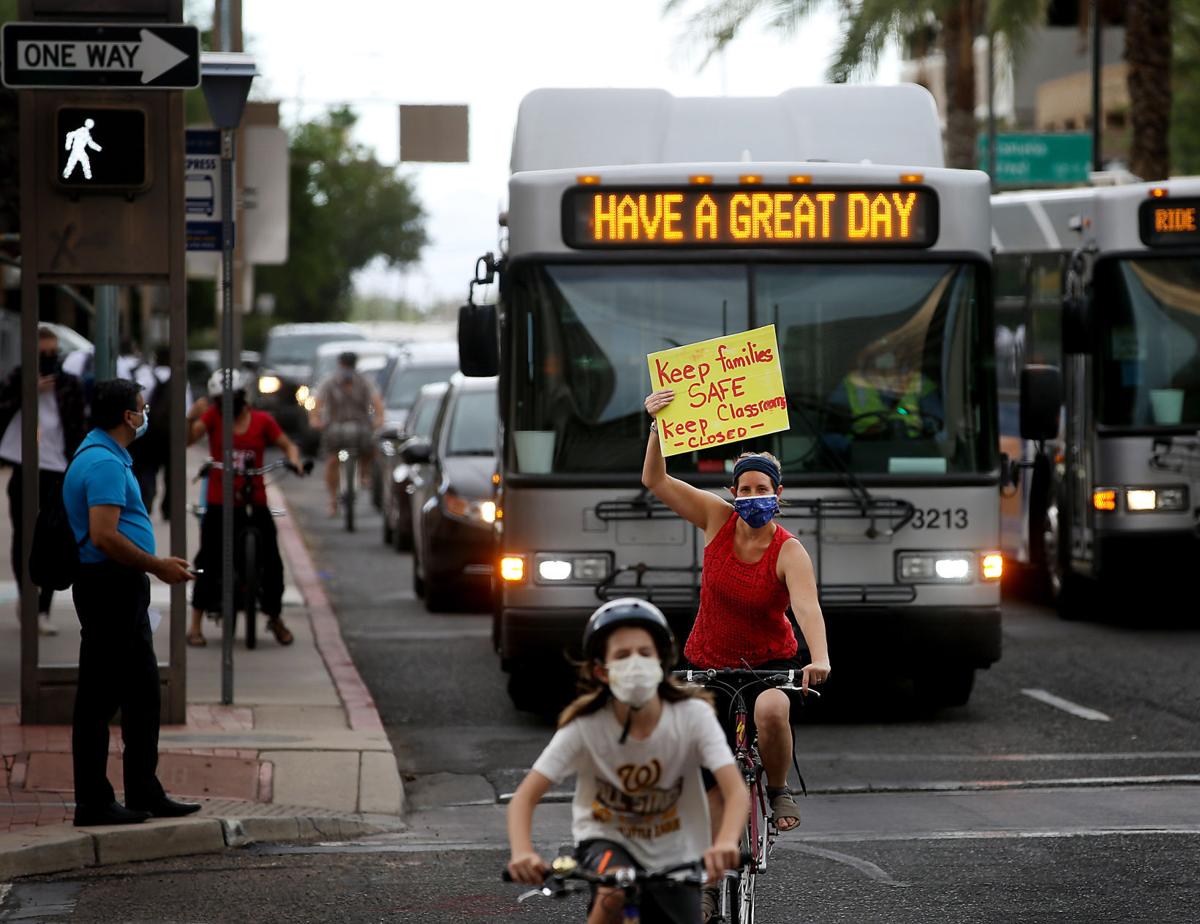
The Pima County Health Department says it’s unsafe to reopen schools for traditional face-to-face learning as the coronavirus continue s to heavily impact the Tucson community.
The guidance to Tucson-area schools, released Tuesday, says the earliest traditional instruction could be anticipated to resume is after Labor Day.
Pima County Health Department Director Dr. Theresa Cullen and Chief Medical Officer Dr. Francisco Garcia used public health data to form their recommendation — which schools are not required to follow.
A memo from Pima County Administrator Chuck Huckelberry outlined the reasoning for delaying in-person traditional instruction:
- Local, daily COVID-19 infections are at the highest amounts since the pandemic began. Pima County’s total monthly infections have gone from 153 for March to more than 6,700 confirmed cases thus far for the month of July alone.
- Coronavirus transmission rates are above 11%. The World Health Organization recommends rates should be below 5% before reopening.
- Masks were only recently mandated, and it will take six weeks to see if the mitigation strategy is working.
- COVID-19 hospitalizations are at record levels. Local hospitals have nearly exceeded their ICU bed capacity, transferring some critical patients to hospitals around the state.
- Widespread testing is just now becoming available, and timely test results to allow for contact tracing do not exist in Pima County.
Though the guidance does not advise resuming traditional face-to-face learning, it does recommend the opening of school facilities for at-risk youth on a limited basis as envisioned in Gov. Doug Ducey’s latest executive order.
Such sites would provide adult supervision during school hours for children who would be completing remote learning assignments.
While Ducey’s executive order directs schools to make a special effort to accommodate vulnerable students at those sites starting Aug. 17, it also says schools cannot refuse any student.
The Pima County Health Department’s recommendation does not change that requirement, says Ducey’s spokesman Patrick Ptak.
Tucson’s largest school district, TUSD, says it plans to seek a waiver from the state to delay offering that on-site supervision beyond Aug. 17.
Ducey’s executive order says school districts can apply for such an exemption through the Arizona Department of Education if a county health department in conjunction with the state health department advise closing.
Tucson Unified Superintendent Gabriel Trujillo will request to offer in-person services only to the most vulnerable, which may include students who use wheelchairs or need assistance with basic self-care.
Although schools are still required to offer a place for students to go, the county recommendation is meaningful because it gets the message out to the community that campuses are not currently considered safe to return to traditional instruction, says Pima County Schools Superintendent Dustin Williams.
“Everything was on the shoulders of the schools, trying to be health experts,” he said. “And the reality is now the Health Department is coming out and saying, ‘These numbers are not good. As a matter of fact, they’re so bad, we don’t recommend starting in person.’ This isn’t about politics. This is about ICU beds, infection rates and all the stuff that we need to really be talking about.”
The Cleveland Indians visited Tucson for spring training each year from 1947 to 1993.
TUSD’s plan already included a completely online learning option, regardless of whether a student is in a classroom or at home.
But not all Tucson-area school districts had a plan that focused on remote learning.
Catalina Foothills quickly shifted its back-to-school plan after the Health Department’s recommendation came out from one that focused on in-person instruction to a completely remote model. Superintendent Mary Kamerzell sent a letter Tuesday afternoon to families and staff workers saying the district would start the school year 100% remotely.
While the district is planning to switch to a remote learning model, it is working on a plan that provides on-site care and will follow the governor’s executive order, said district spokeswoman Julie Farbarik.
Like other local districts, Vail has been working on a learning model that offered both online and in-person learning options. It’s too soon to know if the county’s recommendation will change the plan, says spokeswoman Darcy Mentone.
The metrics don’t change anything in Amphitheater Schools District’s plan, which already delayed in-person learning until after Labor Day. The district is still working on a plan for how to deal with the requirement to offer on-site supervision.
On the athletics front, Pima County advised that school interscholastic sports and extracurricular activities planned for the fall semester be delayed until spring 2021, with the exception of those activities that can be done safely while mask-wearing and physically-distancing.
The Arizona Department of Health Services will release health metrics by Aug. 7 that schools can refer to while deciding when to resume traditional in-person instruction, but the county health department has its own metrics, which the governor’s executive order says that schools should consider as well.
The Pima County Health Department’s COVID-19 website shows nine public health criteria being monitored to determine whether progress is being made in managing the pandemic and slowing community spread. Right now, six of those are in the red zone, which means the criteria has not been met.
The department says the upcoming metrics from the state coupled with the county’s metrics will be a valuable tool for schools.
The county is also in the process of opening additional testing sites, at the Ellie Town Flowing Wells Community Center and the Udall Center, to go along with the recently opened Kino Event Center, which will all provide free testing.
Pima County is working on getting faster test results and hopes to have blocks of time for district personnel to be tested on Thursdays and Fridays, with results coming back on Mondays, so those who test negative can immediately return to work.
The local Health Department also has a procedure for follow-up testing and contact tracing to limit community spread in a school, the memo says.
Photos: Pima County adds two new libraries
Libraries
Updated
A crew member works on the electrical inside the Esmond Station Library, a new Pima County Public library, in Tucson, Ariz on July 27, 2020.
Libraries
Updated
Crew members work on Esmond Station Library, a new Pima County Public library, in Tucson, Ariz on July 27, 2020.
Libraries
Updated
A crew member with RG and Sons Plumbing, INC. looks at documents while fellow employees work on the underground plumbing for a new library in Sahuarita, Ariz on July 27, 2020.
Libraries
Updated
Crew members work on Esmond Station Library, a new Pima County Public library, in Tucson, Ariz on July 27, 2020.
Libraries
Updated
A sign is placed outside the construction site of the Esmond Station Library, a new Pima County Public library, in Tucson, Ariz on July 27, 2020.
Libraries
Updated
A sign placed outside the construction site of the Esmond Station Library, a new Pima County Public library, show the outline of the new library in Tucson, Ariz on July 27, 2020.
Libraries
Updated
Crew members with RG and Sons Plumbing, INC. work on the underground plumbing for a new library in Sahuarita, Ariz on July 27, 2020.
Libraries
Updated
A crew member with RG and Sons Plumbing, INC. takes a drink of water while working on the underground plumbing for a new library in Sahuarita, Ariz on July 27, 2020.
New Pima County Library collection gives a broader view of our shared past
UpdatedFrank De La Cruz, a community activist and librarian in the Pima County Public Library system, was committed to making sure the library collection reflected the voices and the memory of the community.
When he passed away in 2015, a movement began to recreate a collection that reflected the Chicanx/Mestizo history of the southwest borderlands. The library’s Nuestras Raíces committee, dedicated to celebrating and honoring the culture, voice and linguistic heritage of the Latinx community in Pima County, led the project.
This effort has produced a collection that provides Pima County residents the opportunity to access a broader view of our shared past.
Recently, two publishing industry surveys reiterated what people of color have known for decades — there is a lack of diversity in the book business.
This dearth of representation, coupled with the slanted history taught in schools, results in a generation of young people who view themselves as outcasts. The public library helped me see our country’s history in a way the school system never supported. Even now, the conventional, heavily Eurocentric view of recorded events keeps me and everyone else in the dark — including Americans of European descent.
History books and popular media are consistently conveying a reality that marginalizes those deemed unworthy of recognition by the dominant culture.
Reading about the contributions people of color made, and continue to make, is an empowering experience, not a form of radicalization that the Arizona state government ruled it to be when it banned ethnic study programs in 2010; a ban later overturned in 2017. It seems clear to me now that the deliberate and systematic dismissal of this history is proof enough of its value and power.
Our local youth should have meaningful access to Chicanx/Mestizo history and the understanding that it is just as American as what they will find in their classroom. This is what makes Pima County Library’s Frank De La Cruz Collection essential.
Find more information about the collection at library.pima.gov/frankdelacruz.
Frank De La Cruz, un activista comunitario y bibliotecario de la Biblioteca Pública del Condado Pima se dedicó a que la colección de materias bibliotecarias reflejara las voces y la memoria de la comunidad.
Cuando falleció en el 2015, se empezó un movimiento para recrear una colección que reflejara la historia chicanx/mestiza de la región fronteriza del suroeste. El equipo laboral Nuestras Raíces, un comité dedicado a celebrar y honrar la cultura, voz, y herencia lingüística de la comunidad Latinx en el Condado Pima, dirigió el proyecto.
Esta colección se ha materializado, dando a los residentes del Condado Pima acceso a una perspectiva más amplia de nuestra historia compartida.
Recientemente, dos encuestas de la industria editorial reiteraron lo que personas de color saben desde hace décadas — hay una falta de diversidad dentro de la industria editorial. Esta falta de representación junto al rechazo contra los estudios étnicos resulta en una generación de jóvenes que se perciben como excluidos de la sociedad.
La biblioteca pública me ayudo a ver la historia de nuestro país de una manera del cual nuestro sistema educativo nunca ha apoyado. Aun hoy en día, el punto de vista convencional y primordialmente eurocéntrico de los acontecimientos históricos nos mantiene en la ignorancia, inclusive a aquellos de descendencia anglosajona.
Los libros de historia y medios populares consistentemente presentan una realidad que convierte en marginados los que no son merecedores de reconocimiento por la cultura dominante.
Leer sobre las contribuciones por parte de personas de color y las que continúan logrando es una experiencia fortalecedora. No es una forma de radicalización lo que declaró el estado de Arizona cuando prohibió los estudios étnicos el 2010. Esta prohibición fue anulada por un juez federal en el 2017. Me parece evidente que el rechazo deliberado y sistemático de esta historia escondida es un contundente testimonio de su valor y de su poder.
Esta generación y las que sigan merecen tener un acceso legítimo a la historia chicanx/mestiza y el entendimiento de que es tan valiosa y americana como lo que encontrarán en su salón de clase. Esto es lo esencial de la colección Frank De La Cruz.
Para más información sobre la colección, visite library.pima.gov/frankdelacruz.
— Lu Guerrero trabaja con la Biblioteca del Condado Pima desde el 2007. Guerrero es miembro del equipo laboral Nuestras Raíces y contribuyó a la creación de la Colección Frank De La Cruz
Campaign under way to fund outdoor performance space for Sahuarita library
UpdatedA campaign is underway to fund an outdoor space for the new Sahuarita Public Library.
The initiative seeks to raise $75,000 for the outdoor performance space, adding 1,000 square feet to the approximately 17,700 square foot facility.
The library, on the northwest corner of Sahuarita Road and Calle Imperial, is expected to be completed next spring.
The outdoor performance space would be the first of its kind in the Pima County Library system, providing a public venue for arts and musical offerings, author readings and other open-air events.
The facility will be used by library patrons and staff, students and community members.

The Pima County Public Library is adding new libraries with one in Southeast Tucson and Sahuarita.
New Vail library to be named after community advocate Anne Gibson
UpdatedThe name of a longtime member and advocate for the Vail community will grace the area’s new library.
The Pima County Board of Supervisors on Nov. 17 approved changing the name of the yet-to-open library from Esmond Station Vail Library to W. Anne Gibson-Esmond Station Library.
Gibson is a well-known community member and a tireless champion for bringing the library to the southeast Tucson community. She is also the president and co-chair of the newly formed organization, Friends of the W. Anne Gibson-Esmond Station Library.
The opening of the new library has not been scheduled due to the COVID-19 pandemic.
The 8,000-9,000- square-foot facility, designed by BWS Architects, will feature a meeting room that opens to the outdoors and movable shelving and furniture to create flexible spaces that can be adjusted to meet the needs of the community. Connected by trailhead to the Esmond Station Regional Park, the building will be within walking distance of Empire High School and Esmond Station K-8.
The Pima County Public Library is adding new libraries with one in Southeast Tucson and Sahuarita.

