


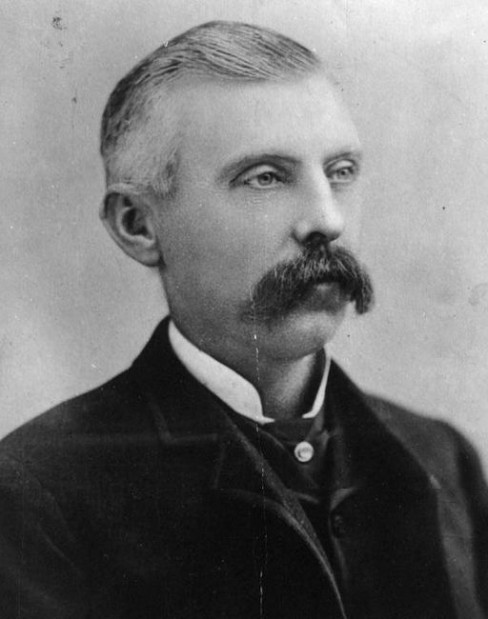
An early Tucson lawman and politician found that it pays to have friends in high places when he ended up with a road in a west-side barrio named after him.
Charles A. Shibell was born in 1841 in St. Louis to George and Mary Shibell. He grew up in Missouri and got his schooling there. Of the five children in his family, he was the only one who survived to adulthood.
In the late 1850s, he attended Iowa College. During the Civil War, he enlisted in the Army, and on May 20, 1862, while under the command of Gen. Carleton, he came to Tucson. He was honorably discharged in March 1863 and returned here to set up a permanent residence.
For the next 12 years he spent most of his time and energy farming, ranching and mining. In 1870, he testified before the Arizona Territorial Legislature concerning Apache depredations.
As reported in the Arizona Territorial Legislature in 1971: "Memorial and Affidavits Showing Outrages Perpetuated by the Apache Indians in the Territory of Arizona During the Years 1869 and 1870": In August, 1870, while coming from Camp Goodwin to Tucson on the Rio Grande mail road, he found the mail coach destroyed and the following persons murdered and mutilated: John Collins, Wm. Burns and two U.S. soldiers. They were scalped, one partially burned, and another with his eyes gouged out.
In 1876, Shibell was elected sheriff of Pima County at a time when it encompassed most of Southern Arizona. He then turned his attention to the Palace Hotel, which later became the Occidental Hotel, serving as its proprietor for three years. (The hotel was located about where "Hotel Arizona" sits now, on Broadway at the western edge of the present downtown.)
In 1888, Shibell was elected county recorder and took office the following year. He held the position until his death two decades later.
Shibell was married twice - first to Mercedes Sais and then to Nellie Norton. In total, he had six children.
He was a charter member and president of the Arizona Pioneers' Historical Society and was passionate about collecting and preserving the records of the early years of Tucson's history.
He died of breakbone fever on Oct. 21, 1908
Shibell got a street named after him when his friend Thomas Hughes Sr. bought land in 1902 and called the neighborhood McKinley Park - it is now Barrio Anita.
Hughes named the streets after his friends and family members.
Sources: Special thanks to Mike Lopez of Pima Community College Richard E. Sloan, "History of Arizona," Record Publishing Co., 1930 Unknown author, "Portrait and Biographical Record of Arizona," Chapman Publishing Co., 1901 Arizona Territorial Legislature, "Memorial and Affidavits Showing Outrages Perpetuated by the Apache Indians in the Territory of Arizona During the Years 1869 and 1870," Francis & Valentine Printers, 1871 Paul L. Allen, "Pioneer Shibell known as Indian fighter, 'brilliant' host," Tucson Citizen, July 4, 2005

