


PHOENIX — Starting Friday Arizonans will once again be able to go to barber shops and beauty salons.
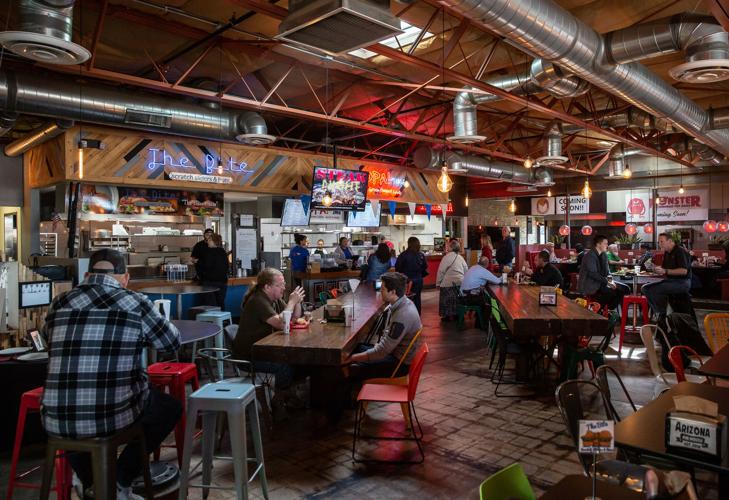
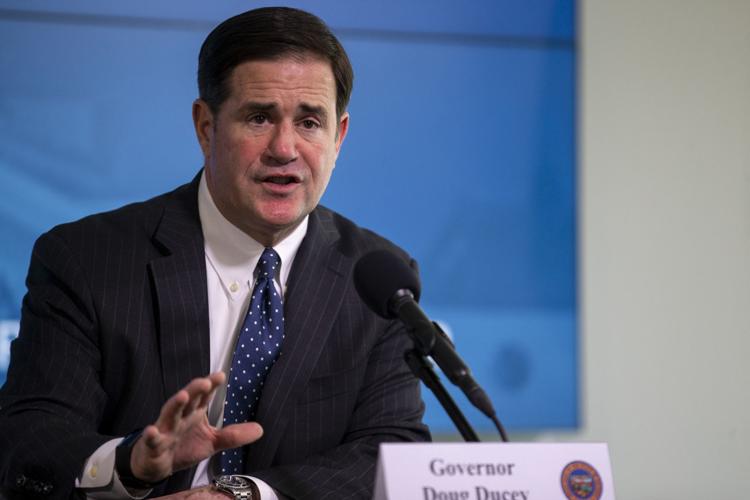
And restaurant dining will resume Monday, under new coronavirus guidelines Gov. Doug Ducey issued Monday afternoon.
But there will be restrictions, ranging from limits on capacity, physical distancing and wearing masks. And depending on the size of the business, appointment-only might be required.
Ducey said he intends to allow other businesses like fitness studio and gyms to reopen, but he did not release a timeline for that to happen. Similarly, pools at apartment complexes, hotels and motels will soon reopen, he said.
Ditto for bars, movie theaters and other businesses. Ducey did not mention tattoo studios and massage parlors.
Ducey said the changes were made as the state has increased the number of tests being performed to check for COVID-19. And he acknowledged that more tests will equal more findings that people are in fact ill.
But Ducey said the key for him is that the percentage of the tests that come back positive.
"And that is what's on the downward trajectory," he said.
"It's a good trend," the governor continued. "And it gives us the confidence to make some economic decisions safely."
The trends the governor is using to explain his latest actions might be a bit misleading.
Until recently, the only people who could get tested are those who showed actual symptoms of the coronavirus. It has only been in the past week that state Health Director Cara Christ expanded eligibility to anyone who believes they may have been exposed.
More tests like that, by definition, leads to a lower rate of positives.
Ducey's news conference came hours after state heath officials reported 279 new coronavirus cases and no new deaths Monday morning. Officials say there are 8,919 confirmed cases of the coronavirus and 362 deaths across the state.
Ducey denied Monday's decision had anything to do with the increasing pressure he is facing, including from many in his own Republican Party, to reopen the state's economy. That ranges from weekly protests at the Capitol to at least two sheriffs saying they do not intend to cite businesses who open and serve customers in violation of his orders.
"There are always going to be outliers in any situation" Ducey said.
"I would say, by in large, the people of Arizona have been fantastic," Ducey continued. "They have been responsible."
But the pressure on Ducey to allow the economy to reopen comes from not just the more libertarian elements of the state's Republicans.
House Speaker Rusty Bowers, R-Mesa, told Capitol Media Services the pure COVID-19 numbers show that the harm to the economy is far outstripping the actual physical danger.
Bowers said he has done some analysis of the 362 deaths in Arizona so far. The vast majority — more than three-quarters — are among those 65 and older who may have had other health conditions.
What that leaves, he said, are the 82 for those age 20 through 64.
"Thirteen one hundred thousands of a percent that have perished, and we say we can't trust the rest of enterprise to open up and use wise business practices," Bowers said. "I'm just hoping that he will recognize that he can trust the rest of the working population to try to exercise themselves smartly in order to help us all put this behind us."
Anyway, Bowers pointed out that the "essential" businesses the governor has allowed to remain open probably make up the vast majority of all of the firms in the state. Yet even with that, he said, the number of cases of the virus has remained small.
Senate President Karen Fann, R-Prescott, did not get into the numbers. But she told Capitol Media Services that Bowers is correct in his conclusions that businesses have figured out how to keep employees and customers safe.
"I'm hoping the governor sees it that way, too," Fann said.
Ducey defended the speed of his changes.
"This is a step forward," he said. "If you want to say I've been too cautious, I accept that."
The governor said that pace is appropriate when talking about this kind of rapidly spreading virus.
"We understand much more today than we did six weeks ago," Ducey said. "And I'm hopeful and optimistic as to what can happen over the next several weeks."
In the meantime, the governor said his stay-at-home order issued more than a month ago is remaining in place, at least until May 15. But he said it's never been a lock down of all activity.
"So if you wanted to go for a run or a walk or go to the grocery store for supplies, you've been doing that," Ducey said.
"Now if you want to take a loved one out to dinner on the 11th or the 12th, or go get a haircut, you can do that, too," he said. "Then you can head home."
In each of these cases, Ducey said, there will be restrictions.
For example, restaurants will not be able to seat parties of more than 10. And there must be at least six feet between tables.
That, however, still leaves the question of why other kinds of establishments, like bars, can't open if they exercise similar controls.
"We're going to work with the industry so there's flexibility so that those places can reopen," Ducey said.
Clint Bolin at Marana’s The Station said being able to open his doors after being closed for the past five weeks is a step in the right direction.
But he and other Tucson restauranteurs said that for the long-term, operating their restaurants at 25 percent capacity was not sustainable.
“My whole thing is we have break-even points and even with the comeback it’s going to be challenging to hit those break-even points to make it work,” said Jesus Bonilla, whose Common Group development company owns the southside American Eat Co. food court on South Fourth Avenue. “This means we get to take one step forward.”
To meet the state-ordered social distancing guidelines, Bonilla said he is removing the family-style bench tables and chairs in the 8,000-square-foot building at 1439 S. Fourth Ave. and putting two- and four-top tables in their place. He expects that when he is finished redesigning the common-area seating, they will be able to serve 10 to 15 percent of the original 300-plus capacity.
“It will only be a fraction of the capacity we need to make a go,” he said, but he and his seven restaurant tenants are determined to give it a shot.
Three of American Eat Co.’s restaurants — Pop’s Hot Chicken, Monster Dogs and Mariscos El Bochas — have remained open for take-out since the mid-March shutdown. The building has space for one more vendor and Bonilla is hoping to bring in a raspado maker.
Ray Flores, president of Flores Concepts, said he’s not ready to commit to reopening his El Charro restaurants next week. He still has questions about safe practices and guidelines that need to be addressed by state, city and county officials.
“We will walk before we run,” Flores said Monday hours after Ducey announced plans to reopen restaurants. “We will examine all of the advice and regulatory rules given to us by the state, county and city and we will do our best to open at a time that we feel is ideally suited to our guests and our crew members.”
Flores said he is in the process of releasing a 100-point plan to guide his company in reopening their El Charro restaurants. The plan will be used to educate employees and guests alike on safe practices including the use of face masks and sanitary practices.
At Marana’s The Station, 8235 N. Silverbell Road, Bolin said he hopes that when he opens on Monday, he can make up some of the money he’s lost since going to takeout only in late March. He estimates his business is down roughly 80 percent; even with less diners in his restaurant, he thinks he can make up 15 or 20 percent of his losses overall.
“It’s not sustainable, but what I’m hoping for is we continue to have a decent amount of the to-go sales and that gets us to around 40 percent,” he said.
Ducey did reverse himself Monday on one key point.
As recently as last week he said that there was no right of anyone seeking to place a relative in a nursing home or other long-term care facility to know if there were residents with COVID-19.
Now, he said, anyone seeking to move a relative is legally entitled to that information, as is anyone who has a relative in an existing facility about any outbreaks there.
The move comes as state officials have acknowledged that these facilities have become relative hotbeds of viral outbreaks, complicated by both the closed nature of the campuses and the age and medical condition of residents.
Christ said it is now her goal to test every staffer and resident at every one of these facilities. But she acknowledged that will take time — she had no idea how long — to do that.
There also are plans to test both staff and inmates in the state prison system.
Photos for April 23: Tucson gets by during Coronavirus Pandemic
Tucson, coronavirus
Updated
Erika Munoz, owner of Seis Kitchen, hands over a bag of meals to Michael Gallagher Carondelet, a registered nurse at St. Joseph's Hospital, to distribute to other nurses and hospital workers, on April 23, 2020. The donation was made in conjunction with A+C (Athletes/Artists+Causes) Foundation's “Project Frontline.” In two deliveries, 400 meals (200 poc chuck chicken and 200 puerco verde burritos) will be given to medical personnel at Carondelet St. Joseph’s Hospital. The particular donation was made possible by the Houston Astros' Pitching Coach Brent Strom, who lives in Tucson.
Tucson, coronavirus
Updated
Hospital workers wheel in carts full of catered meals donated by Seis Kitchen to Carondelet St. Joseph's Hospital, on April 23, 2020. The donation was made in conjunction with A+C (Athletes/Artists+Causes) Foundation's “Project Frontline.” In two deliveries, 400 meals (200 poc chuck chicken and 200 puerco verde burritos) will be given to medical personnel at Carondelet St. Joseph’s Hospital. The particular donation was made possible by the Houston Astros' Pitching Coach Brent Strom, who lives in Tucson.
Tucson, coronavirus
Updated
Kristi Hall, a sixth grade teacher at Desert Sky Middle School, participates in planning a lesson with a fellow teacher on Zoom, at her home on April 17, 2020. Schools in the Vail School District are supposed to open in July due to their year-round school calendar. Plans are being made for the possibility of students returning to the physical classroom.
Tucson, coronavirus
Updated
Bry Kelley, a warehouse assistant, places a pallet filled with food down next to other items donated to the Community Food Bank of Southern Arizona on on April 21, 2020. Forty-one thousand pounds of flour, pasta and canned goods were donated by The Church of Jesus Christ of Latter-day Saints. The donation is part of an ongoing global effort by the church to address immediate needs of people and orgainzations due to the coronavirus disease (COVID-19) pandemic.
Tucson, coronavirus
Updated
A pallet of food is placed down next to other items donated to the Community Food Bank of Southern Arizona on on April 21, 2020. Forty-one thousand pounds of flour, pasta and canned goods were donated by The Church of Jesus Christ of Latter-day Saints. The donation is part of an ongoing global effort by the church to address immediate needs of people and orgainzations due to the coronavirus disease (COVID-19) pandemic.
Tucson, coronavirus
Updated
Christian Bergman, 4th year University of Arizona medical student, takes the temperature of a patient outside the Z Mansion, 288 N. Church Ave., in Tucson, Ariz., on April 19, 2020. Medical students from the University of Arizona and other universities volunteer to help the homeless population with the growing concerns of Coronavirus Disease (COVID-19) within the homeless population. “This is a vulnerable population in our community; they can’t defend themselves in a society already running short on supplies and resources,” said Bergman. Medical students and medical personal help by giving out food, drinks with electrolytes and masks to the homeless. Those who are sick, medically impaired or have been exposed to those with COVID-19 are isolated outdoors in tents on the property. As of Sunday April 19, there were 13 individuals whom are isolated in tents.
Tucson, coronavirus
Updated
Lekha Chesnick, 1st year medical student at Burrell College of Osteopathic Medicine, talks with a homeless man (whom choose to not give his name) outside of the Z Mansion, 288 N. Church Ave., in Tucson, Ariz., on April 19, 2020. Medical students from the University of Arizona and other universities volunteer to help the homeless population with the growing concerns of Coronavirus Disease (COVID-19) within the homeless population. Medical students and medical personal help by giving out food, drinks with electrolytes and masks to the homeless. Those who are sick, medically impaired or have been exposed to those with COVID-19 are isolated outdoors in tents on the property. As of Sunday April 19, there were 13 individuals whom are isolated in tents.
Tucson, coronavirus
Updated
Christian Bergman, 4th year University of Arizona medical student, checks on a patient outside the Z Mansion, 288 N. Church Ave., in Tucson, Ariz., on April 19, 2020. Medical students from the University of Arizona and other universities volunteer to help the homeless population with the growing concerns of Coronavirus Disease (COVID-19) within the homeless population. “This is a vulnerable population in our community; they can’t defend themselves in a society already running short on supplies and resources,” said Bergman. Medical students and medical personal help by giving out food, drinks with electrolytes and masks to the homeless. Those who are sick, medically impaired or have been exposed to those with COVID-19 are isolated outdoors in tents on the property. As of Sunday April 19, there were 13 individuals whom are isolated in tents.
Tucson, coronavirus
Updated
Elliott Dumont, owner of Roadrunner Bicycles, 6177 E. Broadway Blvd., works on a customer's bike on April 22, 2020. The coronavirus disease (COVID-19) has not slowed down bike shops. With many people at home, they are bringing bicycles for repairs and buying new ones for exercise. Dumont says he's booked out till the first week of May for tuneups on bikes.
Tucson, coronavirus
Updated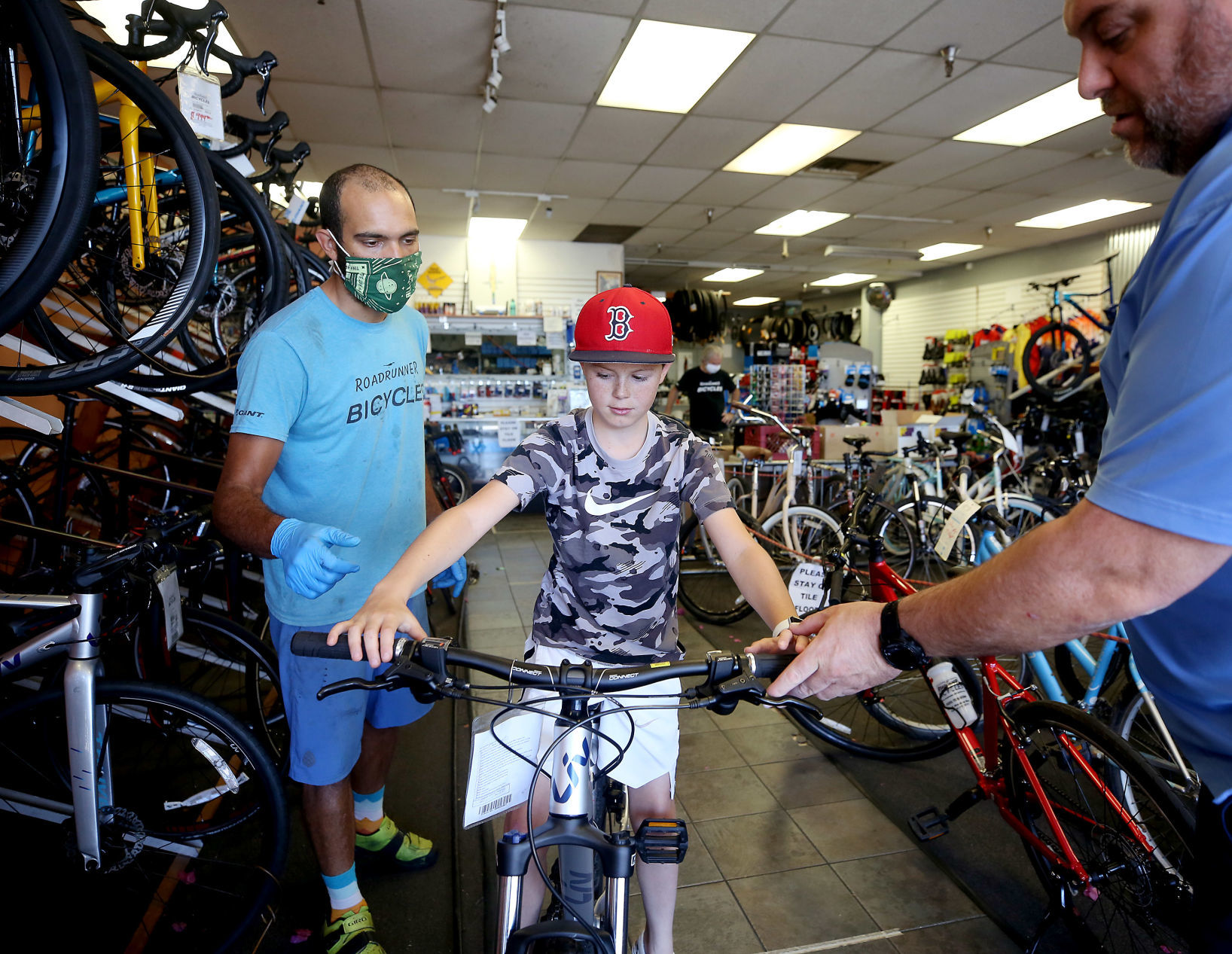
Elliot DuMont, owner of Roadrunner Bicycles, 6177 E. Broadway Blvd., far left, helps Ethan Sasz, far right, and his son, Evan, 10, with a mountain bike purchase on April 22, 2020. The coronavirus disease (COVID-19) has not slowed down bike shops. With many people at home, they are bringing bicycles for repairs and buying new ones for exercise. Dumont says he's booked out till the first week of May for tuneups on bikes.
Tucson, coronavirus
Updated
Marcella Montoya waits in her vehicle as general manger David Kessler brings out her order, as Bear Canyon Pizza serving their customers despite COVID-19 restrictions, April 22, 2020, Tucson, Ariz.
Tucson, coronavirus
Updated
Kitchen manger Koa Hoffmann tosses dough while working up a crust for a call-in order as he and few others keep cooking at Bear Canyon Pizza despite COVID-19 restrictions, April 22, 2020, Tucson, Ariz.
Tucson, coronavirus
Updated
Alvaro Enciso, a local artist, works in one of his studios at his home on April 9, 2020. Every Tuesday Enciso travels into the Sonoran desert to post crosses where migrants have died after crossing illegally over the U.S./Mexico border as part of a project he's titled Donde Mueren Los Suenos / Where Dreams Die. With the outbreak of the coronavirus disease his six year project is on hold and instead he works on other artwork at home.
Tucson, coronavirus
Updated
Dolly Spalding works on a pen and ink drawing in her apartment at the Redondo Tower Apartments on April 7, 2020. During her quarantine, Spalding has been creating drawings of all the Greek goddesses. She is collaborating with Emlyn Boyle, an artist from Ireland, and plans to publish a book with Boyle's writings.

