




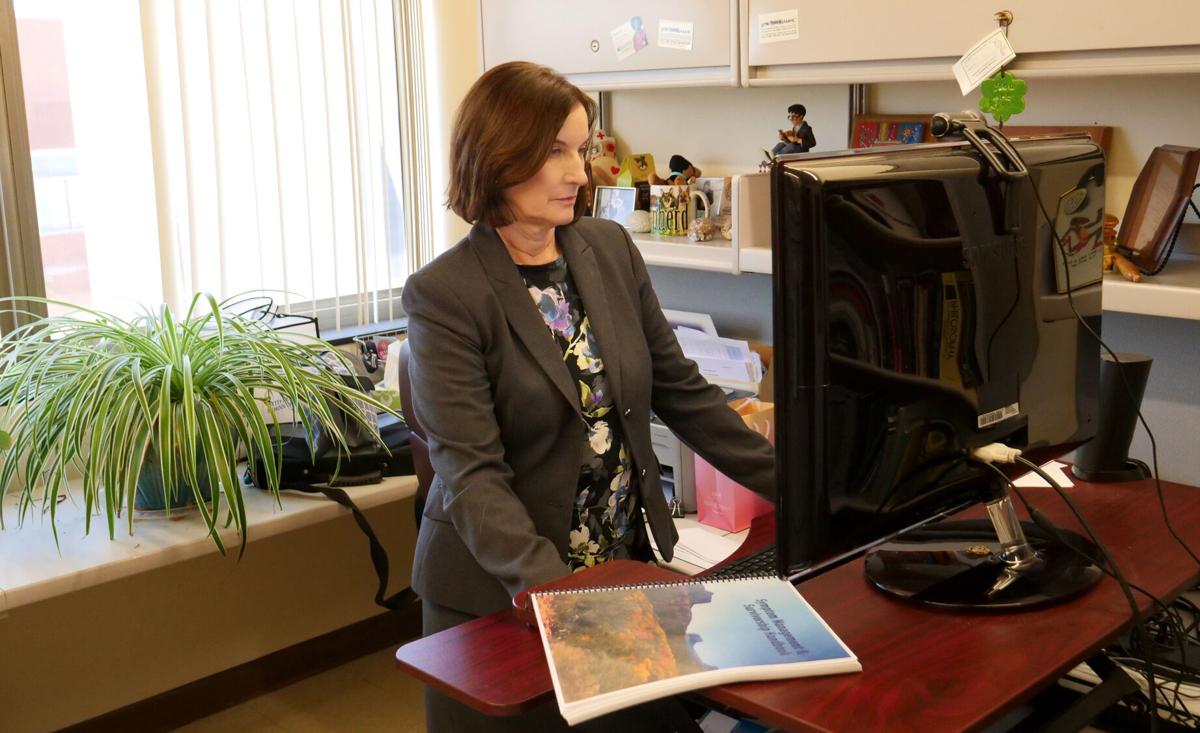
A $4 million American Cancer Society grant was awarded to a UA researcher to improve health equity for Hispanic cancer survivors and their family caregivers.
Under the four-year grant, which will develop a “Cancer Health Equity Research Center,” UA Health Sciences researchers will focus on assessing care and treatment needs in three studies. One study will focus on kidney and liver cancer patients, and the other two studies will focus on all solid tumor cancers, said principal investigator Terry Badger, a professor in the University of Arizona College of Nursing and a member of the UA Cancer Center.
“By looking at social determinants of health, we’re hoping to come up with ideas of how we can decrease health disparities and enable people to access the health care they need,” said Badger.
Researchers will also focus on assessing the impact of diet and physical activity interventions on lifestyle behaviors, and symptom management and health care utilization in rural and urban underserved populations.
Among the project goals for Hispanic cancer survivors and their caregivers are to have research staff develop and deliver by telephone cancer education for symptom management, counseling for psychological distress, and ways to improve diets and to increase physical activity. Also, handbooks in English or Spanish will be available for participants.
Badger said data shows that “diet and physical activity are important factors in the development of many diseases, and obesity has been linked to higher rates of cancer recurrence and death.” She said the obesity epidemic needs to be controlled.
Researchers also will focus on rural patients and their caregivers because they have less access to care and many unmet needs.
“By providing telephone delivered symptom management and counseling we can remove many of the barriers to obtaining care. We believe we will be able to show through this research that we can effectively manage symptoms and reduce psychological distress,” Badger said.
The research will include about 500 cancer survivors and caregivers. Participants will be recruited from the UA Cancer Center, the Mariposa Community Health Center in Nogales, Arizona, and through cancer events in the community. The studies are open to Arizona residents. (See box on Page A3 for details.)
Badger said American Cancer Society data shows “one in four Hispanic adults do not have a usual source of medical care, and have lower rates of health insurance compared to non-Hispanic groups.”
“Individuals without health insurance or health care access are more likely to be diagnosed with advanced cancer and have higher death rates than those insured with health care access,” Badger said.
The researcher said those who do not have insurance may use a hospital emergency room or urgent care more than going to a primary care doctor.
“You may wait until you are really ill before seeking treatment, thus many cancers in Hispanic survivors are diagnosed later rather than at early stages,” Badger said.
“We can help with this through research and linking Hispanic Americans to resources as needed. The American Cancer Society, Cancer Support Community of Arizona and other organizations have support services to help with transportation and other services needed,” said Badger.
Cancer is a leading cause of death in the U.S. Hispanic population, whereas heart disease is the leading cause of death in non-Hispanic whites, according to the American Cancer Society report, “Cancer Facts & Figures for Hispanic/Latino People 2021-2023.” Among Hispanics, lung cancer is the leading cause of death in men and breast cancer in women.
“The risk of being diagnosed with cancer increases with age because most cancers require many years to develop,” states the report. It says “about one in three Hispanic men and women will be diagnosed with cancer in their lifetime and one in five men and one in seven women will die from the disease.”
Others working with Badger include professor Cynthia Thomson, associate professor David Garcia, and research associate Celina Valencia, all in the UA Mel and Enid Zuckerman College of Public Health; Ken Batai, a cancer health disparities researcher, and Jennifer Hatcher, associate director of Community Outreach and Engagement Cancer Prevention and Control Program, both at the UA Cancer Center; and Chris Segrin, professor in the UA College of Social and Behavioral Sciences.
In addition to the UA, the other minority-serving institutions the American Cancer Society designated funds to were Morehouse College, Howard University and University of Illinois-Chicago.

