


In the lush courtyard of an old adobe building on South Stone Avenue sit two artifacts that connect today’s Tucson to when the Old Pueblo was in the midst of deep changes.
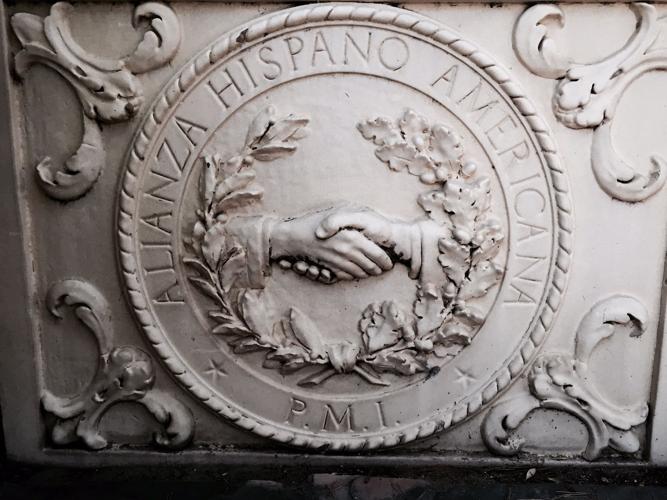
The first is a terra cotta, bas-relief panel with a pair of clasped hands between two laurel branches set within a circle. On the outer ring are the words Alianza Hispano Americana.
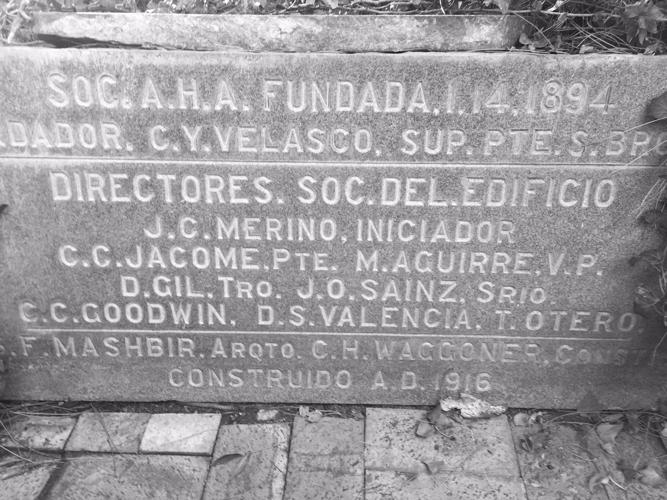
The second is an engraved block with dates and names related to the Alianza, stating its founding date and the names of some of its principal founders: C. Y. Velasco, J.C. Merino, C.C. Jacome, M. Aguirre, D. Gil, J.O. Sainz, C.C. Goodwin, D. S. Valencia and T. Otero.
The cornerstone, like the bas-relief panel, was part of the Alianza’s building, erected in 1916 on West Congress Street, where the Pima County administrative building now stands. The two mementos are in the patio of a private residence and professional office, which was the territorial home of Carlos Y. Velasco, the moving force behind the Alianza.
The Alianza means virtually nothing today but in its time, the Tucson-born Alianza was the largest Mexican-American mutual-aid organization with thousands of members in the Southwest and Mexico. It provided low-cost insurance and burial benefits, and information to Mexican-American communities, which were confronting new challenges and obstacles.
The Alianza was established on Jan. 14, 1894 by Tucson’s Mexican-American leaders and businessmen led by Sonoran-born Velasco, who in 1878 started the Spanish-language newspaper “El Fronterizo.” Like the newspaper, the Alianza championed civil rights and justice for the Mexican-American community.
But the Alianza’s reach was wider and it became a precursor to Mexican-American civil rights organizations that emerged after World War II, according to local historian Thomas E. Sheridan, author of “Los Tucsonenses: The Mexican Community in Tucson, 1854-1941.
“At its height in the late 1930s, the Alianza numbered more than 17,000 members scattered in local chapters across the western United States and northern Mexico,” he wrote. Although their names are not etched on the block, other key founders included Pedro Pellon, Mariano Samaniego, Samuel Brown, Miguel Riesgo and Ignacio Calvillo.
A couple of weeks ago two large green tomes were loaned to me. They contain original Alianza newsletters from the 1950s to the early 1970s, when the Alianza had withered away due to societal changes and financial malfeasance.
The newsletters celebrated Mexican-American unity and culture. They promoted political participation and civic engagement. They encouraged literacy and social activities. The newsletters reminded readers of Mexican history.
They carry photos of the young Tucsonans who belonged to social groups like the women’s Club Mavis and the men’s Club Monte Carlo.
The monthly publications promoted young Mexican-Americans in government and business, many of whom would later become the new Chicano middle class. Principally the newsletters championed the Alianza.
The Alianza was similar to other ethnic mutual-aid organizations that flourished in other parts of the country, especially in the East Coast where the cities were swelling with large numbers of European immigrants charting new lives.
But in the Southwest the border crossed over. The residents of what was once Mexico were now part of the United States. Tucson folded into the U.S. in 1854 after the ratification of the Gadsden Purchase. The once-dominant Mexican-American communities succumbed to the economic and political power of Eastern newcomers. However, beyond losing dominance, Mexican-Americans were targets of groups promoting American-Anglo-Protestant purity.
The Alianza stood against the hate.
By the late 1950s other Mexican-American civil rights groups, with wider reach and fresh energy, eclipsed the Alianza. And in November 1963 the president of the Alianza, J. Carlos McCormick, resigned under accusations of embezzlement. The organization limped along and fizzled away about 10 years later.
The Alianza is long gone but its legacy is more than its two reminders in the courtyard.

