


GALLOWAY TOWNSHIP — Sometimes there is an upside to disaster, even one as big as Hurricane Sandy.
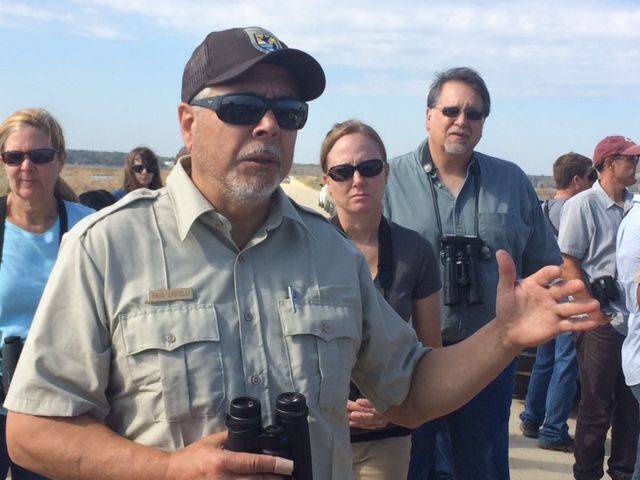
For birds, there were bright spots after the storm, Paul Castelli, senior wildlife biologist for the Edwin B. Forsythe National Wildlife Refuge, said at the fall meeting of the New Jersey chapter of the Wildlife Society on Wednesday.
Sandy flattened the dunes at Forsythe’s Holgate property at the southern end of Long Beach Island, said Castelli, giving beach-nesting birds such as piping plovers more habitat to raise young.
“Many of them are endangered or threatened, and since the storm their numbers and success are through the roof,” Castelli said.
The storm also unleashed a tide of funding for the area, including about $10 million for the refuge to both make repairs and strengthen its resiliency against future storms.
There are also funds for organizations to carry out marsh restoration and living shoreline projects.
The meeting’s theme was “Coastal Restoration in the Face of Climate Change.” It was held in the old refuge headquarters, which is being replaced by a new building under construction. The Wildlife Society’s mission is to promote excellence in wildlife stewardship.
Post-hurricane funding included money for pilot programs for marsh restoration near Avalon and Stone Harbor on the Atlantic Ocean side and in the Fortescue section of Downe Township on the Delaware Bay, said Dave Golden of the New Jersey Division of Fish and Wildlife.
The marshes had shown signs of degradation from rising sea waters and the impact of boat wakes, he said.
That project, which has a large number of partners, including the Nature Conservancy and the New Jersey Department of Transportation, is reusing sediments from channel dredging to replenish marshes that have been threatened by erosion and rising sea waters.
Federal Sandy money to the tune of $880,000 is also funding living shoreline projects at Gandys Beach on the Delaware Bay in Cumberland County, said Katie Conrad, biologist with the U.S. Fish and Wildlife Service.
The service is constructing 3,000 feet of living shoreline and breakwater to restore 337 acres of salt marsh and adjacent uplands, according to its website.
Conrad said different materials are being used at various sites there, from coir logs made of coconut fibers to cement interlocking blocks for creating oyster reefs to oyster shell bags created by schoolchildren.
The idea is to encourage native marsh grasses to grow along stream edges with the help of coir logs. And the blocks and oyster shell bags give oyster spat a place to attach to and grow. The new reefs will both reduce damage from wave action on Gandys Beach and improve water quality through oyster filtering, Conrad said.
The Nature Conservancy estimates Gandys Beach has lost about 500 feet since 1930, she said.
Forsythe is partnering with other agencies on two other marsh restoration projects, said the refuge’s wildlife biologist Vinnie Turner.
Those do not involve post-Sandy funding, he said.
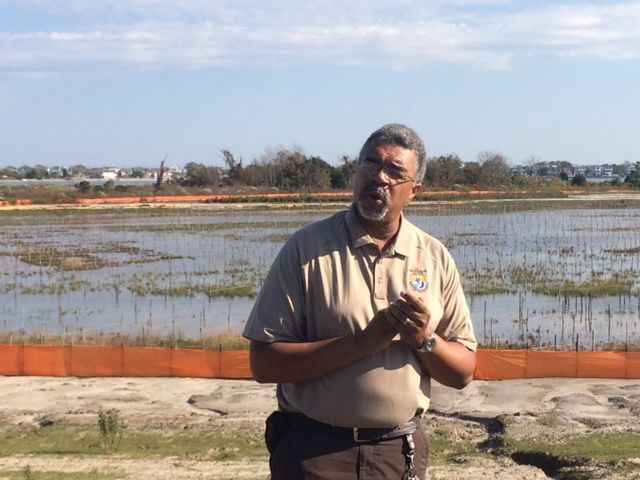
Instead, at Cedar Bonnet Island, Forsythe is working with the DOT to create wetlands on the site. The state department is paying for the project and had to create wetlands to mitigate the effect of a Route 72 bridge project, Turner said.
Cedar Bonnet is a small dredge spoils island off Route 72, just before the causeway hits Long Beach Island. It was created when the intracoastal waterway was dredged, he said, and the soils have tested negative for pollutants.
Until recently, it was an uplands with heavy cover and limited wildlife habitat, Turner said during a Wildlife Society field trip Wednesday.
Now, part of the island has been dredged to create wetlands, and marsh grasses are beginning to grow.
“Hundreds of thousands of Spartina alterniflora and Spartina patens (native wetlands grasses) plugs were hand-planted,” Turner said. A network of criss-crossing lines of fiber above the plantings keeps the geese away, he said.
But Turner said the uplands portion of the project, where the dredged materials were put, is now too acidic for native trees and shrubs to grow. So some clean fill must be brought in to cap it to a depth of about two feet, which will delay planting until next spring.
Once complete, there will be a walking trail on site that will make the island a place for birdwatching and enjoying nature, he said. Barring unforeseen complications, it should be done by mid-2018, Turner said.
The last stop on the field trip was a Forsythe property in Barnegat Township that is a freshwater impoundment created by dikes long ago as a mosquito control measure, Castelli said.
It is too expensive and difficult to maintain the dike system in the face of rising sea water, and the Ocean County Mosquito Commission believes a tidal marsh would be more effective in controlling the biting bugs, Castelli said.
So the commission is removing dikes to allow the acreage to revert to a tidal marsh, he said. That work will begin soon.
This story has been updated to reflect that Gandys Beach has lost about 500 feet since 1930.

