


Cultural anthropologist and folklorist James S. "Big Jim" Griffith, 1935-2021, died on Dec. 18 at age 86 at his Tucson home. Among the many stories he shared over the years are these:
I'itoi and Baboquivari
By Jim Griffith, special to the Arizona Daily Star, Jan 28, 2014:
It’s as close to cold weather as we might get in Tucson this year, so it’s time for me to share with you some of the traditional stories of the Tohono O’odham. According to their owners, these stories should be told only during the cold weather, when the snakes are asleep, and I prefer to respect that stricture. After all, they aren’t my stories.
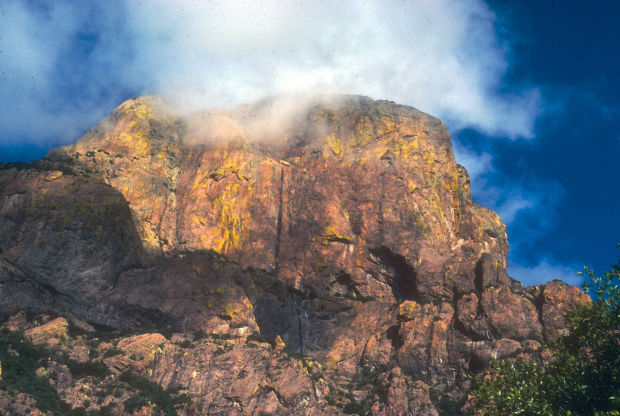
Southwest of Tucson, on the west wall of the Altar Valley, stands Baboquivari Mountain. Its name comes from waw kwiulk, which is O’odham for “Constricted Rock.” It is the center of the Tohono O’odham universe, and contains the home of I’itoi, the Creator of the O’odham. I’itoi was among the first three beings to be created, along with Buzzard and Coyote.
I’itoi then created people, and, many years later, got into a fight with a powerful personage named Siwani, who lived north of the desert, in what is now Pima country. Siwani killed I’itoi, but the latter returned the next morning. After being killed for four nights in a row, I’itoi remained dead, but eventually returned as a little old man. This time he sent for help in all directions, including the Underworld. Those who responded from that place were the ancestors of the Tohono O’odham.
After his defeat of Siwani, I’itoi went to live in a cave on the west side of Baboquivari. There he still lives, according to some, only emerging in times of great need for the people. In later blogs, I will tell about a couple of these occasions, and the ways in which I’itoi responded. According to some, his most recent emergence was in the late 19th century, when he led wild animals out of the way of a railroad that was being constructed across O’odham country.
One recent time I’itoi was in the news was in January 1983, when then-Secretary of the Interior James Watt opened the west side of the mountain to mineral exploration, and potentially to mining. The Tohono O’odham formally objected, mentioning the sacred nature of the mountain, and took petitions to Washington. In April of the same year, the secretary designated the whole area as a Wilderness Study area. The next October, Secretary Watt resigned from his office over a totally different matter. (Even though the T.O.s were called “Papagos” in the 1980s, I have kept their current name to avoid confusion.)
The evolution of sand trout
By Jim Griffith, special to the Arizona Daily Star, Apr 19, 2013:
It all began when the Sonoran Desert started drying up, to become what it is today.
As the surface water slowly disappeared, the trout that lived in our rivers, and especially in the Santa Cruz, began to evolve in order to live in their new world. Their gills were replaced by lungs and their eyes grew on stalks, thus allowing them to both breathe and see in their new environment.
Swimming through the sands of the waterless rivers, they would scan the surface in order to catch the insects and small reptiles on which they fed. In the process, they also became one of North America’s most challenging game fish.
Consider the situation: The trout could see as well as any other surface-dwelling animal. Therefore it was useless to walk through the sand, casting your line. And because swimming through the hot sand in the daytime can be a painful experience, the sand trout would never move very far for its meal.
Finally, some unsung genius hit upon the Horny Toad Solution. One catches a horned toad, ties a leader around its belly just behind its front legs, and lets it loose to scamper down the river. The trout sees it coming, opens its mouth, and GLOMP! swallows the repile. A sharp jerk on the line sets the critter’s spikes in the fish’s mouth, and there you are!
Non-sporting (or very hungry) fishermen discovered that if you haul the trout in hand over hand, the friction of the sands will have it skinned and cooked by the time it reaches the shore.
Of course there’s a caveat here. Horny Toads are a protected species. However, there are no laws against taking them for little walks in the desert. It’s an argument for catch-and-release fishing, but in this case, you catch the fish and release the bait.
For those camp cooks who are reading this, here’s my favorite recipe. Mix a marinade of five parts tequila, three parts lime juice, one part chili powder (Santa Cruz brand, of course) and a tablespoon of salt. Soak the sand trout in the marinade for 12 hours, at the end of which you feed the fish to the dogs and drink the marinade.
Now, I’ve been writing this in the present tense, but the sad fact is that our population of sand trout has been seriously depleted. Most were drowned in the floods of 1983.
FULL DISCLOSURE: Like every teller of tall tales, I reserve the right to add my own details. In these cases, and in these cases only, I violate the Folklorist’s Rule by not telling it exactly the way I heard it.

