


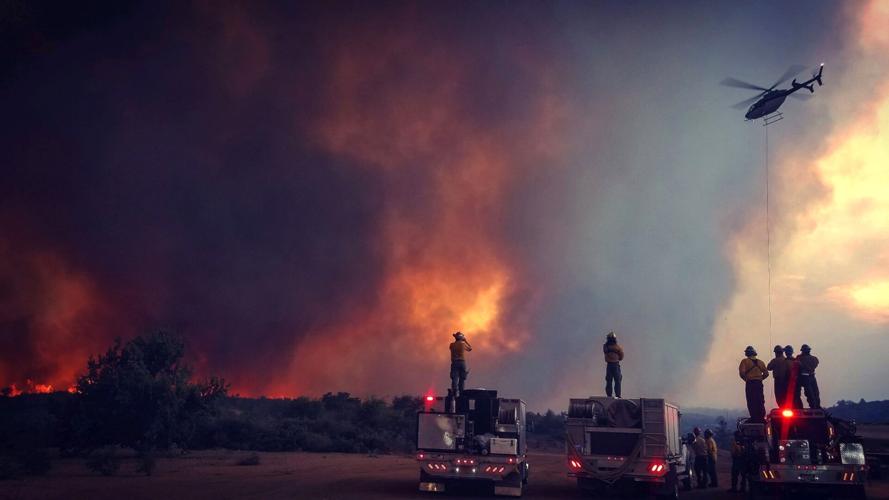
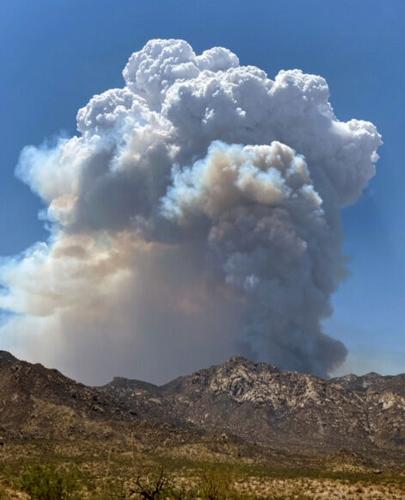
PHOENIX — Legislative panels gave initial approval Wednesday to a $100 million plan for fighting wildfires and their effects, but not before debate broke out over climate change and whether humans are responsible for heat and drought conditions that result in huge blazes.
The measures approved by House and Senate committees on natural resources include $75 million to most immediately fight the dozen or so active fires and prepare for the aftermath, including flooding and repairs.
The package also includes nearly $25 million for “wildfire mitigation,’’ most of that to create 72 crews, each of 10 inmates, who would go out and reduce hazardous vegetation, mostly in areas around communities.
The additional dollars would provide a fivefold increase in the state’s current ability to clear about 4,000 acres a year, David Tenney, the state forester and the agency’s director, told lawmakers.
Tenney also briefed lawmakers on the prospects for 2021 becoming one of the worst fire seasons in state history, saying that 896 blazes so far this year have charred 289,000 acres.
Last year, at the same time, about 62,000 acres had been lost. Ultimately, fires consumed 900,000 acres in 2020.
‘Many reasons’ for fire danger
Tenney sidestepped questions from Sen. Kirsten Engel, D-Tucson, about how much of this he believes is due to climate change — particularly any caused by human activity.
“Obviously, there’s people on both sides with strong feelings on that issue,’’ he said.
“We recognize at our agency whether it’s man-caused or nature and not a lot we can do about it. Bottom line is we’re in the middle of a really bad drought and things are drier than we’ve ever seen them,’’ Tenney continued. “So, conditions have changed.’’
He said it’s the heat as well as the drought.
“Then add in the population of Arizona has doubled or more in my lifetime, which means more people that want to get out of the heat and get into our forest, which means more people shooting at exploding targets and more people dragging chains and more people blowing tires and more people throwing out a cigarette butt or leaving a campfire unattended,’’ Tenney said.
That comes on top of the period decades earlier when logging and forest thinning were curtailed, he said.
“So fire danger has increased for many reasons,’’ he said.
‘There’s no debate among scientists’
Sandy Bahr, director of the Grand Canyon chapter of the Sierra Club, told legislators they should not approve this funding without also dealing with the underlying issues of the climate. Those include reducing emissions, including those coming from gasoline-powered vehicles, she said.
She said virtually all of Arizona is in drought, with more than half of the state classified as in extreme drought. Last summer was the hottest on record, Bahr said, and Lake Mead is at the lowest level since it was initially filled.
“But there is complete inaction by the Legislature and the governor,’’ she said.
That provoked pushback from several Republican legislators.
Rep. Frank Carroll of Sun City said climate change is just something that happens over the eons. Sen. David Gowan of Sierra Vista agreed.
“We have ups and downs and you see it through our history,’’ Gowan said. He derided claims that the climate is warming, noting there were stories in news magazines in the 1970s mentioning “global cooling.’’
“Since you can’t get it right, we call it ‘climate change’ now,’’ Gowan said.
“There’s no debate among scientists,’’ responded Rep. Aaron Lieberman, D-Paradise Valley.
“There might be some debate among maybe some politicians,’’ he continued. “But the notion that we don’t know that climate change is real, that Arizona isn’t the third warmingest state in the country, that Phoenix and Tucson aren’t in the top five, is really scary to hear because it completely flies in the face of science.’’
It would be wrong for legislators to deal only with the the fires and the aftereffects and then give up, said Sen. Juan Mendez, D-Tempe.
“I understand fires in the desert are no joke,’’ he said. “And I truly believe making people whole after a fire is a laudable effort. But if that’s all we do with this special session, then this whole endeavor will be a sad joke.’’
Role of cattle in reducing fuel
Sen. T.J. Shope, R-Coolidge, said he’s willing to consider where climate change fits in on the question of fires. But he said the causes and effects are not that simple, citing efforts by environmental groups to oust cattle from public lands.
“Is there going to be an acknowledgment on the other side that things like grazing are a part of the answer to some of this stuff?’’ he asked, referring to the fact that cattle eat and trim grasses that could fuel fires.
Shope argued that various environmental efforts that curbed long-practiced policies of farmers, ranchers and others have simultaneously resulted in an “exponential rise’’ in fires.
One thing that could slow final approval when the measures go to the full House and Senate on Thursday. June 17, has to do with the ability of ranchers to tap into the funds.
“It’s important to get cattle back on the land,’’ said Stephanie Smallhouse, a rancher and president of the Arizona Farm Bureau Federation. She said that can’t happen if ranchers don’t have the money to restore burned fences and reconstruct water supplies.
But Sen. Lisa Otondo, D-Yuma, pointed out that there is only so much money in the package, most immediately in responding to the fires and then to protect communities from future flooding.
“This bill is to address what is happening today and stop it, immediately, and get boots on the ground,’’ Otondo said. It also can help advance dollars for communities that may eventually be able to get federal grants, she said.
“I want to be sure that this doesn’t become a slush fund,’’ Otondo said. So the senator said she will seek a $10 million cap on how much money can go to landowners.
Chris Wanamaker, Pinal County manager, spoke about viewing the area east of Superior. He wants funding for a rain gauge and a stream flow gauge.
“That can give the town some advance warning when floods or rain starts coming,’’ he told lawmakers. Wanamaker said those devices can be set to send out warnings at preset levels, sending out emails and text messages.
Another goal is stopping some of the potential destruction when the monsoon rains come, carrying not just water but debris and ash into urban areas.
“They can take out power lines, take out sewer lines, water lines, any other kind of infrastructure,’’ said Tami Ryall, grants administrator for Pinal County.

