



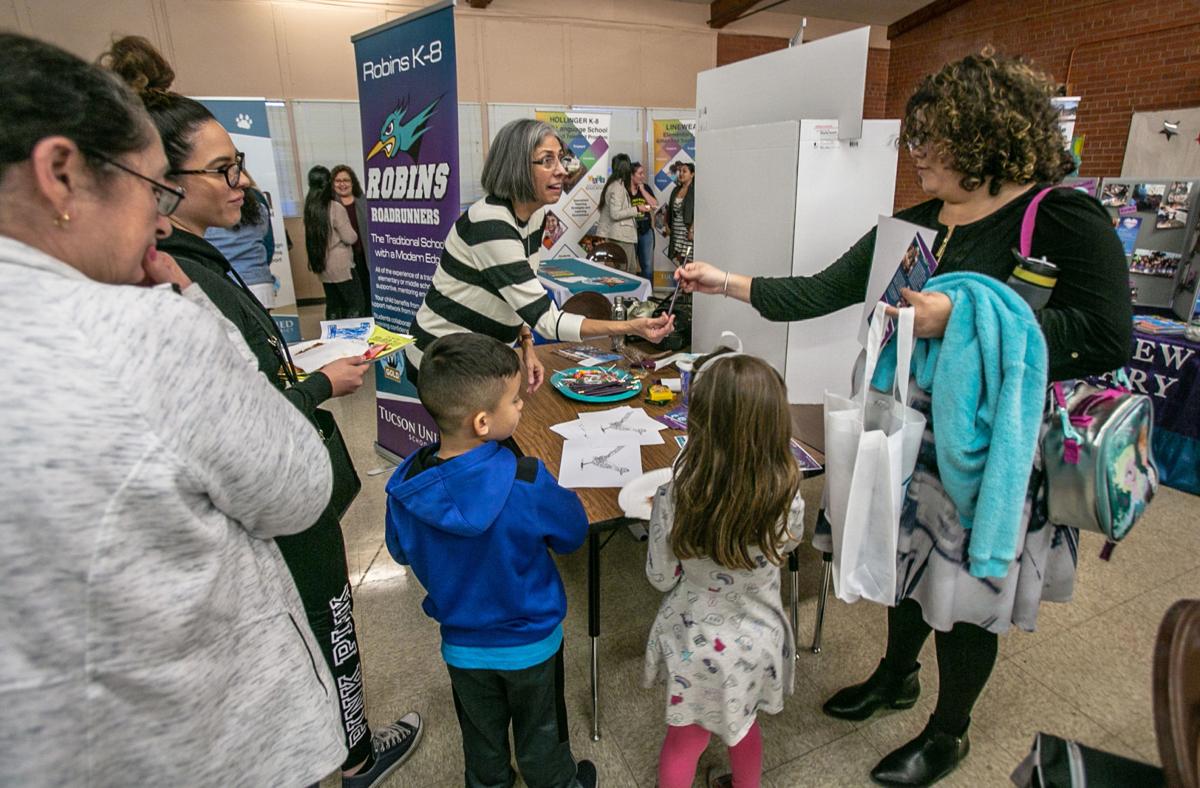
Tucson’s largest school district has continued to struggle with dwindling student enrollment, but in the last few months few concrete actions have been taken to remedy the issue despite convening a task force to study the longstanding decline.
This school year alone, around 2,200 students have left the Tucson Unified School District for another Arizona public, charter or private school, according to student withdrawal data obtained by the Arizona Daily Star through a public records request.
This accounts for less than half of the 5,100 students TUSD lost to in-state transfers last school year. The district lost around 6,100 students on average every year during the four years prior.
Now TUSD is hoping to “(stop) the bleed” of students leaving the district with a twofold approach, according to Superintendent Gabriel Trujillo. It requires recruiting new students, but more importantly it requires the district to take a more hands-on approach to student retention.
There are three key grade levels after which students decide to leave the district most frequently, Trujillo said: after preschool, fifth grade and eighth grade.
“When you look at TUSD’s history with its enrollment loss, one thing that remains consistent is we get beat up at these three key grade levels every single year,” Trujillo said. The data support this: Students do tend to leave at higher rates in sixth and ninth grades — the years they would start their middle or high school careers with TUSD.
It’s those fifth-graders whose parents dislike the TUSD middle school option in their area, preschool families who don’t like their neighborhood elementary school or eighth-graders who don’t get into popular high schools like Tucson, University or Sabino, according to Trujillo.
Most students who withdraw from TUSD do so because they are transferring to another in-state school, but they also leave because they drop out or, in some cases, stop showing up to school without telling the district why.
MOVING FORWARD
Now, the ball is in the district’s court to woo those kids into staying, Trujillo said.
“We had all year with them,” he said. “What did we do? I don’t want to misfire the same way this season.”
Until the end of this school year, wooing them will include more person-to-person contact and engagement between TUSD and vulnerable students. It’s a short-term fix Trujillo hopes will make an immediate, notable impact.
“It’s tours, it’s meetings with school teens,” he said. “You’ve communicated to us you don’t want to go to Cholla. We want to meet with you and ask what your concerns are.”
Longer term, the water is murkier. Trujillo wants to examine the root causes of why students and parents are so weary of certain schools, so the district can work on improving them, from the ground up.
His plans on this front aren’t super-specific, yet. So far, he has planned to examine ways to reform TUSD middle schools. He will present his findings and recommendations on this front at the March Governing Board meeting, most likely.
The Governing Board itself has yet to hear a number of recommendations from the district’s task force dedicated to solving the enrollment issue, despite having opportunities to do so over the last few months.
Most of the shorter-term strategies and fixes recommended by the task force, like investigating enrollment losses at select east-side schools, targeting recruitment efforts in growing neighborhoods and revising the TUSD student exit survey, don’t require board approval.
But many of the group’s longer-term, cost-saving recommendations, like opening a new high school on the southwest side, adding a middle school option to Sabino or reopening Wakefield Middle School, do.
Anything that needs administrative review — like budgeting to build a new school or reopen an old one — requires board review, according to Governing Board policy. If any of the bigger-ticket recommendations were to ever come to fruition, they would need the majority of the board’s support.
Other recommendations include closing buildings, wings and portables in under-utilized schools and studying whether outsourcing grounds and custodial staff would result in cost savings.
The district won’t be able to make many of these suggested cost-saving fixes right now, though, because of its existing financial strife, according to board President Mark Stegeman.
“A lot of this stuff is probably never going to turn into a board item,” Stegeman said.
He added that though he thinks the enrollment decline is one of TUSD’s most “alarming” issues, hearing the task force’s recommendations and findings is not an urgent concern at the moment. He said this is a presentation that’s been done before “without avail,” in a lot of ways.
“I’ll be more impressed with actions to deal with specific problems we’ve known for years,” Stegeman said. He said the board does need to pay more attention to enrollment-decline-related issues in the coming months.
“In a broad sense, the board hasn’t paid enough attention to enrollment loss over the years. The lack of action is … frustrating.”
Board members Adelita Grijalva, Rachael Sedgwick, Kristel Foster and Leila Counts did not respond to emails for comment from the Arizona Daily Star about the Enrollment Task Force.
The board was originally scheduled to hear the task force’s presentation at its Nov. 12 meeting, but it got pushed to the next regular meeting in December. Then it got pushed to the first regular meeting of the year in January, where it was again postponed. Stegeman said he assumes the item will come up again on the Jan. 31 special meeting agenda.

