



OK, readers, here’s your quiz of the day:
What is the supreme law of the land? What does the Constitution do? The idea of self-government is in the first three words of the Constitution. What are these words? Who is the Chief Justice of the Supreme Court? What do we call the first 10 amendments to the Constitution? What is one right or freedom from the First Amendment?
You have a minute to answer. Tick, tick, tick, tick. Time’s up.
I suspect most readers know the correct answers. After all, you are newspaper readers. But I also suspect that most people, if randomly asked, would fail in passing the civics test given to naturalization candidates.
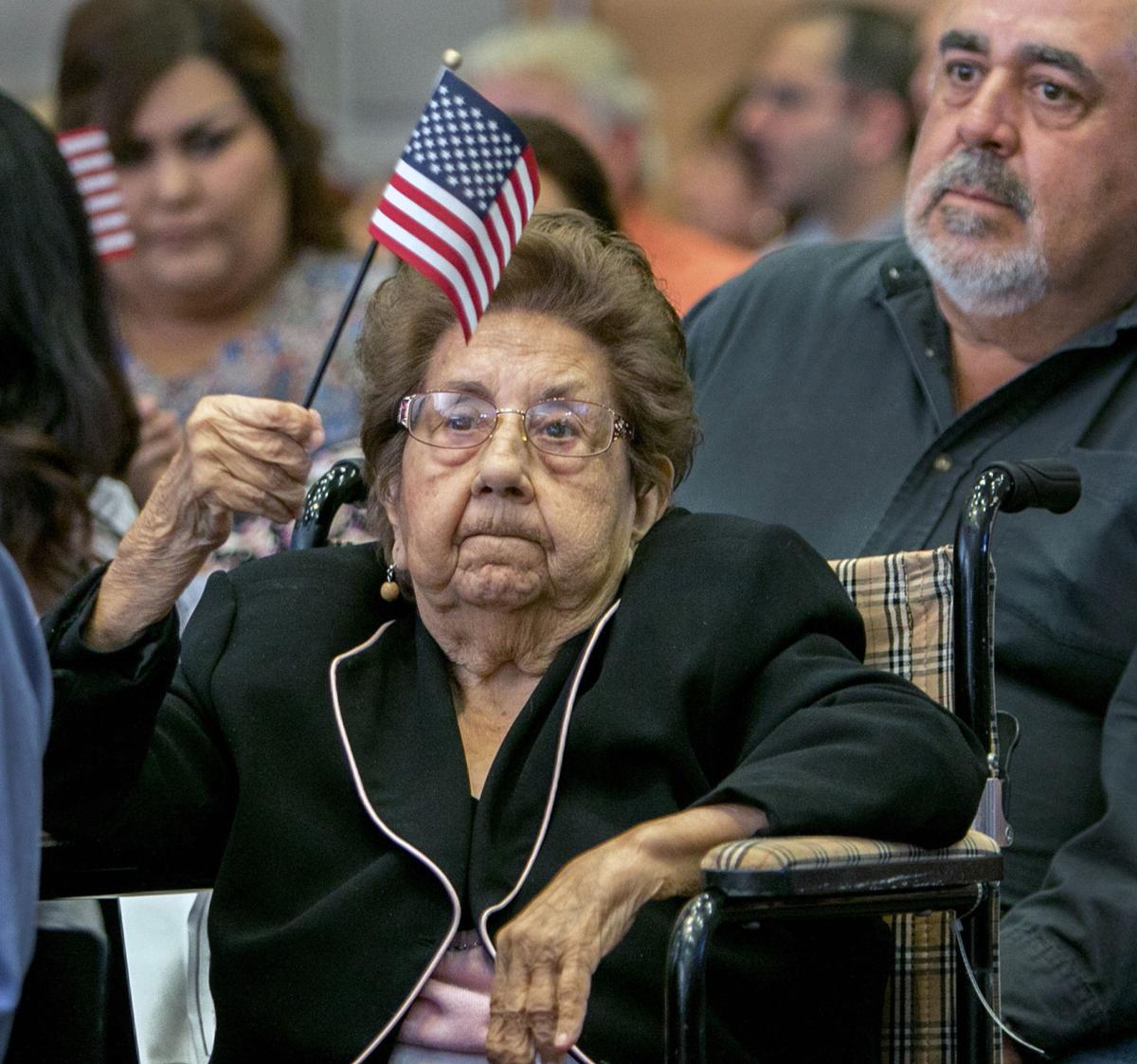
But Magdalena Majalca knew. She’s 86 years old.
On Friday, Majalca, who has lived in Douglas for the past 60 years, became a proud U.S. citizen in a naturalization ceremony at the U.S. District Court on West Congress Street in downtown Tucson. U.S. Magistrate Bruce G. Macdonald administered the Oath of Allegiance to 51 people from the following countries: Bhutan, Brazil, Chad, China, Cuba, Czech Republic, Germany, Hungary, Iran, Italy, Japan, Laos, Malaysia, Mexico, Philippines, Taiwan and Vietnam.
Majalca was accompanied by several of her equally proud family members.
“It was beautiful. It was wonderful,” Majalca said after the ceremony, accompanied by her son Luis Majalca, his wife, a sister-in-law and several grandchildren and great-grandchildren. They were all beaming. They are the reasons Majalca took the oath.
In a phone interview a couple of days before the ceremony, Majalca briefly talked about becoming a citizen. She did it for her family, she said.
“I thought about it for many years,” she said over the din of children and the TV. “I did it for my grandchildren.” She has 11 grandchildren and 11 great-grandchildren.
Because of her age, Majalca received an exemption from taking the test in English. U.S. Citizens and Immigration Services allows candidates, who are at least 50 years old and have lived in the country for 20 years as a permanent resident, to take the test in their native language. All candidates, under the age of 65, study 100 questions and are asked 10 questions and must answer six correctly. Those over 65 study less than the 100 questions. All candidates are interviewed by a USCIS officer.
Majalca passed her civics test in Spanish. She told the officer administering her exam to ask her all 10 questions because she knew the answers.
“She memorized the test better than us,” said Majalca’s eldest son, Reynaldo Majalca Jr. by phone, the night I talked to his mother.
His mother initially was reluctant to start the process. But with her family’s encouragement, she gained confidence in studying for the exam. It helped that Majalca is a news junkie, said Reynaldo. She was an avid reader and now she watches television news programs (as well as telenovelas such as “Los Diez Mandamientos” and variety programs like “El Gordo y La Flaca”) because her eyesight has deteriorated.
“She passed the test on her first try,” Reynaldo said.
But Majalca, who was born in Agua Prieta, Sonora, across the border from Douglas, had another reason to become a U.S. citizen. She’s worried about the changing political climate in the country and especially in her border community.
Many Southern Arizonans can recall the dark days in 1954 when the U.S. government, under President Dwight D. Eisenhower, forcibly expelled more than 1 million Mexicans living in the U.S. without authorization. Through the program derisively known as “Operation Wetback,” immigration agents and local police conducted sweeps in Mexican barrios and agricultural fields from California to Texas, terrorizing communities, separating families. Even legal residents and U.S.-born Mexican-Americans were sent to Mexico against their will.
Reynaldo said his mother remembers those days and is well aware of the political changes occurring and coming under the current administration.
“The situation has changed a lot here in the Unites States,” Reynaldo said.
And it will continue to change as Majalca plans to exercise a cherished right.
“I intend to vote,” she said.
Oh, by the way, the answers to the above questions are:
The Constitution; protects basic rights of Americans; We the People; Chief Justice John Roberts; Bill of Rights; freedom of speech.

