


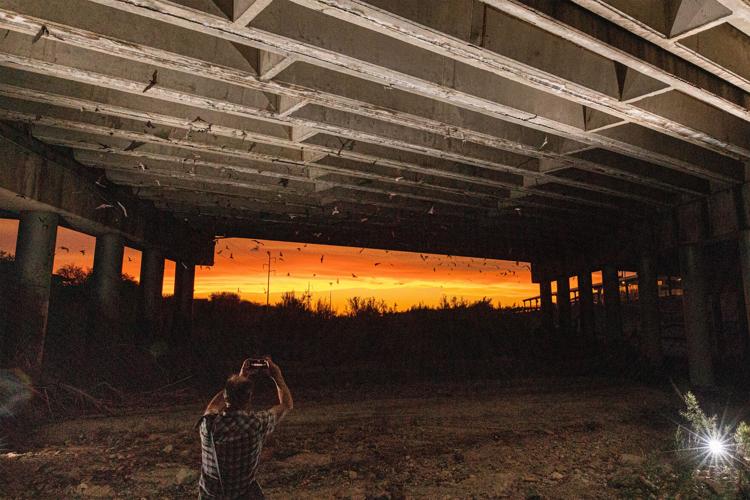
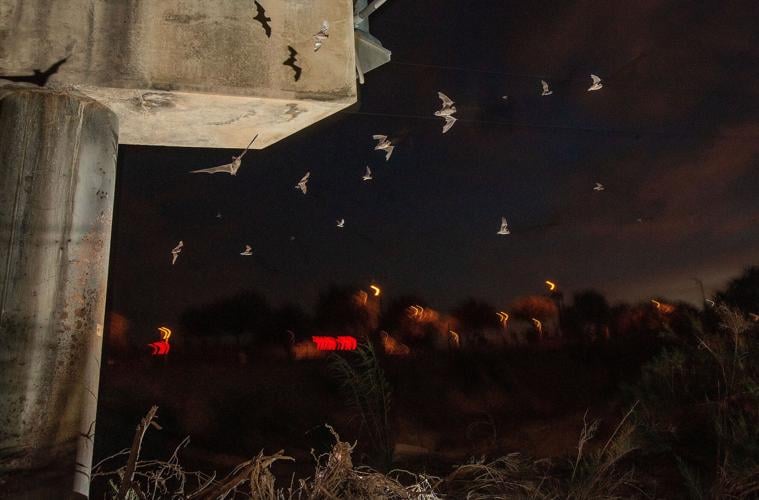
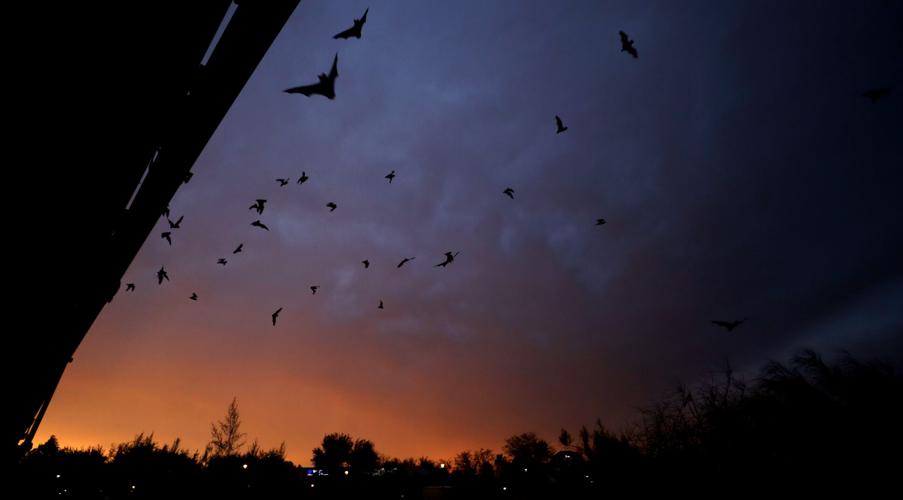
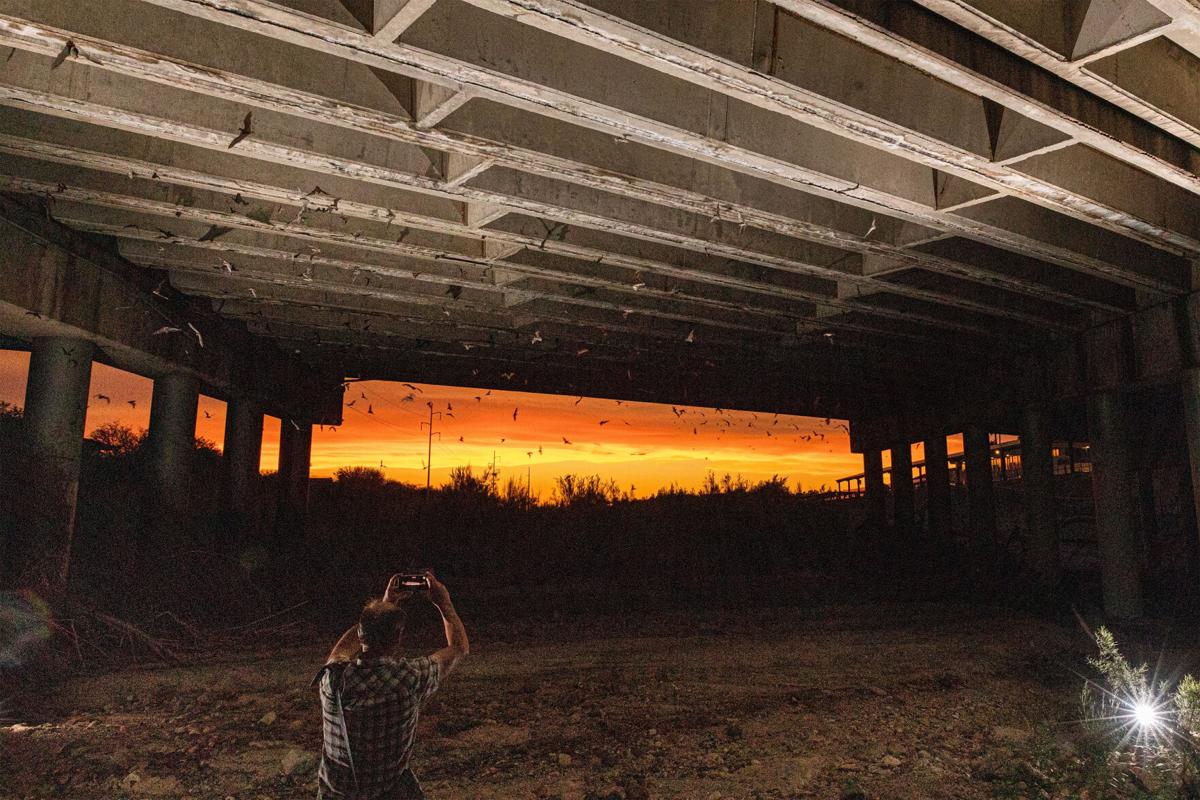
This story begins with an unexpected incident that occurred when a University of Arizona science writer was taking part in a popular Tucson activity: watching clouds of bats emerge from under a bridge in midtown Tucson at nightfall. While gazing skyward at the winged creatures, he suddenly felt a droplet fall into his eye. Was that … bat pee?
To get this out of the way right off the bat (get it?), no, you can’t get rabies from bat urine, nor from coming into contact with an infected animal’s fur or feces. According to the Centers for Disease Control and Prevention, the rabies virus can only be transmitted through saliva, almost always through bites.
That was certainly a relief, but the close encounter inspired more questions about the bats that take up residence under Tucson bridges.
To learn more about these fascinating rulers of the night, science writer Daniel Stolte spoke with two University of Arizona researchers who know bats up close and personally: Melanie Bucci is a curator in the University of Arizona Museum of Natural History, and Jonathan Derbridge is a research scientist in the University of Arizona School of Natural Resources and the Environment.
Which species of bats are found in the Tucson area?
Bucci: Compared to other places, we have a lot of bat species, at least 18 species living in and around Tucson. A number of species live in bridges. A number of species live under bridges. In addition to canyon bats, you can find pallid bats and big brown bats there as well as mouse-eared bats, but by far the most common are the Mexican free-tailed bats. Those roost in the thousands, and 99.9% of the time, if you said you saw a Mexican free-tailed bat fly out from a bridge, you would be correct. We also have nectar-feeding bats such as the lesser long-nosed bat and the Mexican long-tongued bat.
Where can people see them?
Bucci: Bats live in quite a number of places: caves, rock cracks and crevices, trees, cacti, human structures — abandoned and not — and bridges. Canyon bats are well-known for starting their nightly forays early and can be seen flying before dark. They are the little, tiny ones you can see flying around your house or pool. This species is also the smallest bat in the United States weighing in at only 3 to 6 grams — think a sheet of paper. The Mexican free-tailed bats are the large colonies that live in the bridges in town.
I highly suggest an evening at one of the bridges (the North Campbell Avenue bridge over the Rillito River and the East Broadway bridge over Pantano Wash) to watch the Mexican free-tailed bats exit. I have enjoyed many evenings sitting near the bridges at dusk with an ice cream to watch them come out and fly into the night. The biggest colony of Mexican free-tailed bats occurs at Bracken Cave in Texas with about 20 million bats, and Austin has one of the most well-known bridge exits. The nectar-feeding bats can be observed at your hummingbird feeders at night. If you don’t know why your hummingbird feeder is empty in the morning, it is because nectar-feeding bats are visiting you during the night. I have a feeder outside on my bedroom patio just to watch them while lying in bed.

Bats exit at varying times depending on species and weather.
The bats seem to be most active and numerous in the summer. Where do they go in the winter?
Bucci: All insectivorous (insect-eating) bats are most active in the summer when their food supply is most abundant. During the winter, they will lower their metabolism. Here in Tucson, they enter into a torpor state, as opposed to a true hibernation state like their counterparts in the Northeast. The Mexican free-tailed bats migrate out of Tucson to roost in Mexico during the winter. The nectar-feeding bats will follow flowering plants so they won’t be here in the winter either. The lesser-long nosed bats migrate into Mexico like the Mexican free-tailed bats.
Derbridge: The large roosts we see under the bridges are maternity roosts. The females arrive here in April, and they’re already pregnant. The males don’t migrate with them; they remain in the neotropical forests in central southern Mexico. They have done their job. Over the summer, the females give birth to their young — one pup per female — while they’re here, and in the fall, usually around September, they fly back to Mexico with their offspring.
What are the main differences between insectivorous bats and pollinating or fruit-eating bats?
Bucci: For the most part, their diet. Insectivorous bats eat insects such as mosquitoes, beetles, scorpions, etc. Their diet and hunting activities will vary by species and size. Pregnant female nectar-feeding bats will consume insects to meet their higher protein requirements while carrying their young. The nectar-feeding bats consume primarily nectar from flowering plants, cacti and succulents.
Derbridge: In the summer, I replace my hummingbird feeders with bigger ones, because the lesser long-nosed bats are here, and they drain them much more quickly.
Watching bats exit from under a bridge makes it seem it’s a somewhat coordinated process, and it never occurs right at sunset. How do the bats know when it’s time to go?
Bucci: Bats exit at varying times depending on species. The free-tailed bats exit around dusk, but it can sometimes be earlier or later depending on the weather. If you watch the Mexican free-tailed bats beginning to exit, you will see them swirl under the bridge, emerge briefly to test out the light and the weather, and then go back under the bridge before they finally leave. If there is a major monsoon storm, they might choose to come out later. What we do know is they come out for nightly forays to feed.
Are there any health risks to bat-watching?
Bucci: Not as long as people don’t attempt to handle or disturb them. Bats won’t disturb you if left alone. If you are disturbing them in their roost, they may become disoriented and fly at you in an attempt to get away. Problems with bats arise when unqualified persons attempt to handle them. They risk being bitten. If you find a live bat on the ground, especially during the day, you should never handle it. Any bite from a wild animal, including a feral cat or dog, needs to be examined and treated by a medical professional. Because it is impossible to tell if a bat is rabid, people should avoid handling them in any way. And, even if the bat isn’t sick, you pose a danger to bats if you attempt to handle them without proper training and pre-rabies vaccinations.

Mexican free-tailed bats migrate out of Tucson to roost in Mexico during the winter.
Bats are very delicate, so if you handle them, you risk hurting them or potentially breaking their wings. Plus, you risk disturbance to a group of mammals that is already under intense pressure from white-nosed syndrome (a deadly fungal disease), potentially from the coronavirus we might be carrying, from habitat destruction and a whole host of other potentially population damaging impacts. Because of their extremely low reproductive rates, bat populations do not recover quickly like rodents and rabbits. Populations can and have been easily decimated by human disturbance.
What would you like people to know about bats?
Derbridge: Bats are widely misunderstood and underappreciated. A common misconception is that large numbers of them carry dangerous diseases. In reality, the number of bats that carry rabies may not be as high as people imagine. Think about it: If a large proportion of the many thousands of bats roosting under a bridge had rabies, sick or dead bats on the ground would be a common sight. Clearly, that’s not the case.
They also provide incredibly important ecosystem services, such as keeping populations of agricultural pests down, helping farmers to cut down on pesticides. For example, each night, bats consume literally tons of bugs, including major agricultural pests like the cotton bollworm, which feeds on cotton plants. In our research group, we just started working on a project that received five years of funding from the National Science Foundation, where we study a phenomenon we call telecoupling — the multiple ways in which environmental change somewhere along their migration route can affect human well-being elsewhere along that route. Right now, we have an army of undergraduate students going through lists of about 1,000 migrating species, including bats, to collect as much information as possible about each one, including what conservation practices exist.
We are particularly interested in understanding the extent to which conservation measures exist, how consistent they are across multiple countries, and how conservation practices affect human communities. Based on that data, we will study these processes in more detail. We’ll go into the field, talk to managers, stakeholders, and develop a more detailed picture of how these interactions affect communities in Mexico and any other countries that involved in these species’ migrations. The goal is to develop frameworks across borders that could help protect these species and the huge benefits they provide to our economies in a way that is equitable across the human communities they interact with.
Bucci: If you have ever enjoyed a margarita, chances are nectar-feeding bats were one of the main pollinators of the agave that produced the tequila.
Derbridge: There are so many things we have to thank them for. Without bats, there would be no “Batman,” and Halloween wouldn’t be the same, for sure!
Photos: Bats take flight in Tucson

Thousands of Mexican free-tailed bats swarm out from under the Campbell Ave. bridge over the Rillito River at sunset on Oct. 11, 2016.

While most of the crowd is out looking for dinner, several Mexican free-tailed bats still huddle in the crevices under the Campbell Ave. bridge over the Rillito River shortly after sunset on July 19, 2019.
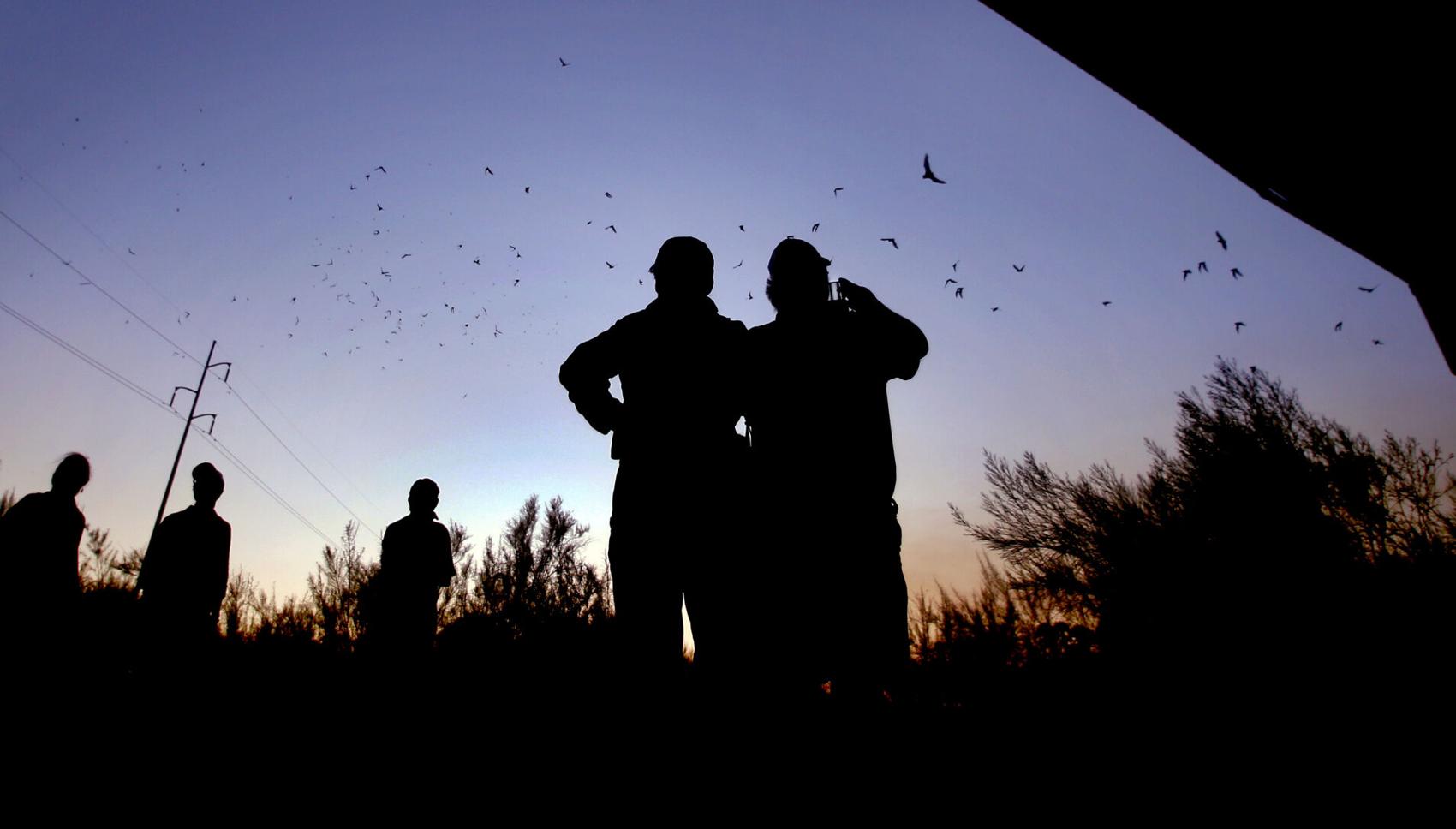
A small crowd gathers in the Rillito River bed under the Campbell Ave. bridge to watch the nightly take-off the Mexican free-tailed bats on July 1, 2014.

A pedestrian stops to watch the evening launch of the hundreds of bats living under the Campbell Ave. bridge at the Rillito River on July 1, 2014.

Mexican free-tailed bats emerge from North Campbell Ave. bridge over the Rillito River July 12, 2008. The bats take flight just after sunset to feast on insects.

A bat nears the edge of its inch wide gap in the bridge beams under the Campbell Ave. bridge across the Rillito River on July 5, 2012.

Some of the estimated 40,000 bats fly around the Campbell Avenue bridge over the Rillito River at sunset Sept. 7, 2010.

Bats fly out from under the North Campbell Avenue bridge over the Rillito River just after sunset Tuesday June 22, 2004.
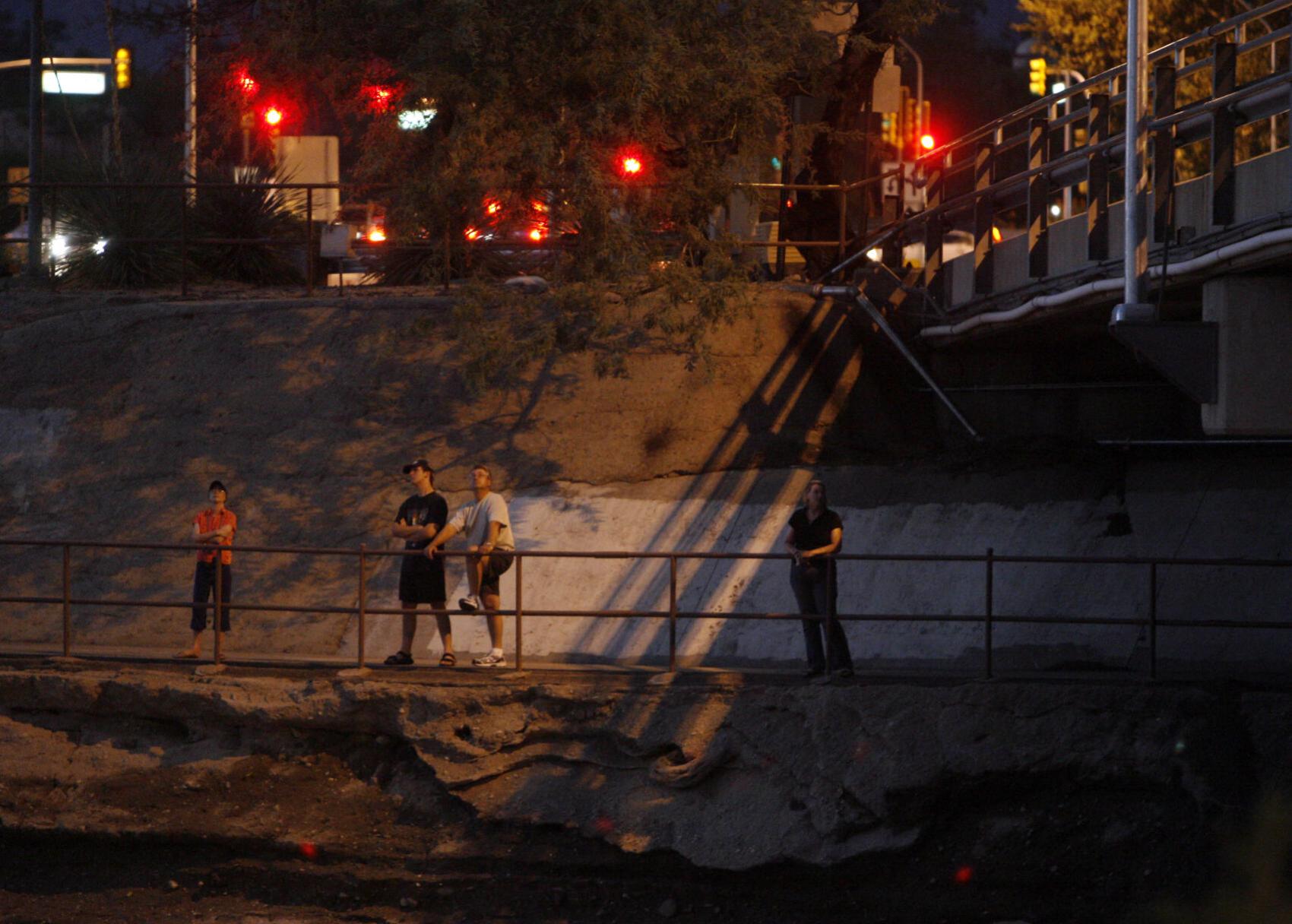
Spectators on the north side of the Rillito River watch as some of the estimated 5,000 bats which roost under the Campbell Avenue bridge take flight at sunset August 1, 2007.
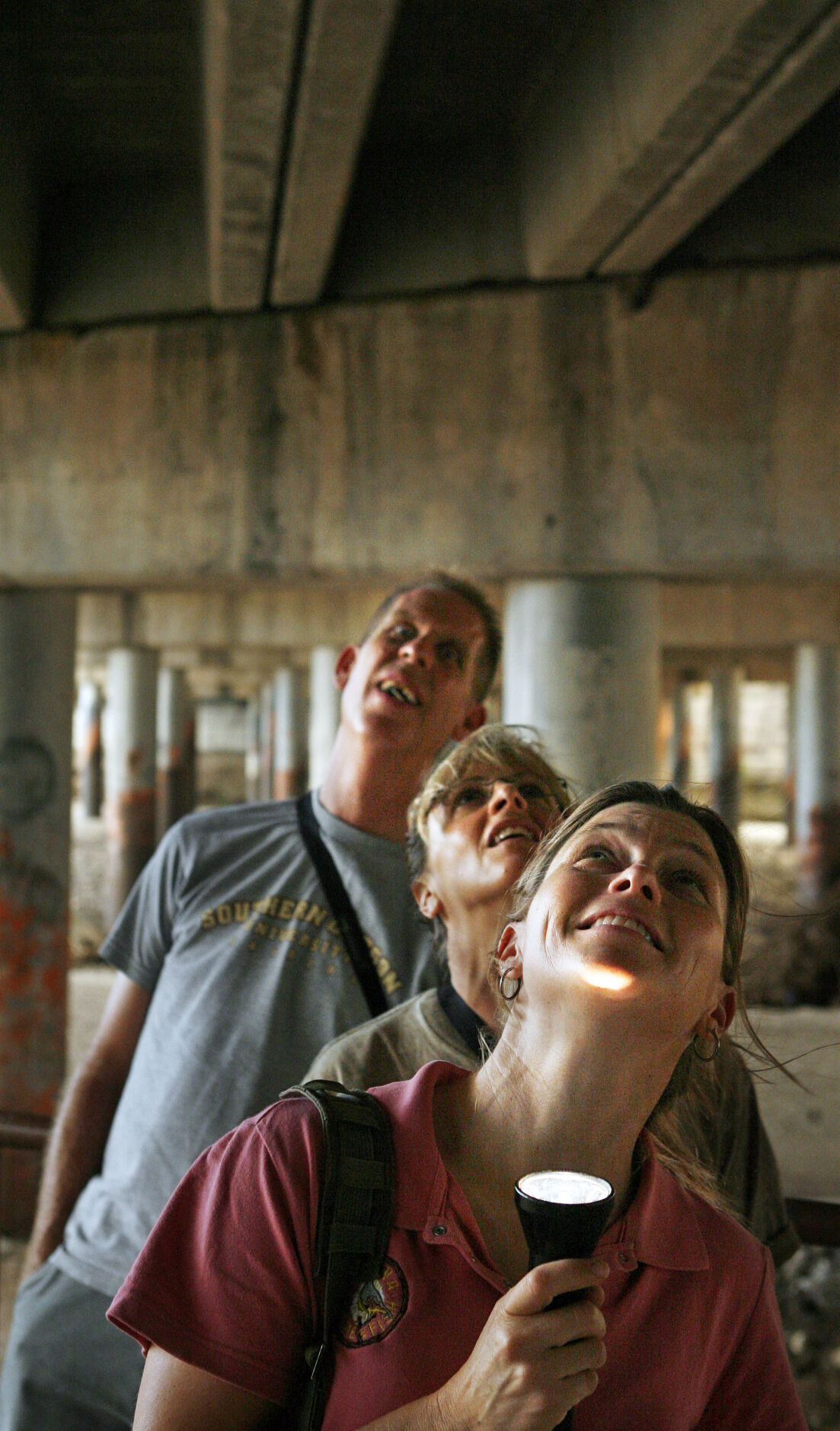
Urban Wildlife Specialist Elissa Ostergaard of the Arizona Game and Fish Department shines a flashlight up into the Campbell Avenue bridge over the Rillito River walk to show Ann Forwood, middle, and Keith Bembenek, rear, where bats roost August 1, 2007.
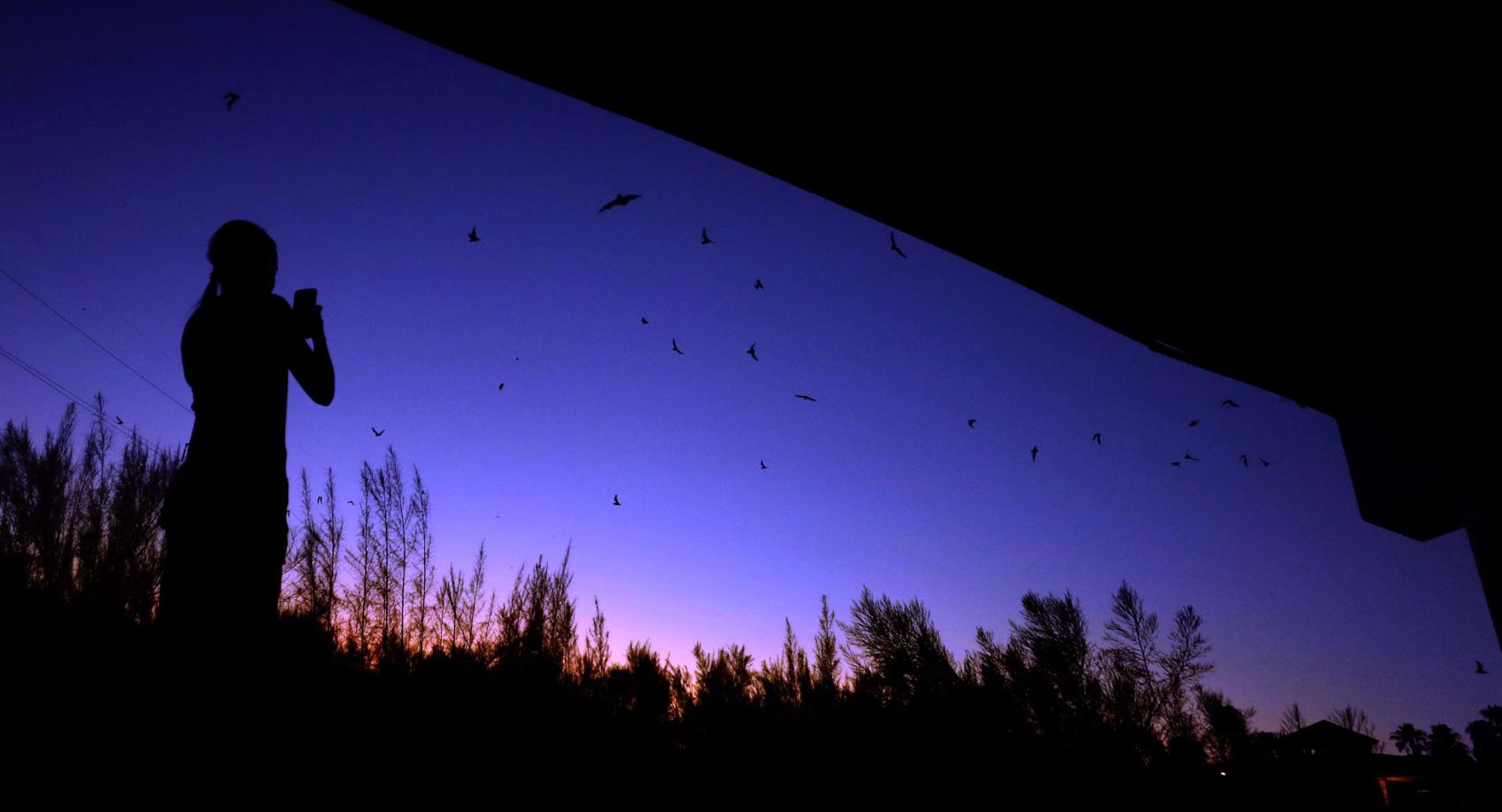
A member of the crowd gets cell phone video of the nightly exodus of thousands of Mexican free-tailed bats from under the Campbell Ave. bridge over the Rillito River, Friday, July 19, 2019, Tucson, Ariz.
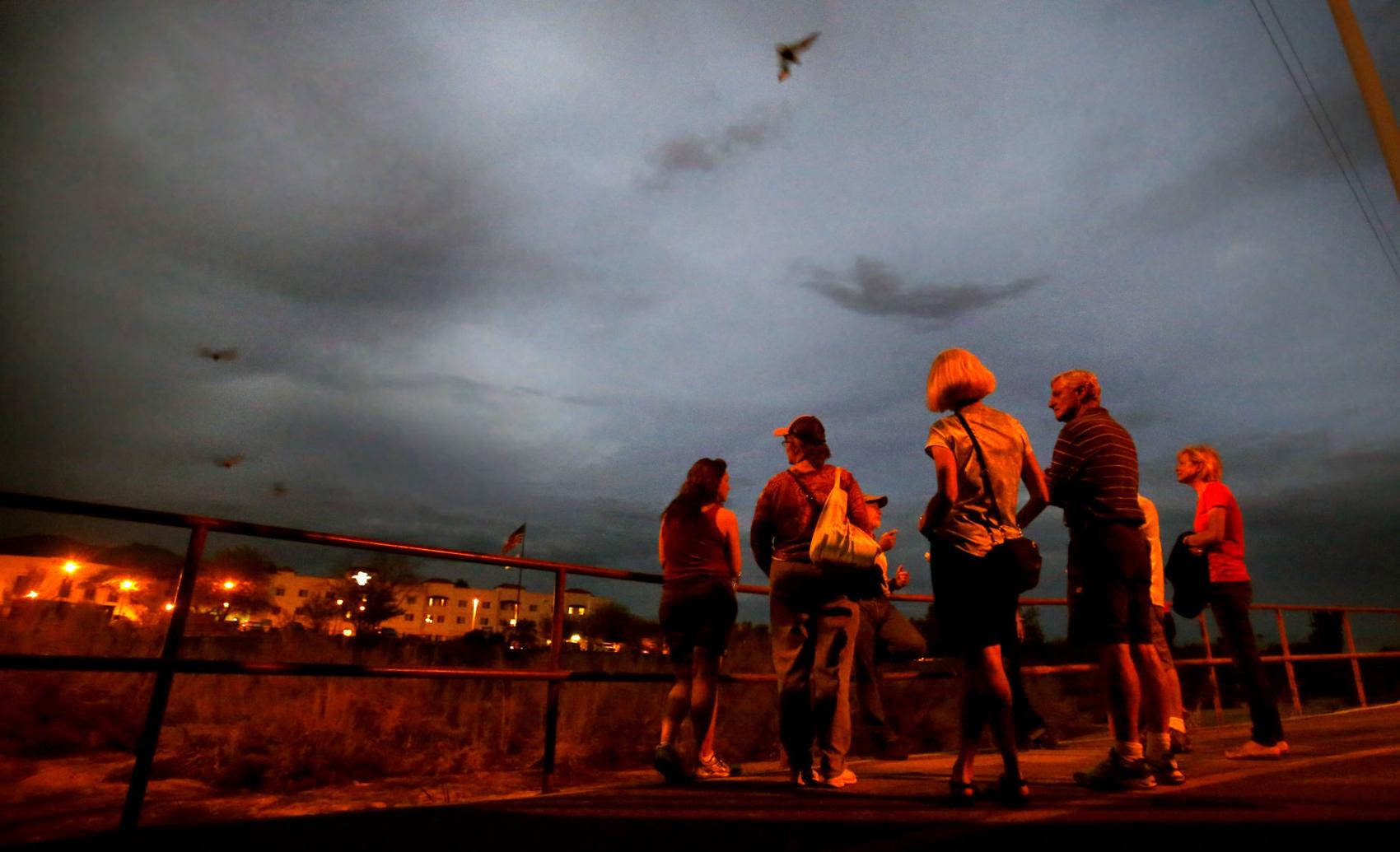
A handful of onlookers gather to learn about the colony of Mexican free-tailed bats under the Campbell Ave. bridge over the Rillito River just before nightfall.

People watches bats emerge from their roosts and swirl among the columns under the Campbell Ave. bridge across the Rillito River on Thursday, July 5, 2012 in Tucson, AZ.

A trail of some of the 40,000 Mexican free-tail bats colonizing the Campbell Bridge over the Rillito River make their home swarm into the stormy skies over Tucson, AZ., Sat., Sept. 12, 2009. The Rillito River Project's Bat Night enticed approximately 3,000 people out to see the bats take to the night.

A giant swarm of bats take to the skies at the Campbell Road bridge over the Rillito River, Thursday Sept. 10 2009 in Tucson, Ariz. Several thousand bats roost in the bridge, flying out around sunset to feed on insects.

John Newman shines a light on a Mexican free tail bat held by Debbie Buecher at the Campbell Road bridge over the Rillito River, Thursday Sept. 10 2009 in Tucson, Ariz. Several thousand bats roost in the bridge, flying out around sunset to feed on insects. Photo by Chris Coduto/For the Arizona Daily Star

Debbie Buecher uses an anabat bat detector to record and monitor a variety of bat calls in many frequencies, at the Campbell Road bridge over the Rillito River, Thursday Sept. 10 2009 in Tucson, Ariz. Several hundred bats roost in the bridge, flying out around sunset to feed on insects. Photo by Chris Coduto/For the Arizona Daily Star

A person takes photos as thousands of bats stream out from the Campbell Road bridge over the Rillito River, Thursday Sept. 10, 2009 in Tucson, Ariz. Several hundred bats roost in the bridge, flying out around sunset to feed on insects. Photo by Chris Coduto/For the Arizona Daily Star

Tucsonan Chris Fortier looks skyward as bats take to the skies at the Campbell Road bridge over the Rillito River, Thursday Sept. 10, 2009 in Tucson, Ariz. Several hundred bats roost in the bridge, flying out around sunset to feed on insects. Photo by Chris Coduto/For the Arizona Daily Star

Photographer Rick "RaVen" Hirschl shares photos he has of bats with a Arizona Sonora Desert Museum docent and passers by under the Campbell Ave. bridge across the Rillito River on Thursday, July 5, 2012 in Tucson, AZ. Photo by Ron Medvescek/Arizona Daily Star.

The final tailings of bats emerge from their roosts under the Campbell Ave. bridge across the Rillito River on Thursday, July 5, 2012 in Tucson, AZ. Photo by Ron Medvescek/Arizona Daily Star.

Bats emerge from their roosts under the Campbell Ave. bridge across the Rillito River on Thursday, July 5, 2012 in Tucson, AZ. Photo by Ron Medvescek/Arizona Daily Star.
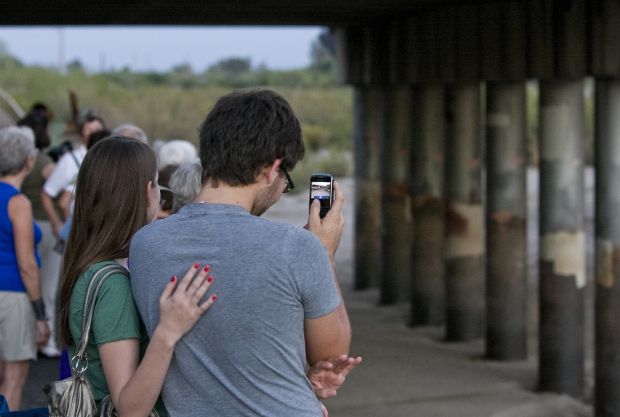
Kendra Mellenberndt, left, and Nick Ribhle wait and watch for the bats to make their initial appearance and emerge from their roosts under the Campbell Ave. bridge across the Rillito River on Thursday, July 5, 2012 in Tucson, AZ. Photo by Ron Medvescek/Arizona Daily Star.

Cub Scout Pack 339 member Zachary Haas patrols the underside of the Rillito River Bridge at Campbell for the Rillito River Project's Bat Night, Tucson, AZ., Sat., Sept. 12, 2009, trying to keep the crowd noise from disturbing the 40,000 Mexican free-tail bats making it their summer home. Pack 339 also took up the duties of cleaning up after the crowd of 3,000 plus drifted away after watching the colony make its nightly swarm into the skies in search of insects.

Some of the crowd lines the railings of the Campbell Bridge over the Rillito River to get photos and watch the colony of 40,000 Mexican free-tail bats take flight during the Rillito River Project's Bat Night, Tucson, AZ., Sat., Sept. 12, 2009.

Stefanie Sardina points up to a group of bats as Julio Marquez looks on beneath the bridge where Campbell Ave crosses the Rillito River in Tucson, Ariz., Friday June 22, 2007. At left, is the couple's daughter Jasmine Barrios, 3. Each night, thousands of bats that sleep beneath the bridge during the day emerge and fly out in mass just after sunset. Photo by Greg Bryan/Arizona Daily Star

A large group of bats head out from their daytime home beneath the bridge where Campbell Ave crosses the Rillito River in Tucson, Ariz., Friday June 22, 2007. Each night, thousands of bats that sleep beneath the bridge during the day emerge and fly out in mass just after sunset. Photo by Greg Bryan/Arizona Daily Star

Bats fill the evening sky as they fly out from beneath the bridge where Campbell Ave crosses the Rillito River in Tucson, Ariz., Friday June 22, 2007. Each night, thousands of bats that sleep beneath the bridge during the day emerge and fly out in mass just after sunset. Photo by Greg Bryan/Arizona Daily Star Transmission

Mexican Free-Tailed bats roost under the Rillito River Bridge, Tuesday June 21, 2005 in Tucson, Ariz.

