



A new exhibit downtown featuring the history and cultural traditions of the early inhabitants of Tucson, the Tohono O’odham and their ancestors, will get a special blessing before opening to the public.
Samuel Fayuant will bless and cleanse the Early People’s Park in a ceremony using feathers to blow smoke from burnt sage inside the exhibit at Presidio San Agustín del Tucson Museum.
The cultural affairs specialist with the Tohono O’odham Historic Preservation Office will conduct the spiritual ceremony in private at the permanent installation at the museum before it opens to the public Saturday, Jan. 28. The Early People’s Park is opening in conjunction with the museum’s annual Native Nations Day Demonstrations & Craft Market from 10 a.m. to 2 p.m.
Fayuant, a consultant to the museum staff, said he will pray for all those in attendance on opening day. He will pray for healing from past wrongs committed against Indigenous people by Europeans who arrived at the ancestral lands of the O’odham.
“I will do a cleansing to get all the negative energy out of the courtyard and the museum building, and I also will offer a prayer giving honor to our ancestors,” said Fayuant in an interview before the ceremony.

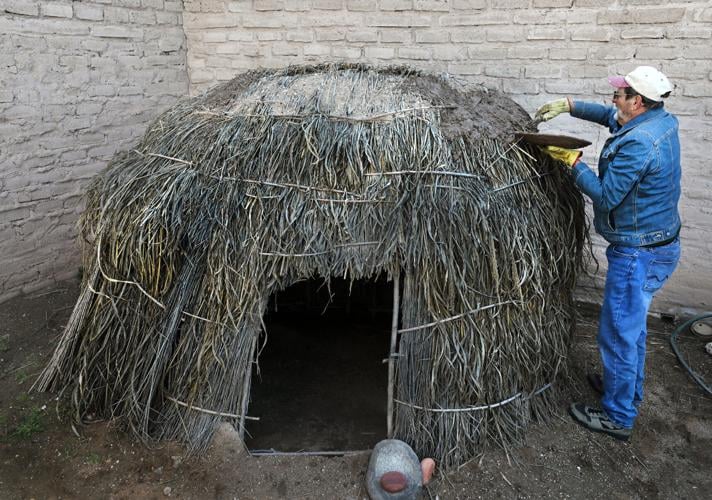
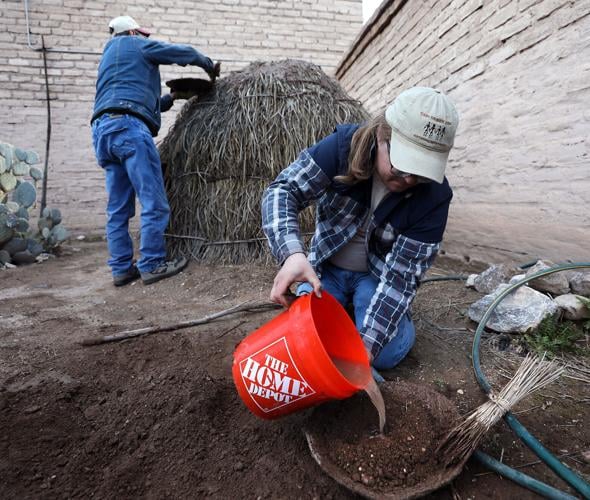
Wolfgang Whitney-Hul, of Old Pueblo Archaeology Center, right, pours water to mix up mud to be applied to a pit house, which is similar to what was used by the Tohono O'odham about 100 years ago.
“We now have an opportunity to voice our concerns,” explained Fayuant, who met museum staff last year and was asked to be a consultant on the park. “We are looking towards the future, and our job is to work towards a better future,” he said.
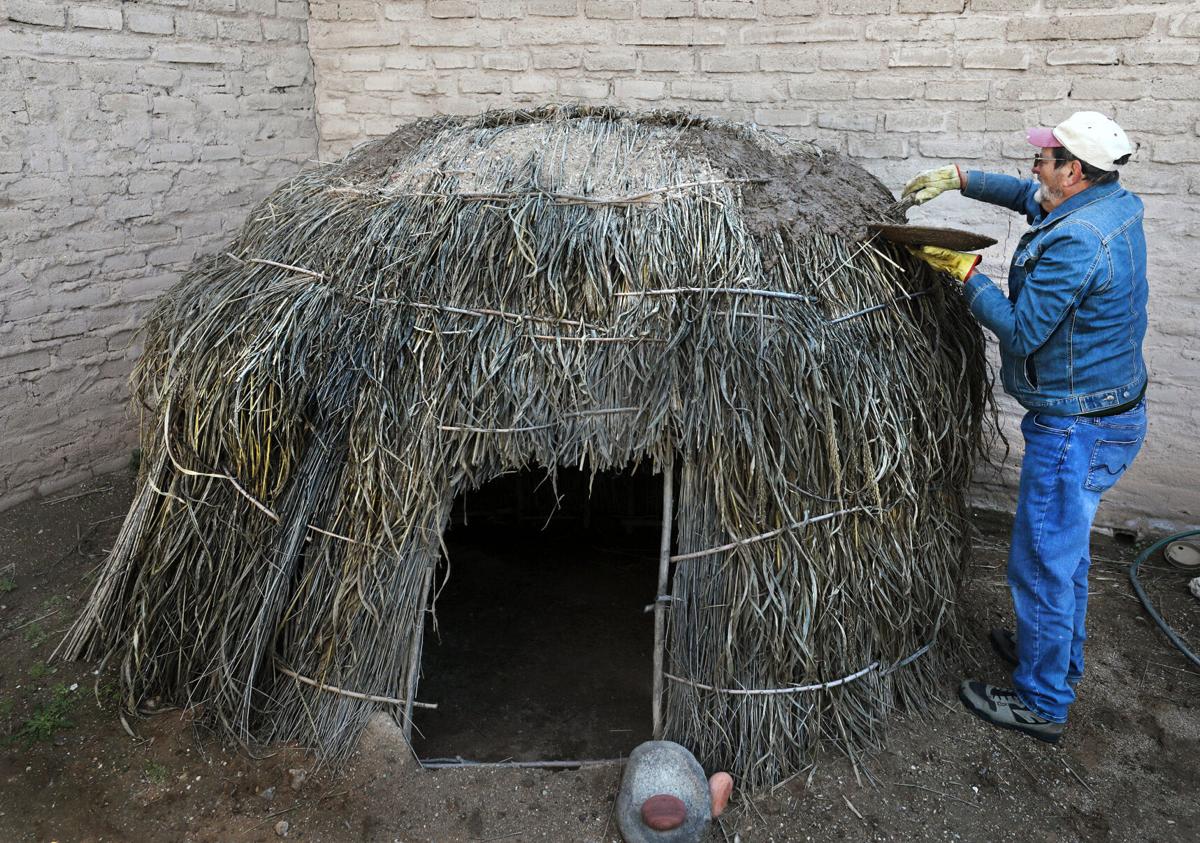
The park includes a re-created pit house, the dwelling structure commonly used by the Indigenous of the area from 2100 BC up to the early 1800s.
According to a museum official, the pit house was created as a partnership between the presidio museum, Archaeology Southwest, the Tohono O’odham Historic Preservation Office, and the Tohono O’odham Cultural Preservation Committee. Archaeology Southwest is a local nonprofit that practices a conservation-based approach to exploring and protecting heritage places. Allen Denoyer, an early technologies specialist with Archaeology Southwest, led this project to create the pit house using authentic materials and construction methods in partnership with the museum’s education and outreach manager, Ginger Thompson.
Years ago, excavations were done downtown before the walls of the presidio were built, and the area was a parking lot, recalled Denoyer. The pit house dug out in the presidio was in use about 2,500 years ago. The remnants were “holes in the ground and it was hard for people to understand, so we built a replica of what it would look like in real life.” The one that is on display in the Early People’s Park is similar to what was used by Tohono O’odham about 100 years ago. It is identical to houses used 2,500 years ago, Denoyer said.
Planning for the park began three years ago, said Amy Hartmann-Gordon, executive director of the museum. Grants were written for funding and the museum matched money totaling $10,000 for the park. More exhibits will be added telling the story of Tucson’s history. Construction began last year and the pit house is built out of willows, grasses and mud.
“The willows and grasses were picked by the San Pedro River in Aravaipa Canyon and are the same materials used 2,500 years ago,” Denoyer said. He said archaeologists know because the materials are based on preserved materials from burned pit houses found through a number of excavations along the Santa Cruz River starting 15 years ago.

The Early People's Park exhibit at the Presidio Museum will open Jan. 28.
“The excavations occurred because of road work, Rio Nuevo projects, and the expansion of the city’s sewer plant west of Interstate 10 and Ina Road. The digs revealed villages of the ancestors to the Hohokam who are the Tohono O’odham today,” Denoyer said.
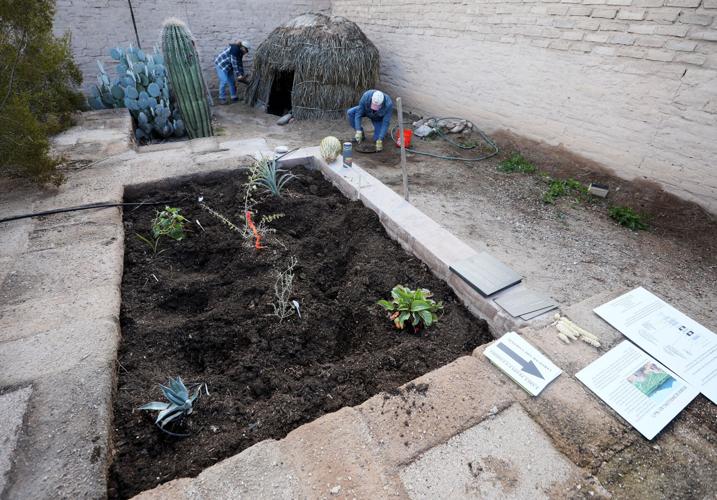
A garden of corn, tepary beans, squash and amaranth — a plant that produces seeds that are ground into flour — are native plants that were grown by O’odham in the area dating back thousands of years, said Thompson, who also is working on signage in English and O’odham for the park. She is doing research for curriculum to share with up to 2,000 Tucson-area students who attend the museum each year.
Other plants in the garden will include corn, agave and saguaros.
“If you look at the history of Tucson, we have dates that put corn here 5,000 years ago, and the ancestors of the Tohono O’odham were growing corn in the Santa Cruz River floodplain thousands of years before the Spaniards arrived,” Denoyer said.
“We have excavated their agricultural fields in the floodplain from ‘A’ Mountain to Ina Road and there are multiple layers of fields that run on both sides of the river. In some places, we have found the footprints of the farmers in the fields. It was so special for Tohono O’odham and everyone to see that. It is a snapshot in time. We could see the canals that came out of the river that they used to irrigate the fields. We could see the lateral ditches coming off the larger canals, and off the side of those they built little mini-fields that had berms around them where they planted corn,” Denoyer said.
“The importance of the park is showing the deep history of Tucson’s native peoples,” he said.
A pit house is part of the new Early People's Park exhibit at the Presidio San Agustin del Tucson Museum, which opens on January 28. The exhibit features the history and cultural traditions of the early inhabitants of Tucson, the Tohono O'odham and their ancestors. Video by Mamta Popat / Arizona Daily Star.
Photos: Congress Street scenes, Tucson, ca. 1950s
Street scenes, Tucson, 1950s
Updated
People on the sidewalk on Congress Street at or near Scott Avenue in Tucson, ca. 1950s.
Street scenes, Tucson, 1950s
Updated
People on the sidewalk on Congress Street at or near Scott Avenue in Tucson, ca. 1950s.
Street scenes, Tucson, 1950s
Updated
People on the sidewalk on Congress Street at or near Scott Avenue in Tucson, ca. 1950s.
Street scenes, Tucson, 1950s
Updated
People on the sidewalk on Congress Street at or near Scott Avenue in Tucson, ca. 1950s.
Street scenes, Tucson, 1950s
Updated
People on the sidewalk on Congress Street at or near Scott Avenue in Tucson, ca. 1950s.
Street scenes, Tucson, 1950s
Updated
People on the sidewalk on Congress Street at or near Scott Avenue in Tucson, ca. 1950s.
Street scenes, Tucson, 1950s
Updated
People on the sidewalk on Congress Street at or near Scott Avenue in Tucson, ca. 1950s.
Street scenes, Tucson, 1950s
Updated
People on the sidewalk on Congress Street at or near Scott Avenue in Tucson, ca. 1950s.
Street scenes, Tucson, 1950s
Updated
People on the sidewalk on Congress Street at or near Scott Avenue in Tucson, ca. 1950s.
Street scenes, Tucson, 1950s
Updated
People on the sidewalk on Congress Street at or near Scott Avenue in Tucson, ca. 1950s.
Street scenes, Tucson, 1950s
Updated
People on the sidewalk on Congress Street at or near Scott Avenue in Tucson, ca. 1950s.
Street scenes, Tucson, 1950s
Updated
The only information on a package of negatives from the Tucson Citizen photo archives. Inside were pictures of Congress Street at or near Scott Avenue in Tucson, ca. 1950s.

