


PHOENIX — Efforts to eliminate the “Jefferson Davis Highway” in Arizona stalled Monday amid questions of exactly where it is, who has the authority to change the name, and whether it even exists.
The state Board on Geographic and Historic Names said it could not consider two separate proposals to rename the road, one for slain civil rights leader Martin Luther King Jr. and the other for former Gov. Rose Mofford. That’s because the number now on the highway named for the Confederacy president is not the same as when the road was designated.
Applicants were told to come back with a revised proposal with the proper sites.
But the board also declined to consider a separate request to strip the name “Jefferson Davis” from any place it shows up on state maps. The board’s staff was able to find a reference to the Jefferson Davis Memorial Highway on some official Arizona Department of Transportation maps, albeit from 1992.
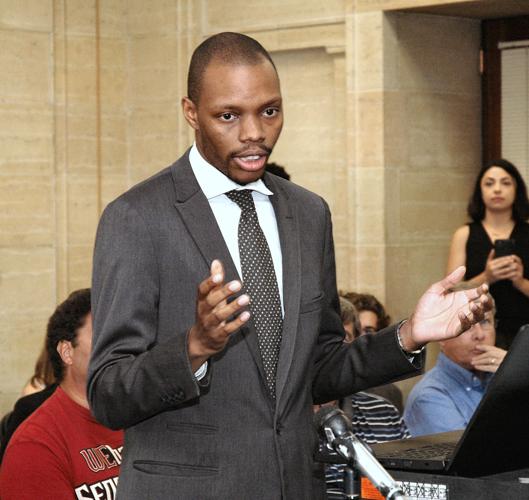
The Rev. Reginald Walton said that should make the board’s job simple.
“That means that wherever we find that name, be it whether you know it now or whether you need to do some more research after the fact, you can take the step to remove the name now,” he told the board. “And it will be applicable to wherever it is found.”
But board members were not interested in such a blanket move, at least not on Monday.
“I can sympathize with your frustration,” said member Chuck Couglin. But he said he and his colleagues won’t act until they get answers to some legal questions.
One of those is whether there actually is an official Jefferson Davis Highway.
ADOT questions whether there is such a designation, despite a 1961 vote by the Arizona Highway Commission, legal predecessor of the State Transportation Board, to designate a U.S. 80 through Arizona as part of a planned coast-to-coast Jefferson Davis National Highway, and despite those 1992 maps and a marker near Apache Junction designating the road as such.
Even if that can be resolved, Dennis Preisler said the board he chairs has no power to remove the “Jefferson Davis Highway” monument along U.S. 60 near Apache Junction. That appears to be an issue for ADOT, in whose right-of-way the monument was placed in 1962.
Gov. Doug Ducey, who appoints ADOT’s director, has shown no interest in directing that Confederate monuments be altered or removed. “It’s important that people know our history,” Ducey said last month. “I don’t think we should try to hide our history.”
And ADOT spokesman Tim Tait said there are no plans to remove the monument, even if it is on state right-of-way, as it does not appear to be a traffic hazard and no state funds are expended in its upkeep.
Monday’s lack of action frustrated Rep. Reginald Bolding, D-Laveen, who has been working for years to strip Arizona of Confederate monuments and designations.
“To simply push it off is what we’ve seen from the governor’s office to this board to every single member that we’ve had conversations with,” he said. “Let’s just make a decision.”
While the board’s questions are answered, any decision will be pushed back at least a month, the earliest the board can meet again.
The issue dates back a century to when the United Daughters of the Confederacy sought to designate a series of roads in the South in honor of Davis.
In 1932 the Arizona Good Roads Commission approved markers at the spots where the road entered the state in New Mexico and exited at California. One was placed in 1943 along U.S. 70 at Duncan.
Then in 1961 the Highway Commission approved the request by UDC to designate all U.S. 80 through Arizona as the Jefferson Davis National Highway. That covered the road from east of Douglas through Tombstone, Benson, Tucson, Florence, Mesa, Phoenix and then out to Yuma through Gila Bend.
At about the same time, the monument at Duncan was moved to its current location east of Apache Junction on what at that time was part of U.S. 80.
But here’s the thing: U.S. 80 was “decommissioned” in 1989.
All that remains is a stretch from Benson to the New Mexico line that was re-designated as State Route 80. Much of the rest of it became part of U.S. 60, including where the monument sits.
Priesler said that means the petitions to rename the road after King or Mofford are out of order, as they refer to U.S. 80 which no longer exists. He told proponents of both proposald to rewrite them to include U.S. 60.
Marissa Scionti, however, said none of that should affect the petition she submitted to have the commission simply search out the Jefferson Davis name wherever it shows up on official maps and vote to strip it.
“The name Jefferson Davis represents racist ideas,” she told the board. “That’s what he’s known for: being president of the Confederacy and working to preserve slavery.”

