



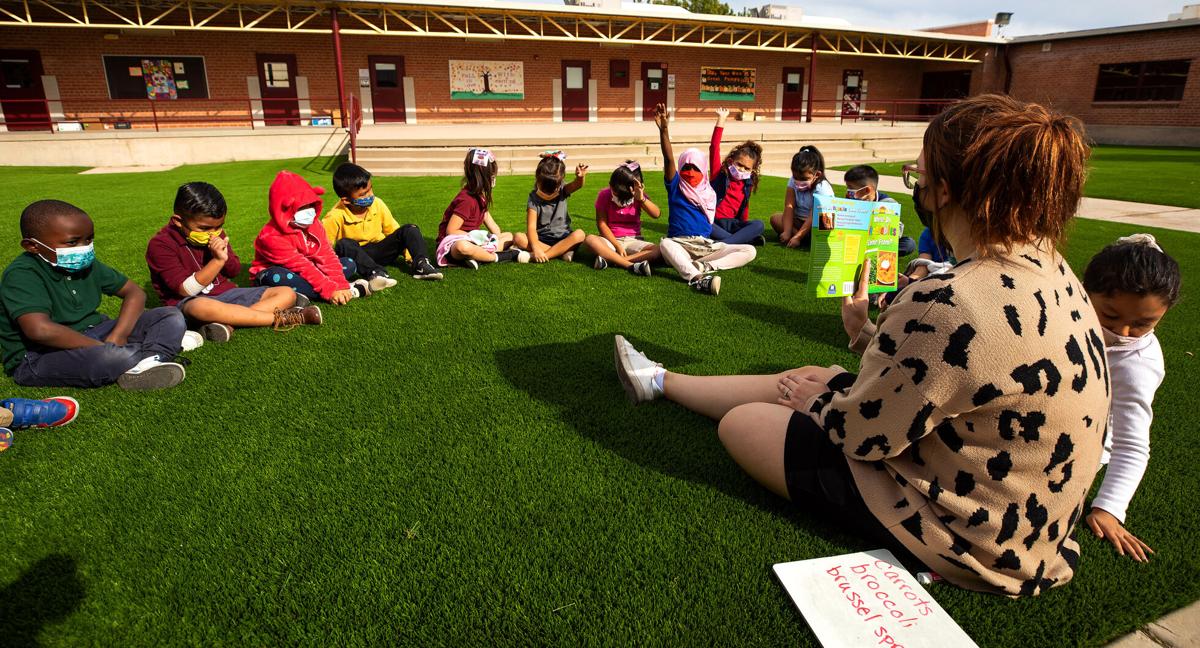
A group of kindergarten students at Bonillas Traditional Elementary Magnet School marched in a line from a classroom to the recently renovated courtyard, where the students formed a circle and sat on the new, green turf.
As the group listened to teacher Mackenzie Kiewel read a book about where vegetables come from, some kids pulled strands of grass from the ground to play with in their hands and occasionally put their hands in the air to answer Kiewel’s questions.
The scene at Bonillas Elementary last Wednesday reflected one of the recent changes that Pima County educators have implemented to their teaching models in light of the learning and social experience gaps created by online learning during the pandemic.
For some school districts, including Tucson Unified, those changes have consisted of creating more outdoor learning spaces to enhance kids’ learning experiences.
“We’ve always had grass out there, but the grass had bugs and everything that comes with the monsoon season,” Kiewel said, adding that Principal Frankie Schiavone advocated renovating the courtyard and turned it into an outdoor learning space earlier this fall.
“Since then … we’ve been able to bring kids out for more outdoor lessons, especially with the weather getting a little bit nicer. It’s finally comfortable to go sit out there,” Kiewel said, noting that she now holds outdoor lessons about twice a week.
At the Tanque Verde Unified School District, Superintendent Scott Hagerman said that administrators recognized there would be a challenging road in bringing students’ learning gaps up to par.
But, he said, district personnel wanted to be more deliberate in the way they brought kids back to classrooms and began to address the individual gaps.
“Start with trying to understand kids’ needs, but don’t necessarily go trying to reteach everything. … I don’t want it to be that you had a horrible year, followed by a horrible year of remediation,” Hagerman said.
“If I can get a kid really engaged in what they’re learning, that’s going to have a bigger impact on their learning,” he added.
So, he said, one of the district’s main takeaways was to use relief money to create more outdoor learning spaces.
Social and emotional learning
Along the same lines of enriching students’ learning experiences back inside the classroom, Heidi Aranda, the senior director of curriculum and professional development at TUSD, said the district began incorporating more social and emotional learning at schools to help kids readjust to in-person classes.
“It’s the readjusting to the school environment, the expectations of the amount of time focusing on work, or their ability to give attention to the task at hand,” Aranda said. “Then the other part is the acknowledgement of everything that kids have been through … whether it’s students who struggled being at home all the time or losses in their family.”
Some of those social and emotional learning lessons, she explained, can be as simple as creating activities that bring students to introduce themselves to each other to create social interactions.
In addition to addressing the social and learning gaps, Aranda said, teachers have also noted that students’ retention has been fairly low compared to prepandemic years. So, she said, TUSD brought reading and math interventionists to all schools in the district.
Real-time math tutoring
Similarly, the Vail Unified School District allocated a portion of its relief funds to hire additional tutoring professionals at Andrada Polytechnic High School.
Principal Geoff Parks said that, upon returning from distance learning, students’ learning retention in mathematics varied on a much wider scale than before.
“Normally, a teacher can kind of handle that because the gap is not so widespread, but kids were just all over the place with ability, based on their learning for a year and half that has been nontraditional,” he said.
His solution? Hiring math professionals, some with doctorate degrees, to engage with and help students in real time.
“It’s not a pull-out-of-class method. We have tutors in the class while the teachers are teaching, and so that they intervene in real time,” Parks said.
For Andrada senior Kiera Toumey, who is enrolled in AP calculus, the tutors have made a big difference in catching up on her learning.
She explained that during distance learning it was particularly difficult to ask her teachers for help in math considering it was a challenge to describe the math problems in written words by email.
Oftentimes, she said, the process of communicating was complicated as she had to send her teacher photos of her work to ask which parts were incorrect. With additional tutors in class, she said, she feels as though they have had a “huge impact” in helping her and her classmates catch up.
“I would say almost every day that I’m in there, there’s a question to be asked to them,” Toumey said. The tutor “has made such a difference because he’s given us more real-world connections to the problems we’ve been working with, and it’s beneficial for us to see how it connects.”

