



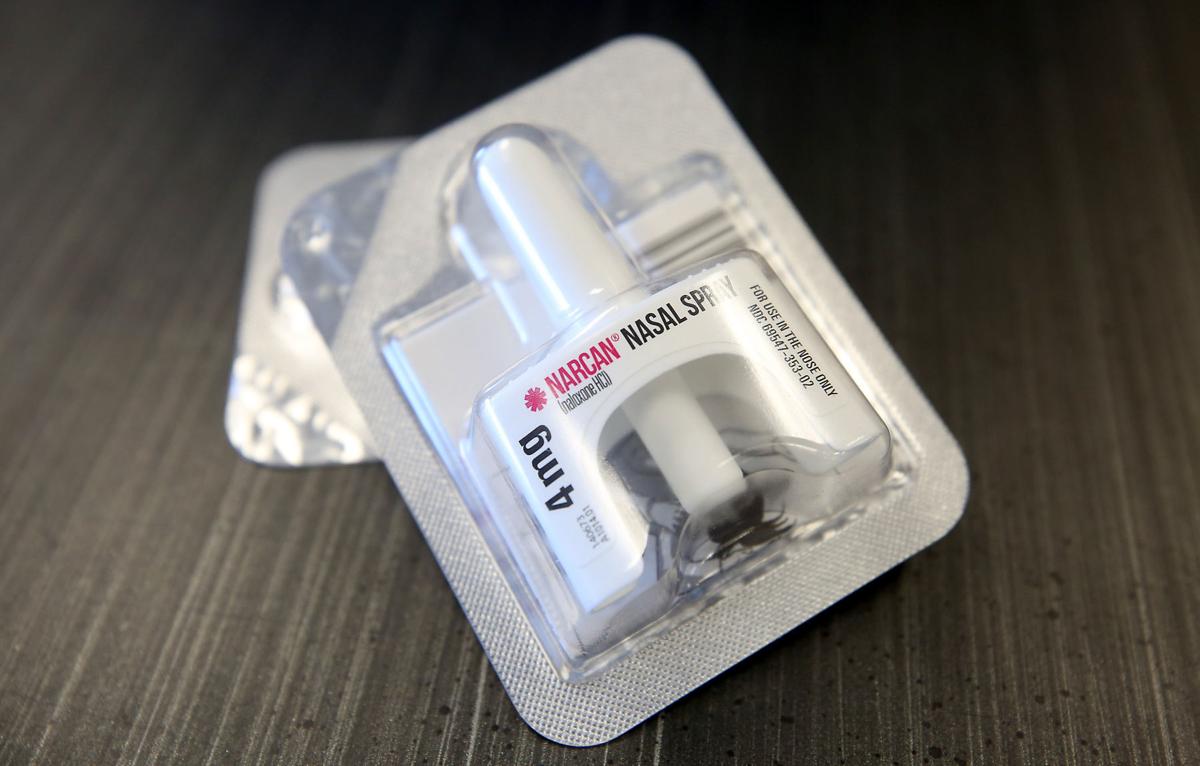
The drug naloxone reverses opioid overdoses and is free to law enforcement in Arizona, but the Pima County Sheriff’s Department and some other agencies still aren’t carrying it.
Eleven of Arizona’s 15 sheriff’s departments told the Star they are equipping officers and deputies with naloxone to reverse opioid overdoses in emergency situations. The Pima County Sheriff’s Department is not one of them.
Officials with the local Sheriff’s Department, which is in charge of law enforcement in unincorporated parts of Pima County, say since paramedics responding to medical emergencies already carry naloxone, there’s little need for sheriff’s deputies to carry it, too.
And while other Arizona law enforcement agencies are carrying naloxone in triple-digit heat, Pima County Sheriff’s Department officials say they are concerned the FDA-approved drug would degrade in the heat of their patrol cars and render it ineffective.
“It’s not that we’re opposed to it. It just doesn’t seem practical at this point,” said Pima County Sheriff’s Department Chief Byron Gwaltney, who is a bureau commander with the department.
“We’re keeping our options and radar open on it. We’ve been tracking the number of scenarios where it could have been used and we’re finding it to be minimal.”
Most officers in the Phoenix Police Department, who are responsible for law enforcement in Arizona’s largest city, are not carrying naloxone either, Sgt. Mercedes Fortune confirmed.
She said that’s because in most cases, paramedic first responders are getting to overdoses faster than police, or at the same time as them.
But advocates of equipping police and sheriff’s deputies with naloxone say it’s a measure that could save lives from opioid overdoses at a time when such deaths in Arizona over the past year have numbered nearly four per day.
Minimal side effects
Law enforcement agencies are able to get naloxone for free from the Arizona Department of Health Services.
“If they have an opportunity to save a life and it’s not going to cost anything, it makes sense they would carry it,” said Haley Coles, executive director of Sonoran Prevention Works, a Phoenix-based nonprofit that aims to end health disparities faced by Arizonans who use drugs.
“They should be carrying it. County sheriff’s departments, in my understanding, are working in far out areas of the county — not in the middle of the city where paramedics show up immediately.”
Fire departments in Arizona have been carrying naloxone for more than two decades, but an increase in deaths due to opioid overdoses led to an expansion of the law, allowing law enforcement and emergency medical technicians to carry it as well.
Gov. Doug Ducey signed the legislation in 2015.
Since that time, major law enforcement agencies in the state began training their personnel in how to use naloxone, which comes in both a nasal spray and an intramuscular injectable form. A growing number of agencies are now carrying it, including a majority of sheriff’s departments.
Typically, officers and deputies are carrying the nasal spray form in a uniform pocket like an issued piece of equipment.
The nasal spray form, under the brand name Narcan, is easily administered and has minimal side effects for patients. It works as an opioid antagonist, blocking opioid receptor sites and reversing effects of the overdose.
Other than Pima County, county sheriff’s departments that are either not equipping deputies with naloxone or did not respond to the Star are Apache, Greenlee and Pinal.
Pinal sheriff’s officials said they are in the process of developing a policy on Narcan.
First responders carry it
Among the Southern Arizona sheriff’s departments that have begun carrying Narcan in the past two years are those in Santa Cruz, Graham and Cochise counties.
Graham County sheriff’s deputies in Southeastern Arizona were trained and began carrying Narcan in the spring of 2017, Undersheriff Jeff McCormies said.
“I do know it has been used a number of times,” McCormies said. “I’m just glad we were able to do it. I think it’s beneficial, since we are generally there pretty quickly. It’s effective and it won’t harm them.”
But Gwaltney of the Pima County Sheriff’s Department says that since fire departments and other medical first responders carry naloxone, there’s rarely a need for sheriff’s deputies in Pima County to have it, too.
About 330,000 people live in the areas the Sheriff’s Department oversees.
“We don’t have the same instances of opioid overdoses they do in the city,” he said. “It’s much less of a problem for us. There are so few instances where deputies are on the scene at an opioid-related issue and fire and medical are not there within seconds anyway.”
The Pima County Sheriff’s Department’s naloxone supplies are limited to paramedics on the department’s SWAT Team. Deputies doing drug testing at substations and officers with police dogs have it as well — primarily as a protection in case those officers or dogs are exposed to opioids, in particular the powerful opioid fentanyl, Gwaltney said.
Heat issues
Reported law enforcement use of naloxone remains low, but lives have been saved.
State records show that in the past year, emergency medical first responders administered most of the 5,649 naloxone doses reported to the Arizona Department of Health Services.
Still, law enforcement across the state have administered it more than 300 times over the past year, the data shows.
The Tucson Police Department was one of the first law enforcement agencies in the state to start carrying naloxone after the state law passed. All of the department’s officers carry Narcan in a pocket in their uniform, police Assistant Chief Kevin Hall said.
Hall said the department has used Narcan 30 to 40 times and to date recorded four “saves” where officers used the Narcan on someone who overdosed and the person lived.
By comparison, the Tucson Fire Department this year alone has used naloxone 618 times on 487 patients. Fire Department officials don’t categorize “saves” but said naloxone had a positive effect in 44 percent of the cases where it was used.
Some law enforcement agencies around the country have begun regularly touting their Narcan “saves” on social media.
The Bergen County Prosecutor’s Office in New Jersey (@BCPONJ) tweeted on June 18 that police in the area “continue to save lives,” with 117 Narcan “saves” to date this year.
Similarly, the Grand Rapids Police Department (@GrandRapidsPD) in Michigan has been tracking and tweeting its Narcan “saves” since its officers began carrying it in 2016; the number was 51 as of June 26.
Opting out
While deputies in some departments carry Narcan in their uniform pocket, Gwaltney said that would not be practical for Pima County deputies, and that keeping it in the car would mean prolonged exposure to excessive heat.
“As soon as there is a version that is more heat-stable, we’ll take a serious second look at the implementation,” he said.
Heat degradation is a concern, but Hall said the Tucson Police Department has sent samples of heat-exposed Narcan back to the company for testing and it has shown little change in the viability of the product.
Adapt Pharma, the Pennsylvania company that produces Narcan, says the drug will survive up to 104 degrees and should not be frozen.
Many local, state and federal law enforcement agencies keep Narcan in their uniform pocket, or the side pockets of their utility pants or duty vests, because if they encounter an overdose victim or if fellow officers are accidentally exposed, they do not have to return to their vehicle, Adapt Pharma spokesman Thom Duddy wrote in an email.
Police officers in Lake Havasu City, which has been nicknamed the hottest city in Arizona, have been carrying Narcan in their patrol cars since last summer, spokesman Sgt. Tom Gray said.
Officers carry Narcan in cases that they check in and check out at the end of each shift. When it’s not in use, the department stores the drug in a temperature-controlled environment, Gray said.
“It is sitting in a patrol car during a shift, but in the big scheme of things it is better to have it than not have it at all,” he said.
Coles, of Sonoran Prevention Works, said that while Narcan is best kept at room temperature, studies have shown that degradation from heat has been minimal.
“A little degraded is better than not having it at all, for emergency purposes,” she said.
Street outreach
While it’s helpful for law enforcement to carry naloxone, the people who really need to have it on hand are drug users, Coles emphasized. Her organization holds trainings to distribute naloxone kits to the public.
An Arizona law passed in 2016 allows members of the public acting in “good faith” to administer an opioid antagonist like naloxone to anyone experiencing an opioid-related overdose.
There’s a proven track record of most out-of-hospital opioid overdose reversals being performed by other drug users, Coles said, citing a CDC report, as they are most likely to be on the scene when an overdose occurs.
“When there are limited resources, we should be putting naloxone in (drug users’) hands,” she said.
Coles said her organization does street outreach to get naloxone in the hands of the people most likely to use it to save lives. She’d like to see more treatment centers and hospitals in Arizona take a more active role in distributing it, too.
Some critics say mass distribution of naloxone just enables drug users. Supporters, however, say the No. 1 goal should be keeping people alive.
The Tucson Police Department may take a more active role in getting naloxone to drug users. Hall said Tucson police are considering having officers carry extra naloxone for distribution, which is something the Navajo County Sheriff’s Office and the Winslow Police Department in Northern Arizona are already doing.
Rural/Metro Pima County, which provides fire and paramedic coverage to unincorporated areas of the county, did not have statistics immediately available on naloxone use, though the department has been successfully using it for decades, spokesman John Walka said.
“If police officers have it and are able to use it, that’s very helpful. The more the better, as long as they are properly trained in how to use it,” Walka said.
“Resuming respiration with naloxone has saved countless lives. ... The opioid crisis is scarier than ever.”

