



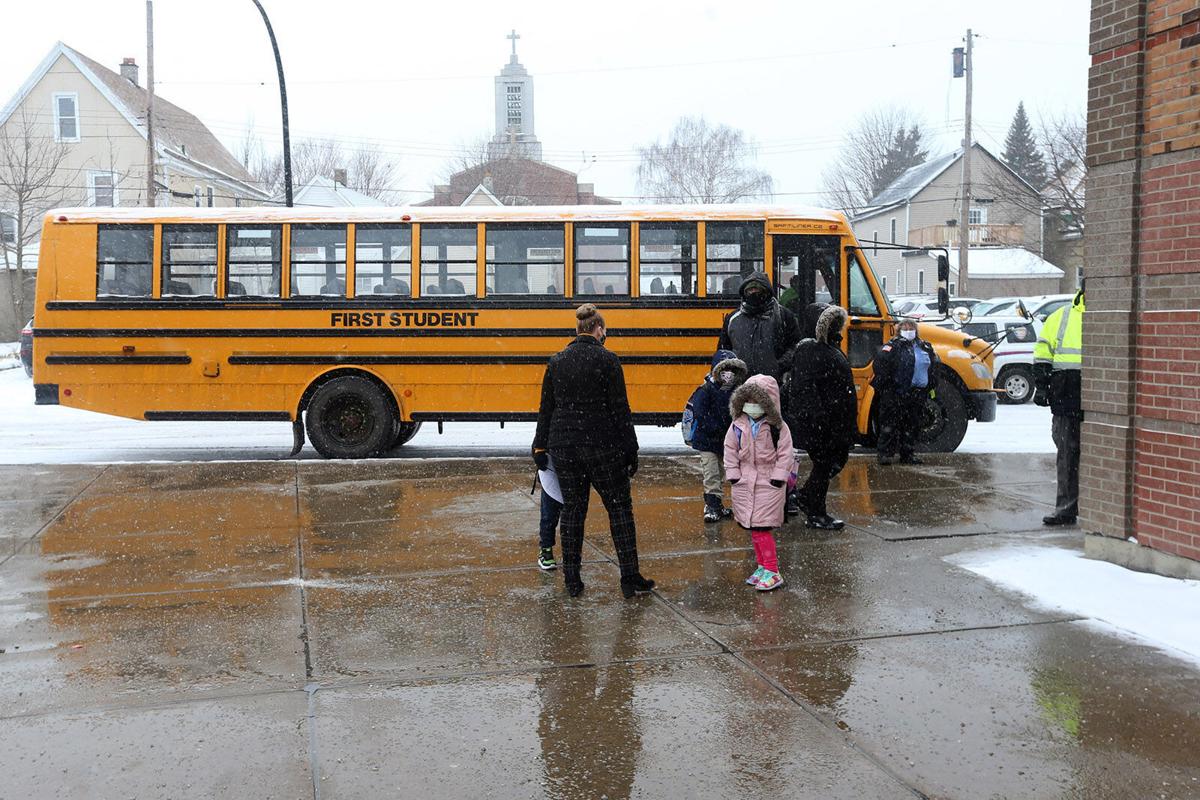
Is it time to reopen schools five days a week?
When and how to reopen fully continues to be the discussion as the school year wears on, but the data from the state Department of Health paints a picture for both sides of the argument.
Proponents point to data that shows falling Covid-19 cases and a general acceptance that transmission rates are lower within the schools.
But that same data also lends proof to those who say now is not the time to change tactics in the schools, particularly with new variants of the virus emerging.
“We’re still in a high transmission risk zone so we have to continue to be as aggressive as possible with our mitigation strategies,” said Dr. Gale Burstein, Erie County’s health commissioner.
Burstein referred to a new tool from the Centers of Disease Control and Prevention used to help communities reopen schools safely. Based on its numbers, Erie County is still considered to be in a “red” or “high transmission” zone.
If schools can't reopen fully under the state guidelines, then students will have to continue working part of the time from school and part of the time from home as they have been, she said.
“It’s not time to take our foot off the gas,” Burstein said.
The state has been tracking Covid-19 cases among students, teachers and staff since the start of the new school year.
As of the end of February, more than 2,700 cases have been reported in the 38 school districts across Erie and Niagara counties. Those only include cases where students or teachers were on-site, as opposed to off-site working remotely from home.
Here’s a look inside the numbers:
January peak: Just 26 cases were reported in schools during the month of September, before districts saw a surge after Halloween. The number of Covid cases jumped to 539 in November, then peaked at 1,016 cases in January. Those January numbers include cases that were identified over the holiday break.
Since then, reported cases in schools have fallen to 541 through the month of February, although that's still not below where they were in November.
“Basically, the trends that we see in the school follow the overall trends of the county,” Burstein said. “So, when the numbers in late fall and early winter were very high in the county, we also saw higher numbers in the schools.”
School variance: The Williamsville Central School District, the region’s largest suburban district, reported the most cases on-site with 283 through February. Frontier reported 179; Niagara Falls, 172; Orchard Park, 160; North Tonawanda, 143; Ken-Ton, 126; Starpoint, 115; and Lockport, 112.
Buffalo Public Schools, which didn’t reopen classrooms to students until Feb. 1, reported 90 cases.
“Early in January and early February, it was two a day. In a week, we probably had 12 to 14,” said Mark Laurrie, superintendent of the Niagara Falls City School District.
“This week, we’re probably going to have two to four cases,” Laurrie said on Feb. 25. “I feel for the first time like there’s light at the end of the tunnel.”
Other districts reported far fewer on-site cases, including Springville, 7; Depew, 12; Iroquois, 15; Eden and Cheektowaga Central, each 20; North Collins, 24; and Maryvale, 25.
Safe schools: Despite the winter surge, school and health officials maintain schools are not a major spreader of the virus and that transmission rates are lower than in the general population because of adherence to the protocols – wearing masks, social distancing and reducing capacity in the buildings.
“They have some cases, don’t get me wrong, but schools have been seen as very low risk,” said Daniel Stapleton, Niagara County’s health director.
“I went to every single school district in the county and we tested staff there,” Stapleton said. “We saw rates that were 10% of the infection rate we saw in the community.”
Few clusters: How much is being spread within the schools?
“It’s impossible to know,” Burstein said.
When contact tracers investigate they are trying to reduce further spread by determining who came into close contact with an infected person – not how that person became infected.
“However,” Burstein said, “we’re not really seeing significant clusters or microclusters within the classroom that would lead us to believe there’s a lot of in-classroom transmission.”
In Niagara Falls, the district found clusters on three occasions that forced three schools to close for in-person instruction for a period of time.
“Otherwise, we’re getting single cases,” Laurrie said. “One case here, one case there.”
“I would go as far as to say a very, very small percentage of the cases we report are cases that were actually transmitted on school property,” said Michael Cornell, the superintendent in the Hamburg Central School District and president of the Erie-Niagara School Superintendents Association.
Kids vs. adults: Of the 2,700 reported school cases over the past six months, the majority were students – more than 62%.
One in five cases – or 20% – were teachers. The rest of the staff accounted for 17% of cases.
When health officials do suspect cases of transmission within the schools, it’s more often among the adults in the school.
“We do see transmission within the schools, but it’s been more among staff than student to student or student to staff or staff to student,” Burstein said.
For example, Burstein said, it may have been teachers eating lunch together in a breakroom or teachers having in-person meetings without wearing masks.
In fact, the data shows teachers and staff are overrepresented in the number of school cases. During a normal school year, teachers and staff represent only 17% of people in school buildings, but they account for 38% of the on-site cases.
Five days a week. The decision to reopen schools fully may ultimately come down to two numbers – three and six.
The state directs schools to keep students seated 6 feet apart in the classroom, but there’s growing pushback from parents and schools to reduce that to 3 feet, which would allow schools to bring back more students for in-person instruction.
However, there’s reluctance locally to do that – at least right now.
“Six feet, we’re pretty stuck to,” Stapleton said.
“What we’re doing with 6-feet social distancing is working,” Burstein said.
“But the guidelines for school safety and school reopening – and policies to stay open – are exclusively written by the state,” Burstein said. “So even if I had other thoughts, we still couldn’t implement any different than what the state regulates.”
Sports resume. Since the return of high-risk sports, the virus has forced at least 49 teams in Erie County – both in school and in independent leagues – to be placed on a 10-day pause, Burstein reported at the end of February. About half of those were hockey teams.
“Just because a team is on pause doesn’t necessarily mean that there’s an outbreak in the team,” Burstein said. “The reason we put a sports team on pause is so that the team members will not be in contact with each other and possibly transmit infection.”
Laurrie, Cornell and Stapleton said they have not noticed an uptick in school cases since sports resumed.
“We’re not seeing it, but we have paused a number of teams and that’s out of an abundance of caution,” Stapleton said.
New variants. The big question is what impact new variants will have on cases in schools.
“That’s something we’re keeping an eye on,” Stapleton said. “We’re aware of it, but we’re focused now on getting people vaccinated.”
“Really, it’s a moving target,” Burstein said. “What is the current situation now may not be the current situation in one or two months from now.”
News staff reporter Mary Pasciak contributed to this story.

