


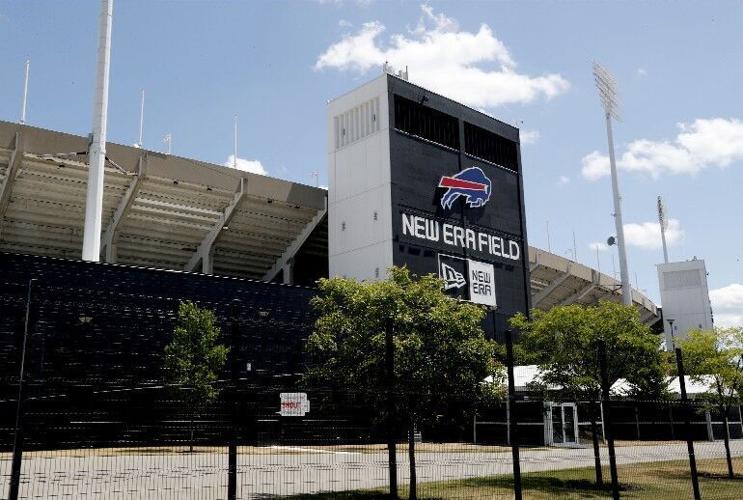
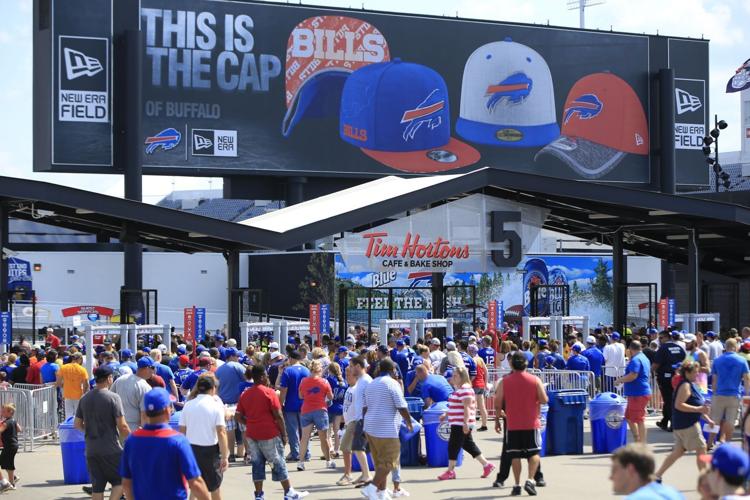
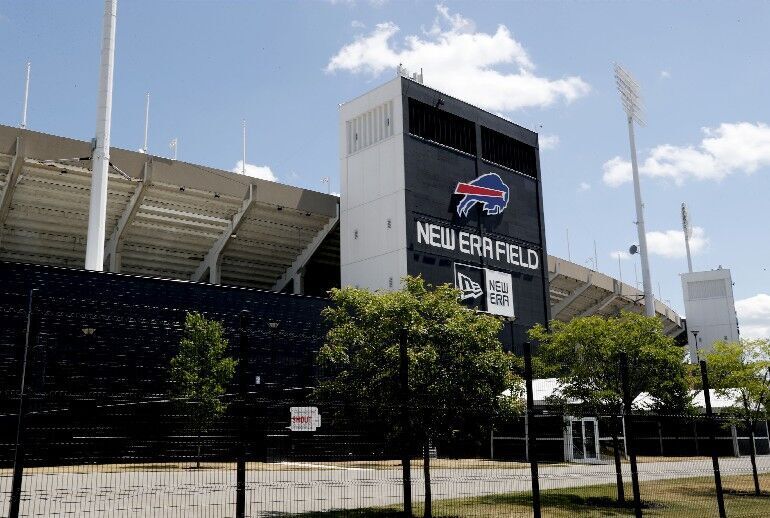
The naming rights for the home of the Buffalo Bills are suddenly in play.
But the opportunity arrives at a time when fans might not even be allowed in the stadium this season, and companies are coping with the economic fallout of the Covid-19 pandemic.
The Bills, who control the naming rights to the stadium as part of their lease, announced they are working on releasing New Era from its agreement. The stadium was supposed to be called New Era Field through 2022, but that won't happen now.
The announcement raises questions:
• What company might want to step up and buy the naming rights, in the midst of a recession and so much uncertainty?
• Is the buyer of the rights more likely to be locally based or a national brand?
• How expensive and how long would such a deal be, given the plunge in the economy and questions about fan access to the stadium?
John Cimperman, a sports marketing industry veteran, said in spite of the current circumstances, whoever emerges as the next naming rights holder is bound to benefit.
"If there's a company looking to making an immediate impact in the region from a brand awareness perspective, there's millions of dollars of unpaid media awareness that comes from that," said Cimperman, executive vice president of the marketing agency FuseIdeas. He has worked on naming rights deals before.
New Era was expected to pay about $4 million annually over the course of the seven-year deal — a sum that reflects Buffalo's standing as a midsized media market and one of the smallest in the NFL. That's a far cry from the 20-year, $400 million deal that SoFi reportedly signed last year to put its name on the new Chargers and Rams stadium in Los Angeles.
Whatever the next deal for the Bills looks like, it will be another source of revenue for the team and will give the Bills a new partner to promote the franchise.
CNBC's Kate Rooney reports on her conversation with SoFi CEO Anthony Noto after the company bought naming rights to the new stadium for the Chargers and Rams.
Cimperman said companies paying for naming rights are looking for three things: branding and name awareness; "activation," or getting customers to take action related to its brand; and hospitality, to entertain clients and prospects at the stadium or arena.
He cited the example of Staples, the Massachusetts-based office products company, which bought the naming rights for the home of the Lakers in 1999. "Staples was nowhere on the West Coast," he said. "They were an unknown brand and they needed to make an immediate impact, because they were opening up 50 stores in Los Angeles."
Putting Staples' name on the arena gave the company instant exposure, he said. "It has paid dividends for the brand ever since."
Cimperman pointed to an example closer to home. Buffalo-based M&T Bank bought the naming rights to the Baltimore Ravens' stadium when the bank was making a push into Maryland, as the result of an acquisition.
"That investment I think has paid off with them, because they're now ubiquitous as a bank in the mid-Atlantic and they do a nice job activating around it," he said.
As for the Bills' situation, Cimperman conceded this isn't ideal timing for the hospitality element of a naming rights deal, given all the restrictions on access. But if the games are still played, the company's name will still get exposure through TV broadcasts, he said.
Cimperman said he doesn't think the Bills should rush into another deal just to slap another name on the stadium.
"I would focus on, who's a long-term partner here that we can grow with? Don't look at a short-term deal; look at a long-term deal."
The Bills haven't revealed how quickly they might strike a new deal or remove New Era's name.
"We do not currently have a timetable and have not yet made any plans for signage," said Don Heins, a spokesman for Pegula Sports and Entertainment, which oversees ownership of the Bills. "We are in the process of negotiating the terms of our separation."
Heins said that within the first 24 hours of the news breaking about New Era giving up the naming rights, the Bills had received a "significant amount of inbound interest" in the rights from local and national companies.

The Bills' stadium became New Era Field in 2016.
Michael Leeds doesn't see a bottom-line payoff for companies buying stadium naming rights.
"It's not that it hurts the company," said Leeds, an economist at Temple University in Philadelphia. "It just doesn't do anything special for it."
Leeds and his wife, who is also an economist, several years ago conducted a study of what naming rights deals did for publicly traded companies. They researched 50 examples of branded major league facilities, using a method linked to the companies' stock price.
"If people expect the naming rights deal to enhance the profitability of the company, that should almost immediately upon the announcement of the naming rights lead to an increase, effectively, in the stock price," Leeds said. "We found basically no discernible movement for the vast majority of companies."
What, then, are these companies signing up for? Leeds cited the example of the National Football League, an exclusive club with just 32 members.
"What's the next best thing?" Leeds said. "You can put your company's name on the stadium. I think that it's just a lot more exciting for the decision makers to do that than to take the money and buy advertising or put it in the bank, when in fact the return is no greater."
Leeds said he didn't expect the next buyer of naming rights for the Bills' stadium to get a bargain. "It won't be Los Angeles prices, but it will be in line with more comparable markets," he said. "I don't think it's a disaster because of the Covid situation."
And as for finding a company willing and able to pony up the dollars, Leeds noted: "It only takes one."
Jim Pokrywczynski, associate professor of strategic communication at Marquette University in Wisconsin, said the economic turmoil caused by the pandemic might alter the list of candidates for the naming rights. Some companies, such as pharmaceutical companies and supermarket chains, might be in better financial shape to make such a deal.
"Even the beer industry's doing pretty well," he said.
Even though Buffalo is a small market within the NFL, Pokrywczynski said there is still value to a company to connect itself to an improving team like the Bills, whose games are getting more exposure in coveted national TV time slots.
But other realities might influence the next agreement, he said.
"Probably the deal's going to be shorter, given the uncertainty of the future. Naming rights deals that were usually 20-year deals may have to be five-year deals or 10 year deals, to make it attractive to a middle-size company."
Buffalo sports fans are used to rooting for their teams inside venues with changing names.
The Bills' stadium was called Rich Stadium, and then Ralph Wilson Stadium, before the New Era deal.
The downtown baseball stadium now called Sahlen Field is on its fifth corporate name since the park opened in 1988 as Pilot Field. KeyBank Center, the home of the Sabres, has operated under four corporate names since debuting in 1996.
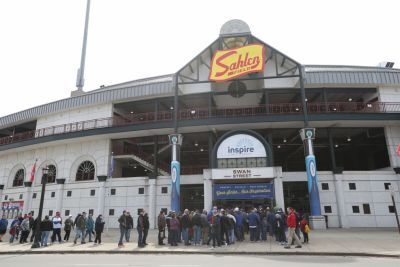
Sahlen Field opened in 1988 as Pilot Field.
So what company might be next to put its name on the Bills' stadium?
The Buffalo News reached out to a number of companies either based in Buffalo or with connections to the region, to gauge their interest in buying the naming rights. A few rejected the idea. None declared its intent to acquire the rights. Some didn't answer directly.
KeyBank cited its longstanding ties with the Sabres and PSE through KeyBank Center.
"This relationship provides us with valuable exposure and visibility on a wide scale," said Matt Pitts, a spokesman. "We look forward to continuing our work with the Sabres and PSE as business and community partners.”
Independent Health noted it already works with the Bills on a number of healthy lifestyle initiatives. "This partnership, which we are extremely pleased with in its current form, extends through 2024," said Frank Sava, a spokesman.
Wegmans said it was not interested. Neither was Paychex, the Rochester-based company founded by B. Thomas Golisano, the former Sabres owner. Toyota, a longtime sponsor, said it didn't have any information to share.
How about M&T Bank? True, the bank already has its name on an NFL stadium in Baltimore. But Mercedes-Benz has its name on two NFL stadiums, in Atlanta and New Orleans. "We’re proud to be the official bank of the Buffalo Bills for the past 35 years," said Julia Berchou, an M&T spokeswoman.
What about ACV Auctions, the Buffalo startup that has surpassed $1 billion in valuation? ACV has not "received any outreach to pursue naming rights of the football stadium," said Maura Duggan, a spokeswoman. "As loyal Bills fans, we would welcome learning more."
How about Rich Products, in a throwback idea? “We share and appreciate the Buffalove for Rich Stadium," said Allison Conte, a spokeswoman. "We’re especially proud of that part of our history."
Labatt USA, which has its headquarters in Buffalo, was asked about its interest in the naming rights. Replied Mary Beth Popp, vice president of communications for Labatt: “As the unofficial beer of tailgating, we’ve already secured our spot and it’s in the parking lot.”

