



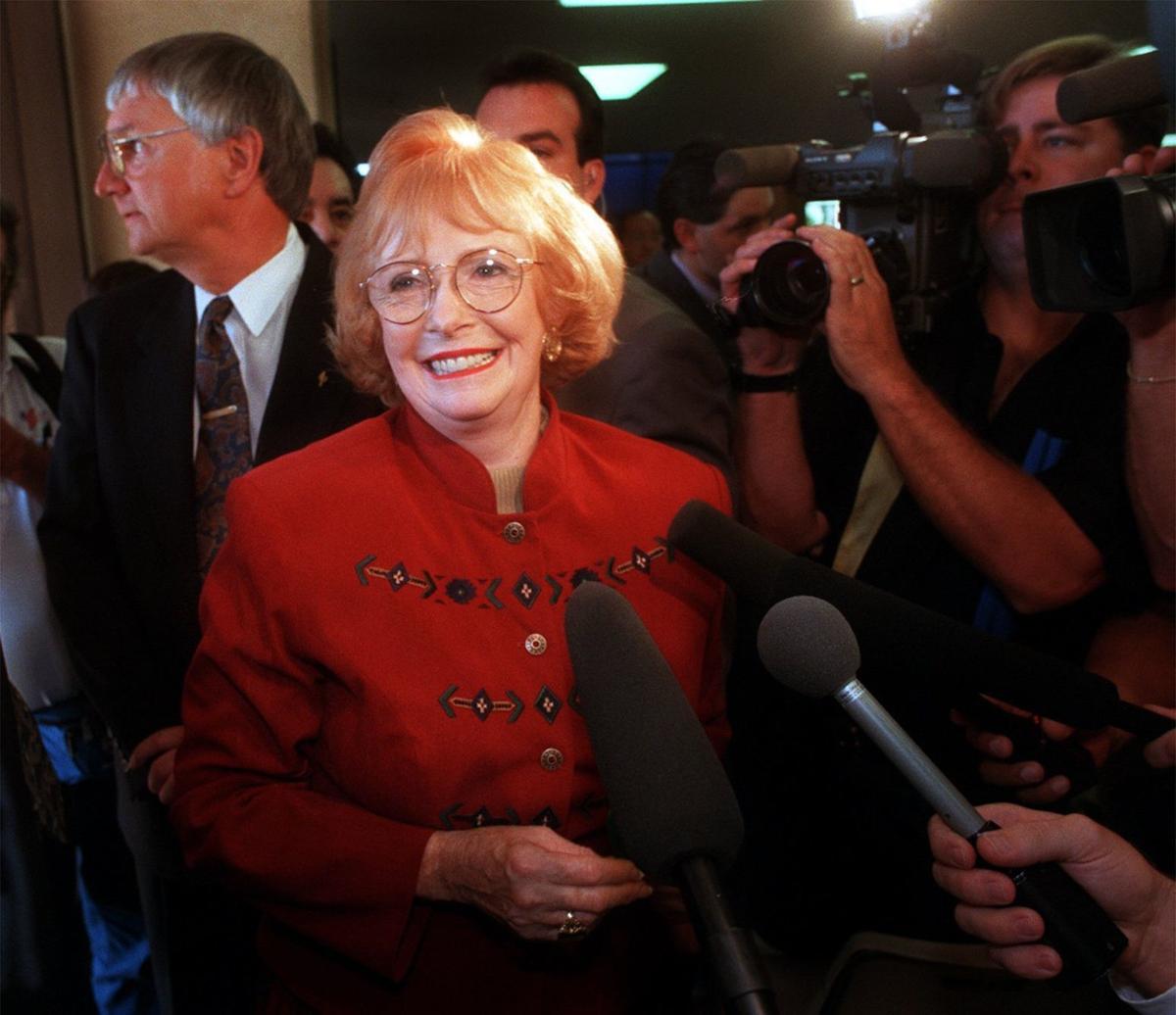
PHOENIX — Jane Dee Hull, whose tenure as Arizona’s first elected female governor led to major changes in state government, education and health care, died Thursday, and her husband, Terry, died hours later.
Former Gov. Jan Brewer said both died of natural causes.
Hull, 84, had a political career that stretched more than 25 years, starting with her election to the state House of Representatives as a Republican. She eventually became speaker, presiding over the chamber during the 1991 AzScam scandal, in which several lawmakers were accused of taking bribes in exchange for votes on legalized gaming.
Hull stripped the five House members of their committee assignments and demanded they resign. She also told the three who did not quit immediately to stay off the House floor.
But it was her elevation from secretary of state to governor in 1997 — after Gov. Fife Symington was forced to quit after a criminal fraud conviction — that created a legacy that has lasted until this day.
She ushered in casino gaming, negotiating a deal with tribes to give them exclusive rights to operate slot machines and similar devices in exchange for the state getting a share of the profits. That deal helped persuade voters in 2002 to defeat two other competing measures, one of which would have allowed gaming at racetracks.
It was her support of issues relating to children, however, that may have had the most long-lasting impact.
First, Hull took advantage of a provision in federal law to enroll Arizona in the KidsCare program. It provides subsidized health insurance to children of the working poor, those who earn too much for the state’s Medicaid program but not enough to afford their own premiums.
The sweetener for Hull was that the federal government provided $3 for every dollar of state funds. And the state’s share came out of a 40-cent-a-pack tax on cigarettes.
KidsCare remains a state program, with close to 38,000 enrolled.
Second, she persuaded voters to approve a plan requiring that state aid to schools be increased every year to match inflation and student growth. That was financed by a 0.6-cent sales tax for 20 years. Lawmakers more recently voted to extend it.
The provision requiring annual inflation adjustments enabled educators years later to successfully challenge moves by the Republican-controlled Legislature to curtail K-12 funding.
Her programs and positions as governor at one point launched a conservative movement to deny her a full term of her own in 1998. But that fizzled when then-U.S. Rep. Matt Salmon refused to challenge her in the primary and Hull coasted to an easy victory in the general election against former Phoenix Mayor Paul Johnson.
The 1998 election created what became known nationally as the “Fab Five,” as it put the top five state elected offices in the hands of women: Hull as governor, Betsey Bayless as secretary of state, Janet Napolitano as attorney general, Carol Springer as treasurer and Lisa Graham Keegan as schools superintendent.
Hull was Arizona’s second female governor, after Democrat Rose Mofford, who became governor in 1988 when Evan Mecham was impeached. But Hull was the first woman to be elected as governor.
She also made history when she became the first Arizona governor to appoint someone from a political party other than her own to the state Supreme Court.
Hull picked some fights with the more conservative members of her own party.
Over the objection of social conservatives, she agreed to sign legislation repealing what she called “antiquated sex laws” that had made cohabitation, oral sex and sodomy illegal.
“I choose not to judge the conduct of others, even when I know others will judge me for signing this bill,” she said.
Hull said the ban on cohabitation made it impossible to bring domestic-violence charges in cases where people were only living together.
She also did something of an about-face on the issue of abortion.
She was one of a dozen lawmakers who signed onto anti-abortion measures in 1986 and 1987. But Hull said in 1998 she would no longer support such proposals, although she said she was personally opposed to abortion.
What changed, she said, is that she was no longer just a rank-and-file state lawmaker representing a single north-central Phoenix legislative district.
“I was of the Republican mind that, frankly, went along” with the stance of many party members to outlaw abortion, she said.
But as governor Hull said she represented the entire state, and that the state had changed.
Also on the social front, Hull quietly reaffirmed the state’s “don’t ask, don’t tell” policy of placing children for foster care and adoption in the homes of gay couples, rejecting arguments by some GOP lawmakers that the Department of Economic Security should be forced to stop the practice.
She had a sometimes tumultuous relationship with U.S. Sen. John McCain, telling reporters that when he called to complain — and yell — about something, she would have to hold the receiver far from her ear.
It probably didn’t help that in 2000, when McCain first expressed presidential aspirations, the Arizona governor endorsed George W. Bush over the home-state senator. She, did, however, back McCain’s 2008 presidential bid.
Hull had a temper of her own, commenting in 1998 about “cracking heads” of recalcitrant Republicans who would not support a school-finance plan.
She gained headlines by suggesting at one point that the air conditioning be turned off in state prisons.
And Hull generated publicity by insisting that it was a “security issue” that she used an airplane owned by the Department of Public Safety more than 100 times to shuttle her to the cabin she and Terry owned in Pinetop. That generated the moniker “Plane Jane.”
Among bills Hull signed as governor were these:
- Creating the state’s first “road rage” law, making “aggressive driving” a crime.
- Requiring insurance companies that provide diabetes coverage to pay for necessary supplies, like blood glucose monitors, test strips, insulin cartridges and syringes.
- Increasing the maximum unemployment benefit by $20 a week, to $205; the cap now stands at $240.
- Allocating in 2001 $45 million for the following three years to improve programs for students with limited English-speaking skills.
- Creating lucrative tax credits for those who bought vehicles powered by alternate fuels. But she then led a move to roll back the credits after a supposed $10 million price eventually left the state with a $200 million bill instead.
On the other side of the ledger, Hull vetoed:
- Legislation that would have made it illegal for children to ride in the back of pickup trucks in urban areas, saying while she was an advocate for children, she didn’t believe it was right for government to make such acts a crime.
- A bill legalizing sparklers; it took nearly a decade until Brewer signed a similar bill.
Hull was born in 1935 in Missouri and grew up in Kansas, graduating from the University of Kansas with a degree in education.
She worked as an elementary school teacher while Terry was in medical school.
They moved to Arizona in 1962. He worked on the Navajo Nation, and she taught English while raising their four children. Two years later, the family moved to Phoenix, where Hull got involved with Republican issues and candidates.
She left office at the end of 2003 after it was determined that, even though she had only a partial first term as governor, seeking reelection would violate state constitutional provisions limiting officials to two terms.
In 2004, she was a public delegate from the United States to the United Nations General Assembly.

